



 14.4°C Kathmandu

Fri, Oct 16, 2026
Columns
Monkey nation
Most leaders in Nepal have exhibited textbook monkey behaviour. So have the public and the journalists.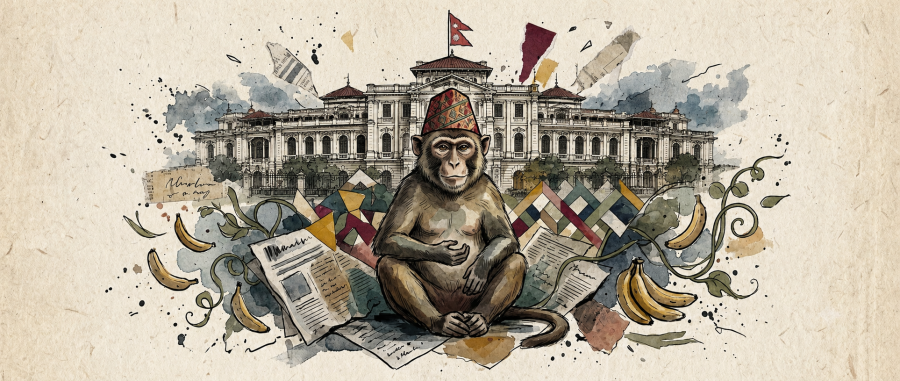
bookmark
Biken K Dawadi
Published at : June 10, 2026
Updated at : June 10, 2026 21:36
Recently, a group of Gen Z journalists sat down for a discussion on contemporary issues. One shared a chilling update from her village in Gorkha. After the 2015 earthquakes, the settlement started being deserted. Today, the entire place has shrunk to merely three households.
Her remark that followed the update surprised everyone in the room. She sighed. “I am worried my parents will be mauled by monkeys one of these days.”
This is the reality of rural Nepal. The monkey menace has been a problem for most of Nepal’s hills for years now. Entire settlements are emptying out. Across the hilly belt, thousands migrate annually because monkeys empty the granaries.
The total monkey population in Nepal is estimated at around 500,000. They are highly organised, aggressive and relentless. They do not wait for fruits to ripen. They descend from the trees to uproot newly sprouted maize. They snap the top shoots of vegetable saplings. They even enter kitchens to steal stored grain. When stopped, they turn violent.
Local governments have tried everything. They have planted fruit trees in the forests. They have hired temporary guards. One local body even declared a public holiday just to chase monkeys. Citizens have cut down their own trees to deny the animals a launching pad. Yet, the monkeys win. They adapt, they disrupt and they destroy livelihoods.
This monkey nature extends far beyond the actual primates. After all, human beings and monkeys are closely related. We share an evolutionary tree. Sadly, we also share a similar nature of disruption and destruction. Humans are remarkably adept at ruining environments, overturning systems and completely overlooking the plight of others. We fail to empathise. We look at a dying squatter settler and see it as their problem. We look at a dairy farmer who has been unpaid for years and offer them a selfie in front of a Dairy Development Corporation outlet. This primal behaviour finds its finest expression in our governance.
Enter the political monkeys.
Since the end of the Maoist conflict, most leaders in Nepal have exhibited textbook monkey behaviour. They operate on pure impulse. They prioritise themselves and their personal interests over the urgent needs of the people. Watch any parliamentary session. It resembles a chaotic canopy. There is loud screeching, dramatic chest-thumping and sudden leaps, crowdsurfing the opposition lawmakers.
The commonalities between monkey nature and Nepali politicians are striking. Monkeys operate on alpha-male dominance. So do our top political leaders. Monkeys scream to protect their territory. Opposition politicians launch chairs to stop the ruling party from passing any substantive policy. And when they do reach a position of power, they behave like when a troop of macaques invades a maize field: They grab what they can, destroy the rest and leave the land barren. This is precisely how our state resources are managed. The administrative and diplomatic branches of the administration act as the silent enablers of this troop, paralysing public service delivery to feed the chaos. Their collective failure has normalised chronic instability, turning bad governance into an art form.
This behaviour is not exclusive to the old guard. For years, the public blamed the ageing primates of the NC, the CPN-UML and the Maoists. Then came the new monkeys on the block: the Rastriya Swatantra Party (RSP) leaders. They promised a new ecosystem. Instead, they brought a high-definition 4K version of the same old circus.
The RSP leaders excel at clout culture. Their politics is driven by social media algorithms rather than state vision. They thrive on political stunts. One day, they are filming theatrical inspections; the next, they are staging dramatic exits. Yet, behind the ringlights, there is a vacuum. They have failed to deliver anything substantial. They lack the long-term vision required to lead a fracturing nation. They do not want to build a better forest; they just want to be the loudest monkeys in it.
Of course, the politicians do not exist in a vacuum. The monkey nature extends directly to the people who elect them. Election after election, Nepali voters pin their hopes blindly on populist individual leaders. We fall for the shiny new fur. We cheer for the most aggressive screecher. By treating elections like a popularity contest for political influencers, we weaken the very fabric of our system. We expect a single alpha to save us, forgetting that institutional strength, not individual performance, runs a country.
As a journalist, I must be blunt. This mimicry does not stop at the gates of parliament or the polling booths. It deeply infects journalism. My entire career has been in journalism. This is something I think I should write about, without sanitising the truth.
Our newsrooms like to pretend they are the ultimate watchdogs. In reality, the media landscape operates on its own primal rules. Like monkeys grooming each other for survival, the sector is entirely governed by the notorious ‘dai culture’. Job-seeking is rarely about merit. It is about seeking favours from influential seniors in the sector. Young journalists are taught early on that the path to a steady byline or a promotion relies on loyalty to a senior handler. Near-and-dears are consistently prioritised. Editorial stance is often sacrificed at the altar of the management’s whim. We leap from one media house to another, chasing the highest branch of patronage, while pretending to serve the public interest.
I am not exactly an expert in monkeys. I am an editor, not a primatologist. I do not know the immediate scientific solution to the actual monkey menace in the hills. I do not know if we should export them, alter our crop laws or fund million-rupee catapult initiatives.
But I do know one thing: The monkey problem in politics, society and journalism has clear solutions.
First, we must dismantle the alpha-worship culture in our politics. The solution lies in building rigid, rule-based systems rather than relying on the whims of individual politicians, whether old or new. We must judge leaders by legislative output and policy depth, not by their Facebook engagement or their ability to disrupt parliament.
Second, the rewarding of blind loyalty in bureaucracy and diplomacy must be replaced with radical accountability. Civil servants must be wrested away from partisan handlers and anchored to a rigid institutional framework.
Third, the public must break the cycle of blind faith. Voters need to hold populists accountable to the same standards as the old guard. If a politician delivers a stunt instead of a policy, they must be voted out.
Finally, inside journalism, we must completely eradicate the ‘dai culture’. Newsrooms need transparent, merit-based hiring and promotion practices. Editorial decisions must be insulated from personal networks. We cannot effectively critique the political circus outside if our own offices are run like tribal territories.
If we do not address these human monkey habits, our institutions will continue to rot. Our villages will continue to empty out. And eventually, the primates in the hills won’t even need to march to Kathmandu to take over. We will have already turned the capital into their habitat.
Biken K Dawadi
Dawadi is an Op-Ed Editor at the Post.



.PNG&w=200&height=120)

Most Read from Columns

Before you take credit for Khula Manch, read its history

Shah went to the UN to speak for Nepal, then left before he could make the most of it

Bhotekoshi flood wasn’t a freak event. It’s the Himalaya doing what it does

Lesson learned after the death of Ronaldo

Why passive neutrality won’t take Nepal anywhere
Editor's Picks

Constitutional Bench caught in seniority, ‘pick and choose’ dispute

A Dom boy’s long road to becoming a doctor

From blankets to handmade dolls, two foreign women bring comfort to flood survivors

News Analysis: When institutional defence exposes institutional fault lines

It’s a bird … it’s a plane … it’s the Indian ambassador’s farewell tweets
E-PAPER | October 16, 2026

×