The future of the QUAD amid global geopolitical shifts
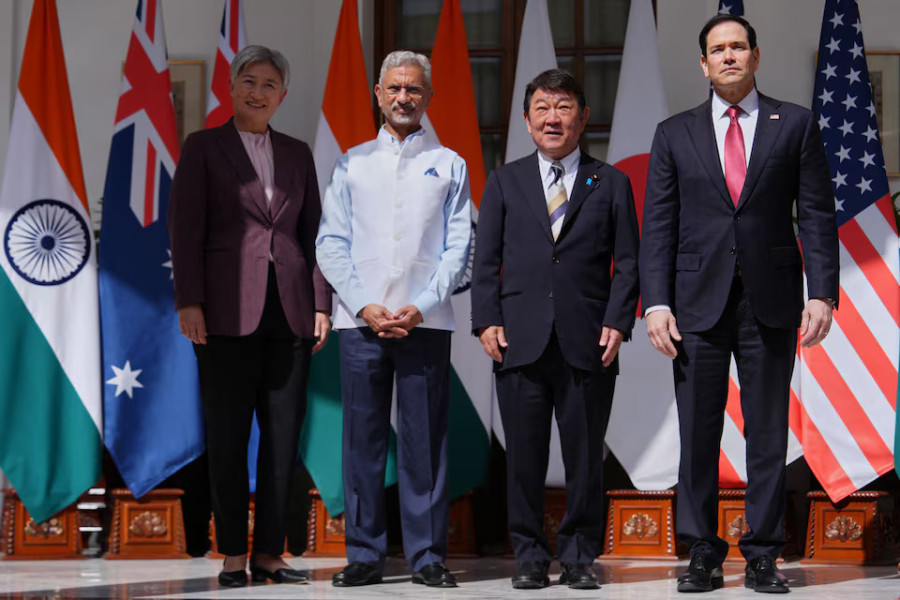
While the US expands its presence from the Indo-Pacific to West Asia and seeks rapprochement with China, the other three QUAD countries remain focused on the Indo-Pacific. Reuters
On May 26 2026, the 11th meeting of the foreign ministers of the Quadrilateral Security Dialogue (QUAD) countries (Australia, India, Japan and the United States) was held in New Delhi. In the global geopolitical flux one is witnessing, the meeting is considered significant. However, many analysts have cast doubt on the future of the Quadrilateral Security Dialogue (QUAD), with US attention diverted to Iran and an apparent lack of coordination within the group over their views on the war in Iran and the Russia-Ukraine conflict. In the Joint Statement, there was no mention of Israel’s role in the war, indicating the differences. Moreover, the QUAD summit scheduled for 2024, which would have been attended by heads of government, has yet to take place. It highlights the divergence among the QUAD member states.
Although at one point the US had prioritised the QUAD in its policy to contain China, other QUAD members do not share the US perspective on China; they are concerned that China’s geopolitical ambitions may undermine their interests. Not surprisingly, the QUAD foreign ministers’ meeting in New Delhi attracted China’s attention. In a statement, China’s Foreign Ministry said it opposes the creation of exclusive ‘small cliques’. The foreign ministers’ meeting followed US President Donald Trump’s visit to China, during which the two countries could not agree on easing restrictions on Chinese exports of critical minerals.
The New Delhi meeting
At the New Delhi QUAD foreign ministers meeting, the Indo-Pacific Maritime Surveillance Cooperation Initiative was launched. A decision was taken to launch a new initiative to boost port infrastructure in the Pacific Islands. The first project under this initiative will be to build a port in Fiji. This initiative is significant as the QUAD countries seek to strengthen their presence in the Indo-Pacific by cooperating with small island nations in the region.
The QUAD vision for a Free and Open Indo-Pacific has been a driving force in the Quadrilateral initiative. All countries are focusing on supply chain resilience, as disruptions will impact their economies. One has recently witnessed how the war in Iran impacted the global energy supply, weakening the economies of many developing countries. Countries discussed the East and South China Seas and the crisis in the Strait of Hormuz.
India maintains a close relationship with the QUAD countries. Over time, they have strengthened security and defence cooperation and are facing emerging maritime challenges. Member countries also agreed to expand the Indo-Pacific Partnership for Maritime Domain Awareness (IPMDA) initiative through the Information Fusion Centre for the Indian Ocean Region in Gurugram. India is set to host the second QUAD-at-Sea Ship Observer Mission, which was launched in 2025 at Guam. This will help expand maritime Law enforcement and enhance interoperability among the Coast Guards of the QUAD countries.
The joint statement by the QUAD foreign ministers underlined support for ASEAN centrality and unity, the ASEAN-led security architecture, the Pacific Islands Forum and IORA, while expressing concern about the continuing violence and conflict in Myanmar. They also expressed concern about international terrorism and transnational crime. The QUAD countries also noted China’s dangerous manoeuvres by military aircraft, coast guard and maritime militia vessels, as well as the militarisation of disputed features in the East and South China Seas.
Cooperation on critical mineral
Critical mineral cooperation has emerged as an important strategic tool as competition to access critical minerals intensifies. One sees such competition in Myanmar, where both China and the United States are trying to extract them. Similarly, the US has partnered with Pakistan to gain access to its mineral deposits, a major factor many think brought the two countries together. During the US Secretary of State’s visit, India and the US agreed to cooperate to secure the supply of critical minerals vital to military hardware, semiconductors, batteries, and other such products. Since assuming power, Donald Trump has focused on securing critical minerals and has entered into several bilateral agreements with many countries from Asia to Africa.
Bilateralism triumphs?
Trump’s transactional approach has cast a shadow over the future of the QUAD as the US seeks to mend ties with China. For the United States, its stake in the QUAD is much more China-focused. Bilaterally, India has strengthened its relationship with Australia and Japan. India’s Defence Minister Rajnath Singh and Australian Defence Minister Richard Marles co-chaired the second Australia-India Defence Ministers’ dialogue, with a focus on further defence industrial collaboration and cooperation in futuristic technology research. The two countries discussed maritime security cooperation and are scheduled to jointly host a Search and Rescue (SAR) and tabletop exercise at the Maritime Rescue Coordination Centre (MRCC) in Chennai in June 2026 to further cooperation in the Indian Ocean Region. The countries share growing concerns over ‘grey zone activities’ and seek to strengthen underwater domain awareness as China expands its presence in the Indian Ocean and is formulating a Joint Maritime Security Collaboration Roadmap.
Similarly, India has enhanced its collaboration with Japan to protect their maritime interests by increasing their ‘defence capabilities and readiness, by promoting interoperability and synergy between their defence forces.’ They have agreed to coordinate their maritime assets to assist third countries in the Indo-Pacific. Interestingly, Japan’s Defence Minister, Shinziro Koizumi, who was participating in the Shangri-La Dialogue in Singapore, has proposed that the QUAD Defence Ministers meet in New Delhi.
Long live QUAD
Despite the US’s shift of attention, the QUAD holds promises for the participating countries. While the US expands its presence from the Indo-Pacific to West Asia and pursues rapprochement with China, the other three QUAD countries have a strong interest in the Indo-Pacific. Not only do they collaborate in the security and defence domain, but they have also focused on economic cooperation, technology sharing and supply chain resilience. Their bilateral engagements indicate the growing strategic synergy. And all three countries would want to build on that synergy, with or without the QUAD.
Yet, the QUAD will remain central to these countries’ maritime strategy and approach to the Indo-Pacific region, where the US has historically had an entrenched interest and would not want that interest thwarted by China’s deepening presence.




 14.77°C Kathmandu
.PNG&w=200&height=120)