



 12.72°C Kathmandu

Fri, Oct 23, 2026
Columns
Banerjee and Kejriwal broke the mould of Indian politics. Now, the pressure mounts
They will remain textbook cases as political mavericks of India’s dynamic political milieu.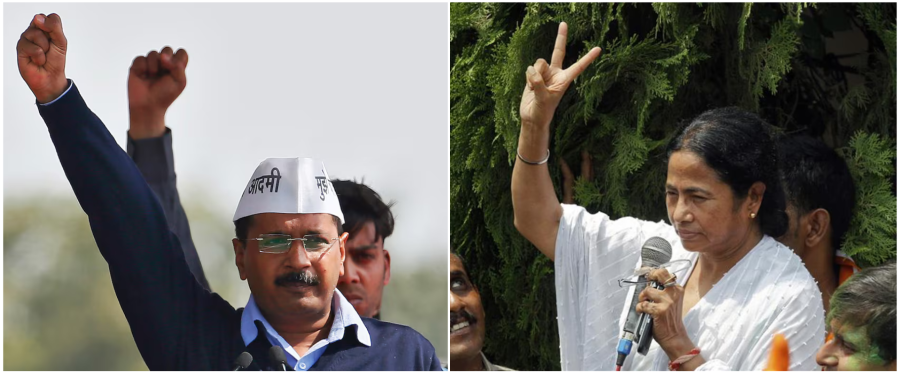
bookmark
Ruhi Tewari
Published at : April 29, 2026
Updated at : April 29, 2026 18:57
The two politicians who have been the most in the news in the past few days in India are not the otherwise headline favourites Narendra Modi and Rahul Gandhi. Hogging news-space for very different reasons have been West Bengal Chief Minister Mamata Banerjee and former Delhi Chief Minister Arvind Kejriwal.
The similarity between them, however, does not end at their current newsworthiness. Both these leaders are at the cusp of a turning point in their political careers. But what makes the two unique is that whatever their future trajectory, they have firmly established themselves as the two biggest disruptors in Indian politics of this century so far. Banerjee and Kejriwal are towering stories and will remain textbook cases as political mavericks of India’s dynamic political milieu.
The 71-year-old Banerjee and 57-year-old Kejriwal have, in their own distinct ways, been agents of change—breaking rules, re-inventing politics and writing chapters on survival and building from scratch, their many flaws notwithstanding. Whether one is a fan or detractor, it is difficult not to be intrigued by their journeys.
Why they are in the news
Banerjee is dominating the front pages of newspapers by virtue of being the incumbent in a poll-bound state that the ruling Bharatiya Janata Party (BJP) has its eyes set on. West Bengal, a politically charged state, concluded voting on Wednesday with the verdict due on May 4.
The aggressive Modi and Amit Shah-led BJP has tried its very best to wrest the state away from Banerjee, with the latter doubling down and ensuring that doesn’t happen. So far, at least. This time, the chief minister faces a tough election, battling widespread anti-incumbency of 15-long years and defending her regime in the face of voter mood for change.
With the elections in West Bengal centred entirely around the cult of ‘didi’ (older sister as Banerjee is fondly referred to in her state), Mamata has been dominating prime-time news broadcast for weeks now. The controversial Special Intensive Revision (SIR) of electoral rolls, which the chief minister has vociferously opposed, has further meant that the spotlight has been on the state and Banerjee.
For Kejriwal, meanwhile, the recent attention seems to have come from a more challenging aspect—the defection of seven of his party’s 10 Rajya Sabha Members of Parliament, including the prominent Raghav Chadha, to the BJP. This big rebellion has brought the former Delhi chief minister much embarrassment, projecting an image of his Aam Aadmi Party (AAP) being a house in complete disarray.
Further, Kejriwal also made headlines when he invoked “Gandhian Satyagraha” in a letter to Delhi High Court judge Justice Swarana Kanta Sharma, stating that he would not participate in further proceedings in the liquor policy case pending before her Bench. Being newsmakers, however, is not new to these political figures who brought into vogue a completely street-fighter, agitator style of politics in India.
The ‘didi’ chronicle
Unfortunately, politics even today is considered to be largely a male preserve. Barely 15 percent of India’s Parliament comprises women, and among 29 states, India boasts of just two women chief ministers.
Banerjee is an inspiring example of a woman with no family political backing or a mentor rebelling against established norms, fighting all odds and bringing down entrenched giants. The feisty leader formed the Trinamool Congress in 1998 as a breakaway faction of the Congress with a clear objective to fight the very established Left Front in West Bengal. By then, the Left had been in power in the state for over two decades, and its cadre network was tentacled, powerful and often intimidating.
With her grassroots style of politics, Banerjee endured and fought the might of the Left Front and the wrath of the Congress to make herself a formidable force, becoming Bengal’s beloved ‘didi’ and routing the Communists out after 34 years of rule, a feat that India’s grand Old Party Congress, with all its means and resources, failed to achieve.
‘Didi’ caused a disruption in the existing structure—fighting male domination in a patriarchal political set-up, successfully setting up a regional political party with no backing, overthrowing a very established and powerful dispensation and also never quite allowing the Congress—technically the main other alternative till then in the state—to find a footing in Bengal again.
Of course, there are many questions to be asked of her, and many faults to be found.
Today, she faces a very tough election, but while the results will determine her immediate fate and shape her political future, Mamata Banerjee will remain a lesson in how to bring in a revolution for generations of aspiring politicians.
The phenomenon of Kejriwal
A former Indian Revenue Service (IRS) officer-turned-civil society activist, Kejriwal was a late but extraordinary entrant into politics. His tale, in fact, is truly one of its kind in India’s political history. With absolutely no political base, zero experience and no established political outfit to latch on to, Kejriwal’s trajectory has been remarkable. As I once wrote, “Arvind Kejriwal has been like Indian politics’ Maggi noodles — cooked and ready in no time.”
It isn’t easy to start a political party from absolute scratch, let alone establish it as a powerful force that manages to keep the two giants—the BJP and Congress in check. Kejriwal started off as part of the famous Anna Hazare anti-corruption movement, but quickly managed to sideline all else to bring the spotlight upon himself as an anti-corruption crusader and a voice of the common person.
It took the BJP a decade and all its might to bring Kejriwal down in Delhi, the national capital through which Modi and Shah have ruled over India. And to be fair, Kejriwal’s loss in Delhi in 2025 was perhaps more a factor of the usual anti-incumbency and fatigue than absolute anger against the incumbent and a vociferous desire to see the BJP in power.
Meanwhile, Kejriwal managed to make AAP a force in neighbouring Punjab as well, bringing it to power despite the presence of a powerful national party (Congress) and an established regional force (Shiromani Akali Dal) in the state.
There are many flaws in the former chief minister’s journey—from naivete in governance to lack of a focused political ideology, absence of one overarching, long-term message, often a lack of political maturity and hubris that has led to many he started the party with abandoning him. But these inadequacies aside, Kejriwal has been a massively disruptive force in Indian politics, challenging an established set-up, giving the big forces a run for their money and achieving the near-impossible task of writing a political success story with zero political base.
Mamata Banerjee and Arvind Kejriwal have dissimilar backgrounds but similar political stories of brazen rebellion. Love them or hate them, but both have ensured you cannot ever ignore them.
Ruhi Tewari
Tewari is a Delhi-based senior journalist and author of ‘What Women Want—Understanding the Female Voter in Modern India’.





Most Read from Columns



Editor's Picks





E-PAPER | October 23, 2026

×