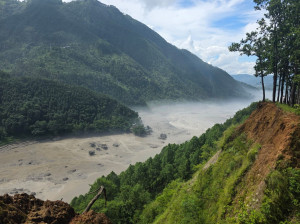
The purple ink in the voter’s finger is the accomplishment of years of struggle, it is the quiet residue of a revolution, a colour of hope and change. For some, it is just a minor inconvenience that stains their finger even after wiping it on their hair. But as the sun sets over Tarai, and the shadow of a high mountain stretches over the state, the stain begins to look like a bruise. People are often told that they are participating in the greatest festival of democracy, but this festival feels like any other festival with an end. . What remains when the drums of festival, or in a recent context the melody ofshankhafade? A land littered with broken promises, false expectations and high metallic scent of a dangerous democracy.
What constitutes a ‘dangerous’ democracy? It is not just the presence of violence. In a dangerous democracy, a chorus of lies harmonises into truth. It is the system where the mechanism of voting is intact but it is just present as a ghost, where the soul of representation is absent. It has been hollowed out by the ‘goat mentality’, a collective trudge toward whoever is trending and whatever people around are thinking. Idolisation of a certain person takes place quite quickly and with an overwhelming intensity, which manifests through a desperate hunger for change. Everybody wants an overnight overhaul of everything from digital servers to systemic corruption, and the representative of the change, becomes their Messiah.
The creeping fascism
While discussing dangerous democracy, Socrates should not be overlooked. Centuries ago, Socrates asked a simple question in Athens, ‘If you were out at sea, who would you want deciding what was done with the ship?Just anyone, or people educated in the rules and demands of seafaring?’ Socrates and his student Plato leaned towards Noocracy (ruled by the wise). The idea was what mattered. In the present context, the democracy of ideas has been left as a hollow casualty by identity politics. They trade policy for populism, trying to create a ‘Us vs Them’ narrative that symbolises creeping fascism. There is a calculated shift toward the religious and regional aspect, which fuels the ‘Us vs Them’ mentality, especially in the Tarai region, which is not new, and not an accident, but a product. The irony of creeping fascist politics is that the tools of democracy, such as free speech, are used to dismantle democracy itself.
The ‘democracy of ideas’ is the vision of political parties reflected in their manifesto. But in the name of the party’s vision, vague dreams are being sold. They tend to be high on emotions and symbols and low on actual accountability. They lack the procedural aspect and are only substantive in nature. Political parties share similar slogans of making Nepal prosperous, which suggests the weak state of ’democracy of ideas’. There is no discussion regarding different schools of thought, just an effort to brand certain emotions and dreams to desperate citizens.
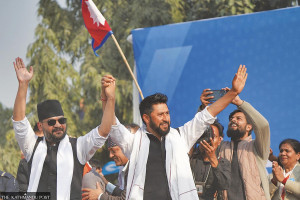
In Nepal, we are witnessing the revitalisation of Representation 1.0. The media houses and analysts gush over how this phase shows a ‘youth wave’, the new faces, fresh energy and passion. There is no doubt that the Gen Z movement has catapulted new faces into the limelight and has led to a transformation of the mentality of the larger population, as witnessed by the long lines for Voter ID. But look closer, beneath the populist rhetoric, the architecture remains static. A glance at the 2026 FPTP (First-Past-The-Post) candidate lists reveals the same structure. It is still a fortress of the Hilly region, Khas-Arya and male dominance, where women are relegated to the status of ‘token participants’. When representation is merely a quota and not a transformation of power, the ‘New Nepal’ is simply the Old Nepal with a better filter.
Paradox of liberal democracy
While ancient scepticism saw democracy as a fragile bruise, modern scholars once argued that Liberal Democracy is the final destination, the end of ‘history’. For the Global South, the ‘destination’ feels like a paradox. The question here is, for whom is this form of government truly ‘liberal’? In Nepal, economic liberalisation packaged with democracy often feels predatory. Is a system truly ‘liberal’ if it collapses domestic industry under a flood of subsidised imports?
We must distinguish between democracy’s two pillars: Economic and political. In Nepal, we often see enforcement of economic demand while the promises of justice remain in the shadows. Ultimately, liberal democracy, like any other ideology, is not a self-executing guarantee of success. Ideology provides a map, but the direction of the journey depends entirely upon the agent. A nation’s failure is rarely a failure of the system itself, but of the leaders who hollow out its principles for personal gain.
In Why Nations Fail, Acemoglu and Robinson highlight ‘critical junctures’, pivotal moments that break systemic chains. From 1951 to 2006, Nepal has cycled through revolutions that promised magic overnight but delivered only exhaustion. The disillusionment makes us easy prey for the next strongman.
A dangerous democracy is one where the people have learned to love their chains because the chains are painted in the colours of their own religion or region. It is a democracy where the act of voting has replaced the act of thinking. As we head to the booths, we must ask ourselves: Are we choosing a navigator for the storm, or are we just following the herd toward the cliff? True emancipation does not lie in the overnight transformation of our traffic or our servers, but in the slow, transparent work of building a 'democracy of ideas.' On election day, the purple stain on our finger must not be a bruise of defeat, but the ink of a new, reasonable and inclusive social contract.




 20.85°C Kathmandu