Democracy rarely succumbs to external shocks. Yet it remains vulnerable to gradual erosion from within. Disregard for the legal and normative foundations of democracy is often the primary cause.
In How Democracies Die, Steven Levitsky and Daniel Ziblatt argue that the survival of democratic systems depends on mutual toleration, institutional restraint, and an unflinching commitment to the rule of law. The vilification of political opponents, the trampling of civil liberties, and the normalisation of violent rhetoric for political ends are early warning signs of democratic decline. When elected leaders—the so-called gatekeepers of democracy—treat citizens as utilitarian instruments for electoral gain and hollow out institutions to shield themselves from accountability, democratic erosion accelerates.
Nepal’s democracy, though constitutionally robust, has long grappled with operational stagnation and institutional fatigue. Years of leadership embedded in patronage networks produced governance paralysis, with political energy oscillating between rhetorical reform and cautious preservation of the status quo. Political discourse grew increasingly intolerant of dissent, with critics cast as adversaries rather than participants in democratic debate. State institutions were bent to serve the interests of those in power rather than deliver public goods. The resulting frustration contributed to the emergence of the Gen Z movement in early September 2025. Nepal’s democratic trajectory has since entered a moment of reckoning.
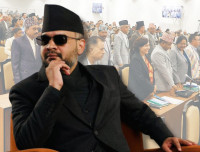
Gagan Thapa was among the first within the political establishment to acknowledge the depth of youth frustration. He publicly accepted a share of political responsibility for the conditions that provoked it. Rather than dismissing the movement as a conspiracy or foreign manipulation, he treated it as a warning against complacency and performative reform. At the same time, he was categorical in rejecting violence, drawing a principled distinction between the legitimacy of public grievance and the impermissibility of violent methods. His response was neither theatrical nor defensive, but measured and rooted in self-scrutiny and institutional reform.
It is against this backdrop that the electoral Commitment Paper of Nepali Congress—and Thapa’s public engagement with it—warrant careful examination.
For decades, the Nepali Congress has carried the moral capital of being the champion of democracy. Internally, however, it struggled with renewal and rejuvenation. The Commitment Paper appears to recognise that historical legacy alone cannot compensate for organisational stagnation. Its emphasis on internal democracy, generational transition, policy coherence and respect for the opposition as political equals signals an effort to restore credibility from within. Whether these commitments translate into consistent practice will determine if this moment marks a new beginning.
Within the party, Thapa has earned a reputation as a reformist insurgent. In July 2004, when the Nepali Congress leadership was firmly advocating a constitutional monarchy, he unequivocally defied the party line and stood for a republic—a position the party formally adopted a year later. In the wake of the Gen Z movement, fuelled by gerontocratic politics and self-aggrandisement, Thapa called on the party leadership to ensure a smooth transfer of power. When that did not materialise, he pressed for it through a special party convention. In a political climate where frustration often manifests as anti-party rhetoric or calls for total rupture, his insistence on working within institutions stands out.
Yet institutionalism is not an end in itself. It must deliver tangible results and withstand the litmus test of accountability, both within the party and in governance that affects citizens’ lives. The Commitment Paper gives substance to this principle by framing good governance as a people’s right, thereby opening the Party and the government to public scrutiny. Proposals for merit-based appointments, laws on conflict of interest, compensation for delays arising from abuse of authority, and the right to recall elected officials signal a willingness to subject institutions and leaders to measurable standards. By linking poverty alleviation to the right to life and framing social security as a state obligation, the document envisions development not as discretionary welfare but as enforceable entitlements. In doing so, it marks a departure from an era of declaratory commitments toward a framework of rights-based accountability.
Of particular significance is the commitment to concluding the transitional justice process by reconstituting the commissions through a transparent and credible procedure in close consultation with victims. This acknowledges the extent to which transitional justice has been entangled in elite bargaining and transactional politics. To subject the suffering of victims to opportunistic calculation is a marker of moral erosion—not merely of political imagination, but of social integrity itself. Seeing the process through is therefore not only about delivering justice and restoring hope to victims. It is also about affirming that public institutions are custodians of accountability, not instruments of crony accommodation.
Commitment documents can mark turning points. They can also become deceptive to preserve the status quo—or even enable regression. The real test of Thapa’s reformist posture lies in behavioural consistency as a defender of democracy. Are critics and opponents respected consistently? Does restraint become the norm in moments of anger? Are political appointments genuinely insulated from inherited entitlement and factional bargaining? Institutional credibility is built through sustained action, not proclamation. To become the difference he projects, Thapa must act with integrity and decisiveness—and answer these questions in practice.
Electoral competition and parliamentary arithmetic are not the guardrails of democracy in themselves. They can, instead, become a source of internal decay, as experience over the decades shows. The health of democracy lies instead in the protection of civic space—a dynamic arena where citizens organise, dissent, deliberate, and hold authority accountable. True rejuvenation requires both society and state to be strong: A strong state to deliver, and an equally strong society to safeguard democracy from an authoritarian tilt. The insistence on participatory governance, the empowerment of marginalised groups, youth involvement in policymaking, and firm rejection of structural violence, such as caste-based discrimination, signals a political commitment to that end. Yet the translation of such commitments into concrete policy and practice is precisely where scrutiny becomes indispensable.
Nepal’s democratic future hinges on disciplined adherence to the rule of law and the unwritten norms of democratic morality and integrity. Thapa’s tryst with democratic reform will ultimately be judged by the consistency with which he upholds these values. The promise of reform—like any delicate tryst—can falter if neglected.




 20.85°C Kathmandu