



 26.04°C Kathmandu

Wed, Oct 21, 2026
Columns
Can goodness survive with political power?
Expectation of a morally pure leader fuels saviour politics, shifting duty away from citizens.
bookmark
Pragya Pokharel
Published at : February 8, 2026
Updated at : February 8, 2026 07:15
Every generation produces its great leader, and every age condemns them. From emperors to televised presidents, anyone with massive political power is ever remembered without accusations and criticism for their politics. Mahatma Gandhi, often noted as a symbol of peace for his satyagraha (truth-force) and Ahimsa (non-violence) movement, also faced criticism for failing to prevent the partition of India into Hindu and Muslim communities. Likewise, Nelson Mandela, who is an icon of moral leadership, faced backlash for overlooking corruption within his party. These examples demonstrate the tension between moral idealism and political reality.
According to Hannah Arendt, politics exists because of individuality within humanity. In The Human Condition, she argued that governance is necessary due to the distinct nature of human beings. This plurality makes politics necessary and tragic. Necessary because collective living requires coordination, decision-making and power. Tragic because almost all decisions favour a group of people while marginalising others. Therefore, political wounds are an inevitable feature of governing diverse societies. Even well-intended leaders must act within a space of conflict and consequences.
This reality suggests that the statement ‘power corrupts’ is an overly simplistic explanation of political life. Reinhold Niebuhr suggests that power exposes the limits of human ethical capacity. In everyday life, our decisions are more personal, but when it comes to the power where a single policy can ripple through economies, generations and influence culture. It often exposes politicians to the limits of human morality under pressure. In Nepal, where public resources are limited but expectations are vast, politicians must constantly navigate demands for infrastructure, disaster relief, education and other essential services. While corruption and nepotism should never be an excuse, it is also essential to understand the institutions that can trap even the most idealistic leaders into morally compromising situations.
Corruption, whether institutional or personal, is permanently etched into public understanding of politics. Regardless of how educated, ideological or motivated a leader appears, their name always seems to be attached to scandal-filled headlines. It raises a troubling question: Can there be a good politician at all? Or does power corrode morality once responsibility grows too large? At first glance, politicians seem to enter with a ray of hope; they speak of justice, peace and prosperity. But the gradual moral decline suggests that these patterns indicate a structural contradiction rather than an individual failure.
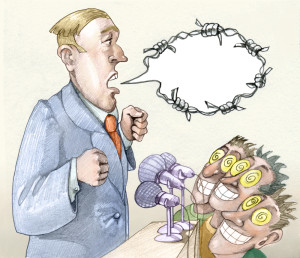
If political power is structurally incapable of moral purity, the ‘Can a good politician exist?’ question reveals more about the relationship with the power rather than about politicians themselves. Perhaps citizens expect a hero who operates in moral absolutism, forgetting that democracy distributes the moral burden. Philosopher Friedrich Nietzsche warned that expecting someone to come as a saviour will inevitably lead to another person being exposed as a fraud. It will lead to politics being a theatre of disappointment.
If a good politician exists, they are not heroes in the traditional sense but rather a tragic figure who knows that harm is unavoidable and seeks awareness. They listen even when they don’t agree, govern while being aware of their consequences, follow the law and accept criticism as a cost of having authority. A responsible citizen should not accept moral compromise, as it will lead to cynicism. Decades of unstable and corrupt rule weakened democratic mechanisms for holding politicians accountable. The dangerous politicians are not the ones who are constantly criticised, but rather the ones who no longer feel the weight of the criticism.
So, the question is how citizens ensure that politicians are not misusing their powers?
First, people should be aware of their duty beyond the ballot box. They should actively participate in governance. Generally, law-making is delegated to parliament. However, people can demand that all processes be transparent and must be informed and discussed with the stakeholders before and during the parliamentary process. In addition, people should practice direct democracy regarding the selection of local priorities and development projects. The national projects should follow an intensive consultation with local stakeholders. And all of the above, an effective and fair institutional mechanism for complaints and remedies is required to monitor public decision-making.
Second, it is important not to expect a heroic change but rather to be aware through our own efforts. The political system usually responds to pressure. When resources are distributed, silent groups are usually ignored while vocal groups get their needs fulfilled. It is important to understand how budgets are formulated, who benefits from policies and which groups are underfunded, as ignorance is the ally of inequality.
Third, meaningful changes are usually acknowledged when demands are articulated in collective groups rather than individually. In the United Kingdom, the government has to respond to a petition that gets 100,000 signatures. In Nepal, there is no formal practice like this; however, collective demands could not be ignored by authorities. These demands are generally raised through trade unions, student unions and similar organisations.
Pierre Bourdieu highlighted the theory of class, which states that social inequality exists in our society through everyday meanings and practices that seem institutionalised and normal. In Nepal, we have normalised the injustice, poor service delivery and unequal distribution of resources. For example, even after making it illegitimate, casteism has not disappeared from Nepali society, which is a source of the poverty gap, not only from an economic but also from a social and cultural perspective.
The question of whether goodness can survive political power reveals that politics inevitably involves moral compromise. Expecting a morally pure leader creates an illusion of saviour politics, which shifts responsibility away from the citizens. To expect a politician to be morally pure is to deny them their humanity. If a good politician exists, they are the ones who accept criticism and remain accountable for their actions. In a democracy, responsibility is shared between politicians and citizens. Therefore, citizens should not grow silent, as it leads towards the normalisation of inequality. Fairness is not a destination but a continuous dynamic process sustained by the public that refuses awareness to be overridden by power.
Pragya Pokharel
Pokharel is a law student at Salford University, UK.




Most Read from Columns


Editor's Picks




E-PAPER | October 21, 2026

×