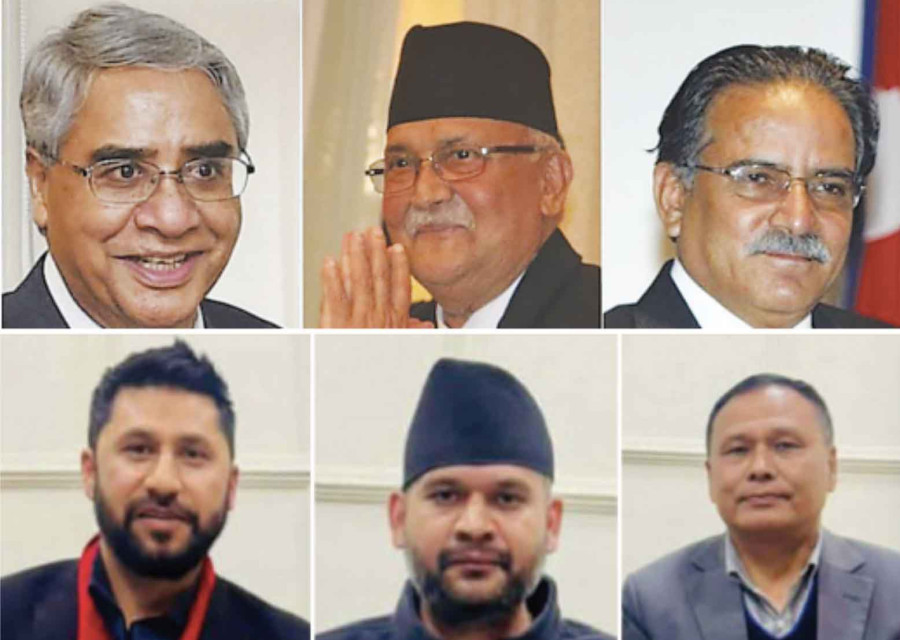
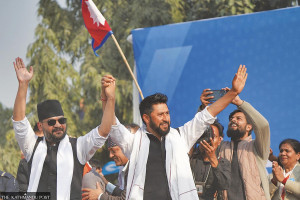
The notion that our established parties have become too old and weak is ridiculous. In this combo, from top clockwise: Sher Bahadur Deuba, KP Oli, Pushpa Kamal Dahal, Kulman Ghising, Balendra ‘Balen’ Shah and Rabi Lamichhane.
As the election is drawing closer, everyone is thinking about the polarisation of political parties and its possible outcomes. In particular, the recent alignment of three populist figures—Balendra Shah, Kulman Ghising and Rabi Lamichhane—has further excited the discussions and debates on social media. Many are questioning the future of the old and established leaders and their parties. Are they really on the verge of extinction, as many think?
I would urge people, first off, to stop outsourcing their decision-making to social media apps and give careful consideration to parties’ ideologies, histories, geopolitical situations and ground realities. If they don’t, the nation may face even greater dangers in the future. We must be wise and considerate in this critical period.
The old
Almost every Nepali eats dal bhatregularly. Lentil soup tastes better if the grain is new, but rice tastes better if it is an older stock. Recently harvested rice does not even cook well. And, as we all know, the older the whisky, the better it tastes. In other words, not everything new is good, and not everything old is bad. The same is true for political parties. Older politicians may become ineffective with ageing, which is natural, but that does not necessarily apply to the life of political organisations.
Consider, for example, American politics. Of the hundreds of registered parties, only two are prominent. Established 197 years ago, the Democratic Party, now in opposition, is one of the oldest functioning parties in the world. The party in power, the Republican Party, is 171 years old. Similarly, in the United Kingdom, the Conservative Party and the Labour Party are 182 and 125 years old, respectively. In China, the Chinese Communist Party was set up in 1921, and in India, the Indian National Congress was founded in 1885.
So, the notion that our established parties have become too old, weak and unfit for purpose is ridiculous. They are not done and dusted. The popular dichotomy between the old and the new is fallacious and misleading. In any case, our parties aren’t even that old. The Nepali Congress was founded in 1950, and the Communist Party of Nepal (United Marxist-Leninist) was founded in 1991. This was a major branch of the communist movement started by Pushpa Lal Shrestha in Calcutta, India, in 1949.
I agree: These parties haven’t functioned as they should have in recent years. They played a crucial role in toppling the autocratic Rana regime and Shah dynasty, but they haven’t been as successful in terms of creating economic prosperity and social equality. Instead, they have been dogged by corruption, nepotism, casteism and many other issues. The anger and frustration amongst the people towards these parties is therefore understandable.
The new
Riding on the bandwagon of the Gen Z protests, some younger figures have emerged in Nepali politics. For instance, Rabi Lamichhane, chair of the Rastriya Swatantra Party (RSP), has played a key role in bringing the newly established parties and their leaders together. The RSP has projected the popular mayor of Kathmandu, Balendra Shah, as the future prime minister. Lamichhane, Shah and Ghising have pledged to control corruption and boost the country’s economy within a decade. I wish them the best of luck with that. But the self-declared champions of progress and prosperity have yet to present feasible plans and strategies to achieve their goals. Frustratingly, these future leaders’ vision and ideology have not been clearly articulated. People do not know where they belong on the political spectrum, although they appear to be right-wing.
More importantly, as is common among the populists worldwide, their analysis of the country’s central problems is rather cheap and superficial. They do not even acknowledge the deeper structural issues plaguing our society. These new leaders seem blind to the issues of class and caste. There is some solid proof of the rather right-wing character of these future leaders, including Balendra Shah. For example, this is evident in the harsh manner in which Mayor Shah has treated street vendors in Kathmandu. Those poor souls making a living on Kathmandu streets have been chased away like wild animals. Their precious items were either thrown onto the streets or taken away. Sometimes violence was used against these vendors. And the mayor has not made any provisions for managing these people surviving in the street economy. Likewise, people who make their living by collecting and processing trash have been kept out of work. Not to mention the homeless people, sukumbasis, residing on the dirty and smelly banks of Kathmandu rivers and rivulets. Balen Shah tried to bulldoze these people out of their homes, where they have been living for decades, without relocating them properly.
In terms of caste inequality, the RSP trio have basically no agenda at all. They seem oblivious to the plight of 13 percent of the population, who have been identified as Dalits and live a life of humiliation and exclusion, even in major cities. Their manifesto does not even mention caste discrimination and hatred.
Conclusion
One cannot control the tide of history. It seems increasingly likely that the new leaders of new parties will emerge as influential players in the forthcoming elections. The RSP has yet to spread its ideologies and organisations, but it is quite popular on social media. The younger people seem impatient to keep the established forces in control.
I would strongly caution, however, against giving a free rein to these new players without political experience and suitable ideology. It could be a disaster. Especially, the issues of class and caste divisions are too large to be thrown under the carpet.
A graduate of Oxford University, Pariyar is a Dalit rights activist who has worked in universities in Australia and England. Pariyar is affiliated with the Nepali Communist Party.




 16.01°C Kathmandu