



 13.73°C Kathmandu

Fri, Oct 23, 2026
Columns
When power breaks rules
Redefining regime decapitation as law enforcement blurs the line between war and policing.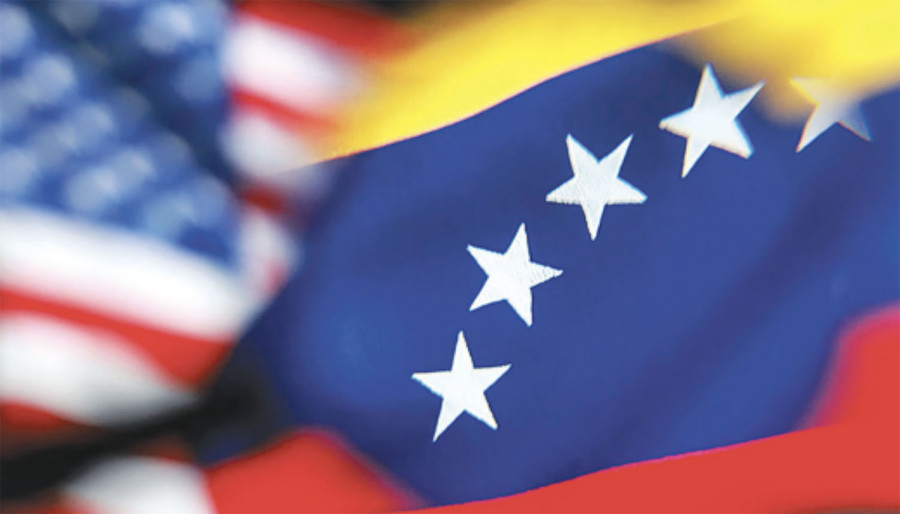
bookmark
Niraj Gautam
Published at : January 5, 2026
Updated at : January 5, 2026 07:27
On January 3, the United States declared that it had initiated massive military actions in Venezuela, seized President Nicolás Maduro and his wife, Cilia Flores, and transported them to New York to be prosecuted. Maduro, perceived as an autocrat who carved out the democratic institutions and seen as a rebellious figure in Latin American opposition to Washington, was at the centre of the spectacle, which is profoundly disturbing. An incumbent president captured in one of the foreign military operations is not merely another melodramatic story in an already shaken world. It is an instance that subtly redefines the limits of permissible authority.
For Nepal, a small non-aligned country which has historically relied on the guardianship of international law, this episode is of much more than geographical importance. It signifies the transition of disputed diplomacy to open coercion. It becomes impossible to distinguish between war and policing when even the most powerful state in the world redefines regime decapitation as law enforcement. This diminution is not scholarly for a nation like ours, which has to count on principle, not on armour. It is existential.
Venezuela’s tragedy did not start with airstrikes, sanctions and indictments. It is the protracted, torturous effect of oil money that came together with shaky institutions. For most of the late 20th century, Venezuela operated under a two-party constitutional democracy, which provided stability but slowly consumed itself with corruption, inequality and elite capture of the state. These ruptures left room for Hugo Chávez and his Bolivarian Revolution, which promised dignity to the poor through redistribution, anti-elite politics and aggressive state ownership of the vital resources, especially oil.
Under the pretext of high oil prices, Chávez increased social expenditure and earned loyalty within the marginalised groups. But behind those advantages, more sensitive weaknesses were established. The economy was cast into danger since it was over-reliant on a single commodity, i.e., oil. Institutions were getting politicised. Limitations to executive authority were diluted. After the death of Chavez in March 2013, Maduro, his successor, was elected the following month. He not only succeeded Chavez in the political movement, but also inherited a distorted economy which was already manipulated with price controls, manipulated money and fiscal imbalance.
What ensued was the next 10 years of gradual disintegration. Hyperinflation eliminated savings. One of the greatest peacetime migrations in the Western Hemisphere took place as millions of people fled the country. Protests were initiated and subsequently suppressed. Elections were contested. The opposition leaders were imprisoned, exiled or marginalised. By the early 2020s, Venezuela was a universal synonym for a humanitarian crisis and a state of government failure.
As Venezuela disintegrated within, its relationship with the US became more difficult. What was previously a pragmatic and oil-focused alliance became ideological and punitive. Anti-US rhetoric was one of the characteristics of Venezuelan politics during the rule of Chavez, which became even more rigid under Maduro. This break finally took place on January 23, 2019, when Washington acknowledged an opposition leader, Juan Guaido, as an interim president, denying that Maduro had a mandate. Sanctions expanded. Assets were frozen. Diplomatic ties collapsed. In March 2020, US prosecutors leveled public charges against Maduro as a narco-terrorist. Sanctions were still far-reaching and very political by 2025.
But none of this helped Venezuela out of its internal stalemate. Instead, the Latin American state internationalised it. It was turning the domestic crisis into a global confrontation.
What happened on January 3 was not just a failure of intelligence or execution. It was a failure of judgment. The operation sounded like the decapitation of a regime, which is much closer to war than policing, and officials in the US packaged Maduro as a criminal target. International law establishes a high standard when it comes to the use of force against a sovereign state: self-defence against an armed attack or United Nations Security Council authorisation. The same cannot be said of criminal indictments, narcotics charges and moral outrage.
Reuters reported the strike as the most direct intervention by Washington in Latin America in decades, which explains the extraordinary and destabilising character of such an intervention. Although US leaders may argue that the operation was a preemptive action, the standard of proving something is exceptionally high according to international law. The optics are poisonous: A head of state has been detained and taken to another country, and the extraction is debated like an administrative issue that should be handled or stabilised. This language rings too familiar to many people in the Global South.
What is, however, more dangerous than the chaos that Venezuela is facing is the precedent that such acts set. When powerful states become accustomed to carrying out cross-border military activities to oust leaders they consider criminal, the weaker states suffer collateral damage. The regulations that are set to safeguard them are undermined by selective application. All ambitious or aggressive forces may repeat the same script: ‘We have had a threatening experience. We enforced justice. We removed a criminal.’ In a world like this, justice becomes a stretch, and might is right.
For small and medium-sized nations, this is a nightmare, not because they identify with tyrants, but because they exist by predictability. There is no protection of neutrality when the rules are broken.
The shockwaves of geopolitics have already become apparent. The allies of the US are under a credibility test: How can they protect international law without relying on American power? The regional neighbours are worried about migration outbursts, border instability, and economic disruption, irrespective of their opinion about Maduro himself. Even the opponents of Caracas may become sick of the way, bearing in mind that they could be the next target.
The solution must come through moderation. Humanitarian corridors and de-escalation are urgently necessary. Civilians, migrants and medical services must be protected, without politics in aid. A truly impartial mediation system—based on plausible regional and global actors—is required to mediate security assurances, transitional governance and plausible electoral opportunities. Most importantly, there should be a reset of legality. Silence makes extraordinary violence a part of state policy.
To Washington, January 3 reveals a very clear trade-off between power and legitimacy. Withdrawing an antagonistic leader can be a temporary tactical advantage, but it could invite a long-term strategic defeat. The US has been boasting of promoting a rules-based international order. The fact that it can evade the UN Charter when it suits will redefine the manner in which partners, rivals and fence-sitters understand its intentions.
These implications are far-reaching for the Global South. International rules are already perceived unequally in many countries. It is applied strictly against the weak and flexibly against the strong. With every new exception, there is a shift towards a world in which might makes right.
The teachings are painful yet inevitable. Domestic illegitimacy beckons forth foreign susceptibility. The idea of the justification of ends by means eventually kills the ends. Tiny states do not thrive on favours; they thrive on rules.
Why Nepal must care
January 3 must not become a footnote even in Kathmandu. It must be viewed as an experimentation of whether the world still believes that borders are important, sovereignty is important and force is limited by law. Nepal has neither a veto nor a navy nor a strategic umbrella. The security of our lives is based on the flimsy notion that regulations check authority. Provided that idea collapses, all small countries, including our own, will pay the price in the end.
Niraj Gautam
Gautam is an assistant professor at Lumbini Banijya Campus.





Most Read from Columns


Editor's Picks





E-PAPER | October 23, 2026

×