



 17.84°C Kathmandu

Sun, Oct 25, 2026
Columns
Uneasy neighbours
India cannot afford to lose Bangladesh as a friendly nation.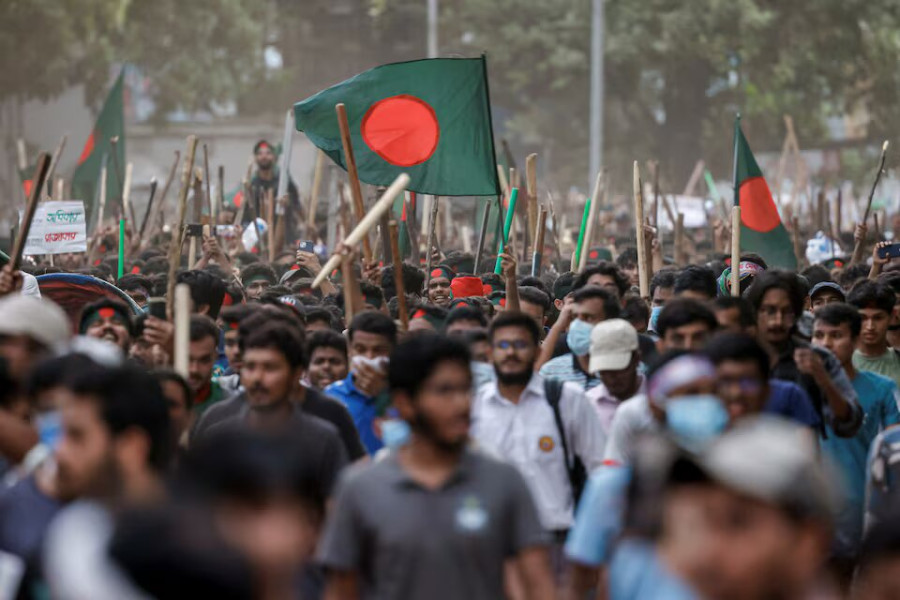
bookmark
Kashif Islam
Published at : January 2, 2026
Updated at : January 4, 2026 07:40
Recent events in Bangladesh have once again exposed the fragility of the country following the 2024 ouster of the Awami League (AL) government. The ongoing mass protests and the ensuing disorder were triggered by the shooting of the popular student leader Osman Hadi outside a mosque. His eventual death at a Singapore hospital brought thousands to the streets in a recap of the 2024 student-led revolution.
The protest was not only about the loss of a popular leader; there was a significant amount of anger directed at India. Rumours had spread that Hadi’s killing had been ordered by India or carried out by remnants of the AL at India’s behest. The killers were said to have escaped back into India. The source for these claims was unclear.
Hadi was an outspoken critic of India, and this sentiment was shared by a wide segment of the population who believed Sheikh Hasina had turned Bangladesh into a client state for India. Furthermore, his view that India was trying to undermine the establishment of a democratic government in Bangladesh also had wide acceptance.
Whoever the actor behind the killings was, the objective was to create disorder and discredit the Muhammad Yunus-led caretaker government ahead of the national polls announced for February. It bears noting that the AL has been banned from contesting in the elections, while other formations—including the political party created by the students—are preparing for the polls.
View from India
If the streets in Bangladesh were animated by rumours and anger, the response in India was equally lopsided. The protests were presented as a breakdown of law and order, and Hadi was described as an Islamist with no mention of his popular appeal. Few covered the reasons for the anger of those out on the streets, while some sections even celebrated his death—noting his anti-India stance.
The media labelled the protesters as Islamists and once again brandished the spectre of Bangladesh turning into an Islamist country. The tragic killing of a Bangladeshi Hindu, lynched by an angry mob in an unrelated event, was widely reported in the Indian media and protested by various groups affiliated with the ruling Bharatiya Janata Party (BJP).
In fact, the present events are only the latest in a long series of misunderstandings and misreporting in India. Since the student-led movement of 2024, the Indian media narrative has downplayed the revolutionary nature of the movement and the desire of many Bangladeshis to bring an end to Hasina’s autocratic regime. Instead, it has focused on Islamists and anti-Hindu violence in Bangladesh. In particular, there was rampant misreporting on the violence faced by Bangladeshi Hindus, which was instrumentalised for domestic consumption.
In addition to the flawed media narrative, India embarked on a series of retaliatory measures immediately after the fall of the AL government. Trade with Bangladesh was severely curtailed, and visas for Bangladeshis seeking medical treatment in India were stopped. An unknown number of Bengali-speaking people were expelled to Bangladesh in recent months, several of whom were subsequently found to be Indian nationals. The Indian border forces ramped up patrolling of the border, shooting down many people trying to cross illegally. The border killings, though not new, were vociferously protested by the Bangladesh government.
Vital interests
From India’s perspective, Bangladesh is of vital strategic importance. It is the key to containing insurgent groups in India’s North East and countering Chinese influence in the Bay of Bengal. Bangladesh is also a major trading partner, and many Indian companies have made investments in the country. Moreover, dealing with a friendly Bangladesh removes the need to have an extensive military presence, unlike the heavily militarised borders with Pakistan and China. Given such important strategic considerations, India cannot afford to lose Bangladesh as a friendly nation.
The choice
There are two broad options for India as it deals with the emerging developments in Bangladesh. If India continues to see itself as a regional hegemon, it will try a carrot-and-stick approach. It will continue to try to find parties and groups friendly to India, even if they lack legitimacy. It will continue to use restrictions on trade, movement of people and the flow of rivers as leverage. The problem with this approach is that there are not many partners today willing to do India’s bidding as the AL once did. Also, restrictions on trade, movement of people, or the flow of rivers as a tool are certain to foster more resentment in Bangladesh.
The other option is to watch events in Bangladesh from a distance and make efforts in good faith to engage with whosoever comes to power in the country. This, however, necessitates a change of mind from both Indian politicians and the media. It requires acknowledging the fears and apprehensions of a small country faced with a much larger neighbour. It requires accepting Bangladesh as fully sovereign, capable of governing itself, and approaching ties with the country on an equal footing. If the reactions on social media to Hadi’s killing are any indication, then India is nowhere near this.
The next few months will decide the course of the relationship between the two countries. Much of it will depend on the ability of the Bangladesh provisional government to hold fair elections and subsequently on having a stable government. Whatever emerges will be very different from what existed in the past.
Kashif Islam
The writer works in the financial services industry based out of Gurgaon.





Most Read from Columns



Editor's Picks





E-PAPER | October 25, 2026

×