



 18.73°C Kathmandu

Sat, Sep 26, 2026
Culture & Lifestyle
Q&A: Climate change is also a cultural crisis
Barsha Rh Lekhi explains how environmental disasters threaten not only lives but also the traditions, knowledge and identities that hold communities together.
bookmark![]()
When I spoke with community members, what emerged was not just grief over infrastructures, but grief over memory.
Jony Nepal
Published at : June 29, 2026
Updated at : June 29, 2026 06:51
Kathmandu
Barsha Rh Lekhi works at the intersection of climate change, biodiversity conservation, and indigenous rights. She believes that what preserves a community is not infrastructure alone, but shared worldviews and the celebration of ceremonies and rituals.
Lekhi holds over seven years of experience with UNESCO, UNDP, and indigenous organisations in Nepal and across Asia, and has recently led research on the impacts of glacial lake outburst on the living heritage of Thame in the Khumbu region of Nepal for UNESCO. She was also crowned Miss Nepal International in 2016.
In this conversation with the Post’s Jony Nepal, she explores her journey at UNESCO Nepal, where she leads the Local and Indigenous Knowledge Systems Programme and works alongside government ministries, civil society, and indigenous communities. She also reflects on her journey as Miss Nepal International.
People first knew you as ‘Miss Nepal International 2016’. Today, many know you through your work with UNESCO. How do these versions of you coexist, and which feels the most authentic to you and why?
Miss Nepal opened doors and gave me a platform and a voice. My work with UNESCO and indigenous communities has given me a sense of purpose and belonging. So, both have shaped who I am.
It was during my Miss Nepal video recording on environmental conservation that I first realised that indigenous communities were the missing voice in every policy room I ever sat in. That moment changed everything.
That said, if I am honest, I no longer resonate with the world of pageantry in the way I once did, a decade ago. My life today is deeply rooted in communities—in listening to elders, in sitting with indigenous youth and women, in understanding how climate change is quietly erasing cultures and livelihoods. Pageantry feels distant from that.
The most authentic version of me is the one found in the project field—whether that is in training young people, group work with women, preparing a policy brief for the UNFCCC, or simply listening to an indigenous elder’s storytelling session, sharing their knowledge on natural resources management and customary governance systems. That is where I feel most like myself.
What did it mean to represent and amplify the indigenous voices through your Miss Nepal journey?
Unlike most Miss Nepal winners, I never dreamed of wearing the crown. I had just completed my bachelor’s degree in environmental science and was preparing to pursue a master’s degree through a scholarship programme. My father was, and still is, deeply involved in Nepal’s indigenous rights movement.
At that point, I began to see the Miss Nepal platform differently—not as a beauty pageant, but as a megaphone. It was a space where I could speak about indigenous rights, environmental protection, and communities that are too often overlooked in mainstream policy conversations.
There was also something else at stake. No Tharu woman had ever won a title like Miss Nepal before me. That, in itself, felt like a responsibility. I hoped that by standing on that stage, as a Tharu woman from the Tarai, I could show young women from my community that they belong in spaces where decisions are made, not just in spaces where they are talked about. If even a few young Tharu women choose to pursue careers they might once have thought were beyond their reach, I will feel that my purpose has been served.
You made beauty pageants a platform for environmental and indigenous advocacy. What socio-political scenario made you take this journey? Did you ever feel the need to prove that beauty, intellect and purpose coexist?
The socio-political context was everything. Nepal’s indigenous communities have long been at the margins of policy conversations, even as they are among the most directly affected by climate change and biodiversity loss. My father’s work on indigenous issues gave me an early understanding of the gap between what communities know and experience and what makes it into national or international policy.
When I was finishing my environmental sciences degree, I was also asking myself: where can a young woman with no institutional power make a difference? The Miss Nepal platform presented an unusual answer. It was not the conventional path, but it was visible. And visibility, I realised, is not a shallow thing—it can be a tool for change.
As for proving that beauty, intellect, and purpose can coexist, yes, that pressure exists, and it is exhausting. There is always an implicit expectation that if you are a pageant winner, you have to put on glamorous makeup every time you show up in public, or even that your ideas should come with a disclaimer. I chose to let my work speak instead.
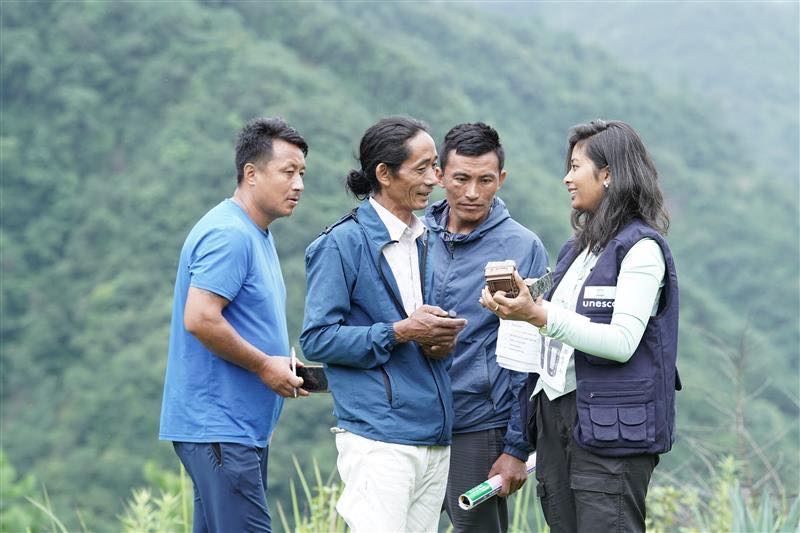
Your recent research with UNESCO focuses on the cultural and heritage impacts of glacial lake outburst in Thame. When did you realise the correlation between a physical disaster, climate change and living cultural heritage?
The Thame project grew out of a devastating event. In 2024, a glacial lake outburst flood struck the village of Thame in the Khumbu region of Nepal.
For centuries, the Sherpa community there has sustained a rich living cultural heritage, embodied in its monasteries, sacred landscapes, oral traditions, traditional livelihoods, and community practices. The flood did not just damage infrastructure. It swept away homes and sacred sites, and, in doing so, threatened the very fabric of a community’s identity.
The realisation that physical disaster and cultural heritage loss are deeply intertwined came not from a theory but from listening to the affected people. When I spoke with community members, what emerged was not just grief over buildings, but grief over memory. A monastery is not merely a structure; it is a living repository of knowledge, ritual, and belonging. When it is gone, something irreplaceable goes with it.
What does the future hold for Thame with minimal presence of youth in the landscape?
The absence of youth is a profound and growing concern. The Khumbu region has seen significant out-migration, particularly among younger generations seeking education and economic opportunity in Kathmandu and abroad. When young people leave and do not return, the thread of transmission breaks, and the oral knowledge that takes a lifetime to accumulate cannot be written down and preserved.
Has your understanding of identity changed, or perhaps become stronger, after working with different indigenous communities across Nepal?
Stronger and deeper, I think, rather than simply changed.
Working across communities, from the Tharus of the Tarai plains to the Sherpas of the high Himalayas, I have come to understand that identity is not fixed. It is dynamic, contested, and constantly negotiated between what communities inherit and what they choose to carry forward.
I am a Tharu woman—that has always been a source of pride, but it has also become a source of responsibility. When I facilitate a consultation or sit across from a government official arguing for the inclusion of indigenous knowledge in climate policy, I am not just doing my job; I am doing something that the indigenous community has not always had a seat at.
But working with other communities has also expanded my sense of solidarity beyond my own identity.
Therefore, my identity today is both more rooted and expansive than it was when I first stood on the Miss Nepal stage, and that, I think, is how it should be.
Jony Nepal
Nepal is a culture and lifestyle reporter/sub-editor at the Post. She is also a Psychology and English literature student.



Most Read from Culture & Lifestyle




Editor's Picks

What triggered the Rasuwa flood? Scientists piece together a complex chain of events

The floods keep coming. Nepal keeps starting over

In a settlement destroyed by the Bhotekoshi flood, a disabled couple offer strangers the little they have

Nepal working on detailed assessment as Bhotekoshi flood reconstruction could cost up to $5 billion

Rabindra Dhant gave Nepal a reason to smile. Now his camp wants real action behind the praise
E-PAPER | September 26, 2026

×