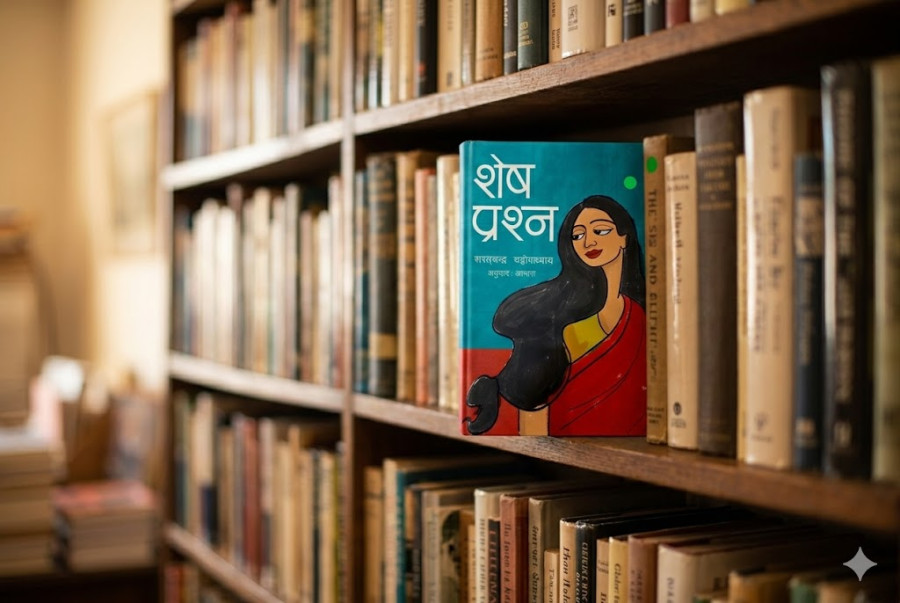
“My father did not leave behind anything except self-belief to protect me from the pity of others. That alone has sufficed me to sustain my life,” says the main character of ‘Shesh Prashna’, Kamal, a blazing force in the harsh Indian society that undermines women. This quote expresses the character’s true nature; it neither relies on relationships nor places others’ expectations above her own.
‘Shesh Prashna’ is one of Sarat Chandra Chattopadhyay’s last novels, released in 1931. Known for his raw and realistic portrayal of social injustices, such as in the esteemed book ‘Devdas’, Chattopadhyay is one of the most celebrated Bengali novelists. In this book, he has placed themes that are significantly progressive for that time, discussing bold ideas of feminism and relationships, serving as a clapback to the patriarchal structuring of Indian society.
‘Shesh Prashna’, the Nepali translation of the book, was released in November 2025. Translated by musician and poet Abhas, this book was published by Publication Nepalaya.
The story unfolds largely within the household of Ashutosh Banerjee (Ashu Babu), a radical widower living in Agra with his unmarried daughter, Manorama, among an elite circle of scholars. One member of this circle is Shivanath, a widely disliked figure who lives with Kamal. His poor reputation stems from abandoning his first wife for personal gain to begin a relationship with her. It is never clearly stated whether the two are married, leading those around them to question the legitimacy of their union.
Kamal can never be perceived with a fixed set of lenses. She is resilient, unapologetic, and compassionate and stays true to herself at all times. Even so, she possesses a mysterious charm, clouding people’s judgment about her.
One of the most striking moments that reveals her refusal to hesitate about her beliefs occurs when she visits the Taj Mahal. As scholars admire the monument and praise Shah Jahan for building it for his wife, Mumtaz Mahal, Kamal surprises everyone by openly disagreeing. She argues that the emperor was driven less by love and more by his own ego and desire for grandeur. At a time when women had little space to assert their views among men, her confidence quickly earned her a reputation for being overly opinionated.
While older men in society, such as Akshay, tarnish her reputation and question her character in the name of social conventions, Kamal is also forced to confront the strain of her estrangement from Shivanath. He disappears for days without revealing his whereabouts or what he is doing, leaving her in a difficult financial situation.
Even under such punishing circumstances, she rarely loses her composure. This becomes especially evident when Shivanath returns to Ashu Babu’s house, suffering from a life-threatening bout of influenza. Despite everything he has done to her, Kamal remains concerned about his well-being.
This moment, in which she acts according to her own moral convictions while remaining emotionally and romantically detached from him, ultimately captures the essence of her character.
The plot takes an unexpected turn when it is revealed that Shivanath is set to marry Manorama, who had once questioned his moral character—an irony that exposes the hypocrisy often present in real life. Other characters similarly reveal how people can profess certain values while acting in direct contradiction to them. Avinash, a close friend of Ashu Babu, abandons his sister-in-law, Nilima, as soon as he decides to remarry.
In contrast stands Kamal, whose unconventional yet emotionally steady nature challenges these contradictions. Her strong sense of individuality unsettles those around her, often forcing them to question their own beliefs and assumptions. Through her sharp, thought-provoking arguments, she confronts and dismantles prevailing stereotypes about what an ideal woman is expected to be.
Later in the story, Kamal develops a romantic relationship with Ajit, Manorama’s former fiancé. Yet she refuses to marry him, defying conventional expectations of relationships and companionship. Through Kamal’s bold choices, Sarat Chandra Chattopadhyay presents a strikingly unconventional view of love and partnership—ideas that were remarkably radical nearly 95 years ago.
The characters’ conversations are rooted in the realities of everyday life, allowing the story to unfold in a natural rather than dramatic manner. The absence of theatrical twists or sensational revelations, combined with dialogue that raises philosophical questions, shifts responsibility for meaning-making to the reader’s introspection and analysis.
At times, however, the lengthy introspections may feel monotonous. The heavy reliance on dialogue to advance the plot can also be tiring for some readers. Even so, this narrative style makes the book feel deceptively light to read, while ultimately leaving readers with lingering questions long after they finish it.
In ‘Shesh Prashna’, Kamal is more than just a name. Like a lotus that rises from water and takes shape at its own pace, she confronts life on her own terms. Much like the slow and steady blooming of the flower, her character meets challenges with resilience, gradually emerging as someone who rises above worldly limitations.
The title itself carries a deeply symbolic meaning. The novel does not grapple with a single dilemma but with many social questions that continue to shape society. These issues challenge rigid expectations about how people, especially women, are supposed to behave. Female characters openly voice their opinions before the male members of their households, and although the responses they receive differ, these moments show that the domestic space can be a site of dialogue rather than silent obedience. In this sense, the book is less about offering perfect answers and more about confronting uncomfortable realities that demand reflection.




 26.08°C Kathmandu