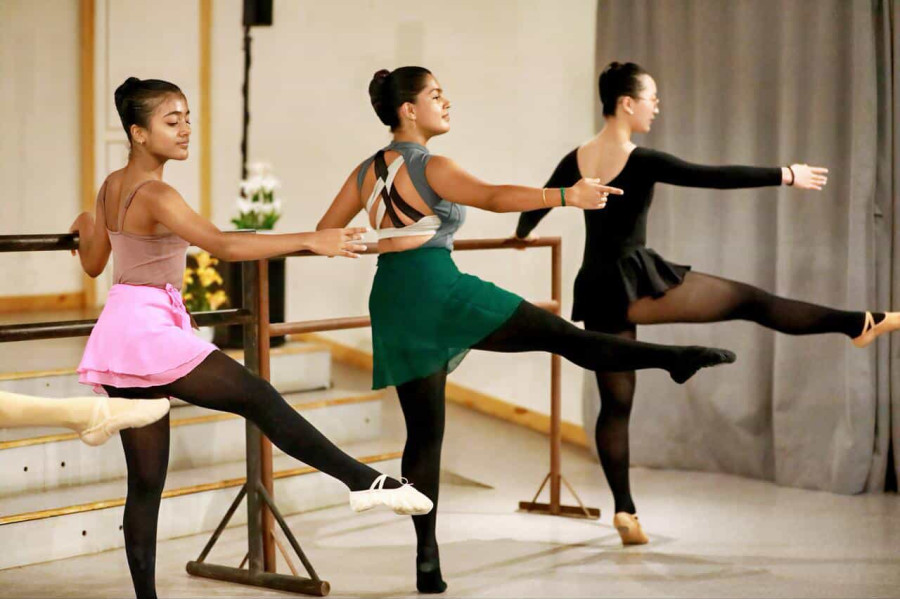
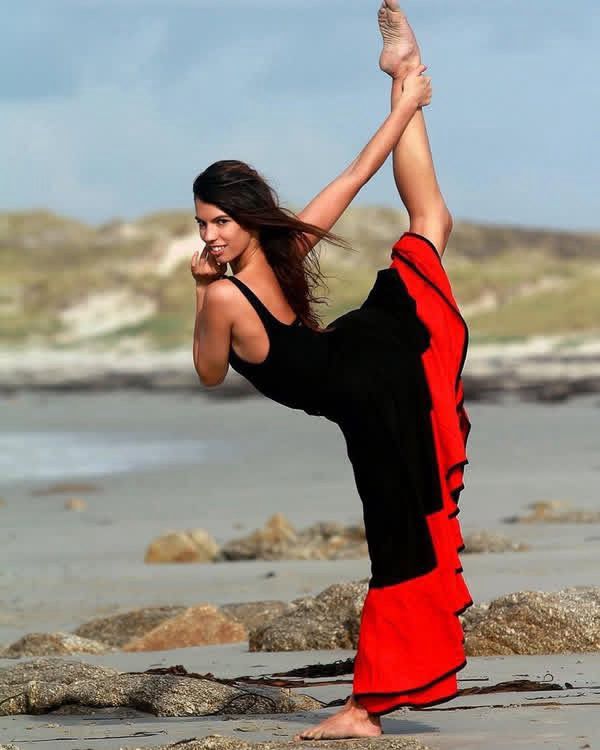
Founded by French ballerina Alizé Biannic, the Academy blends dance, music, and acting to train Nepali performers in global-style musical theatre while embracing local stories. Laya offers ballet, contemporary, jazz, aerial silk, acting, and Pilates classes. Photo: Courtesy of Laya Academy
Imagine the melody of jazz ringing in your ears and the theatrical choreography of a group moving in perfect sync, as you wait eagerly for each part of the performance. This form of stage art is known as musical theatre, in which songs and dance drive the acting and tell their own story.
Theatre that blends music, dance, and storytelling has long existed in Nepal in various traditional forms. However, Western-style musical theatre, such as Broadway productions, is only recently gaining visibility on Nepali stages. Among those working to popularise this format is Laya School of Performing Arts.
The founder of Laya Academy is Alizé Biannic, a French ballerina, actress, and director. She has trained at several performing arts institutions, including the Paris Opera Ballet School, the Ballettschule der Oper Leipzig in Germany, the Youth Ballet Company in Mataró, Spain, and the Royal Ballet in London. Since 2009, she has expanded her artistic work into theatre and film.
With over 50 international productions across plays, films, ballet, and Broadway, Biannic identified a gap in Nepal’s performing arts. The Nepali musical theatre scene rarely stages Broadway-style productions. She then decided to share her expertise and teach how these art forms are practised, starting in 2025.
‘Laya’ translates to ‘rhythm’ or ‘tempo’ in Sanskrit. Biannic says that when the academy was established in Nepal, she wanted it to resonate with local audiences. While Laya produces theatre shows and musical performances inspired by global stories, many of its productions also draw on Nepali narratives.
“It was started with the vision of introducing professional Broadway training, teaching performers all three disciplines—singing, dancing, and acting, and, above all, setting a standard for live theatre in Nepal,” says Biannic.
There are varieties of dance genres to choose from. Laya offers ballet, contemporary, aerial silk (aerial acrobatics in which performers create dramatic poses), and jazz. In addition to dance, the academy also offers Pilates classes.
Biannic (centre) during the staging of broadway classic ‘Chicago’ in Thamel. Photo: Courtesy of Alizé Biannic
Ballet was Biannic’s entry into the arts, so she naturally gravitated towards teaching it. Ballet also helps students build strength, alignment, and discipline. Musical theatre, on the other hand, brings everything together—movement, emotion, storytelling, and stage presence. She wants students to see how these styles connect, rather than feel confined by labels.
One of the Academy’s goals is to honour each student’s artistic voice and gradually develop their performance skills. Individuality matters in all forms of art, giving each piece a distinct, expressive quality. At Laya, this respect extends not only to artistic expression but also to the performers’ unique bodies.
For years, a stereotype has persisted that performers’ body types—especially ballerinas’—must always be lean. Biannic, however, challenges this notion. She says, “I don’t believe in a ‘perfect’ dancer’s body. I believe in listening to bodies. I adapt exercises, offer options, and focus on what works for each individual. Progress looks different for everyone, and that’s respected here. Strength, musicality, expression, and awareness matter far more than fitting into a mould.”
Another significant approach to learning in Laya is to reinforce that process matters more than a quick, showy output. “Laya is personal. I work closely with each student, not just on technique but on confidence, mindset, and artistic voice. I care deeply about how students grow, not just how fast,” says Biannic.
Brahmi Satyal, 23, a student at Laya Academy, developed an interest in ballet after watching the animated films ‘Barbie’ and ‘The 12 Dancing Princesses’. She says ballet has taught her strength and discipline that carry over into other parts of her life. “It has been challenging to balance college, internships, and personal responsibilities alongside ballet, but having a form of self-expression is important,” she adds.
Another performing art beyond dance is acting. Sobit Basnet practised acting as a student before becoming a teacher at the Academy. He says, “By teaching acting, I have learnt to unlearn, grow and improve from my own mistakes.”
Courtesy of Laya Academy/Facebook
Biannic was his drama teacher before he began teaching, and her methods deepened his interest in acting. He has also collaborated with her on ‘Chicago’, a musical production.
Huang Jiaying, 18, from China, began her ballet training at the age of 11. Encouraged by her family to explore various extracurricular activities, she started ballet at a young age. Continuing her training through the Covid-19 years allowed her to take part in several musical productions as a dancer. Eventually, she earned a small role in ‘Chicago’, marking her first step into acting.
She says, “Gradually, I gained confidence in expression and body language, which eventually led to me playing Miss Honey in Matilda’s Broadway-style production.”
When asked about the ideal age to start performing arts, she said there is no limit. “From beginners with a growing curiosity to adults who want to feel good in their bodies, performing arts is for anyone who feels something when they watch or move to music,” Jiaying adds.
Despite art being acceptable to everyone, on a larger scale, its perception remains as a less glamorous pursuit, frequently sidelined in favour of fields or subjects deemed economically sound in the long run. This has reduced the value of the arts across any medium.
Such attitudes pose a heavy challenge to art academies. Thus, there is little institutional incentive for schools like Laya. Even so, with the determination and support of many aspiring artists throughout Nepal, Biannic is working to advance performing arts education in Nepal while promoting Nepali culture through students’ work.




 28.31°C Kathmandu