This man teaches in a classroom with animals and Nepali ancestral tools
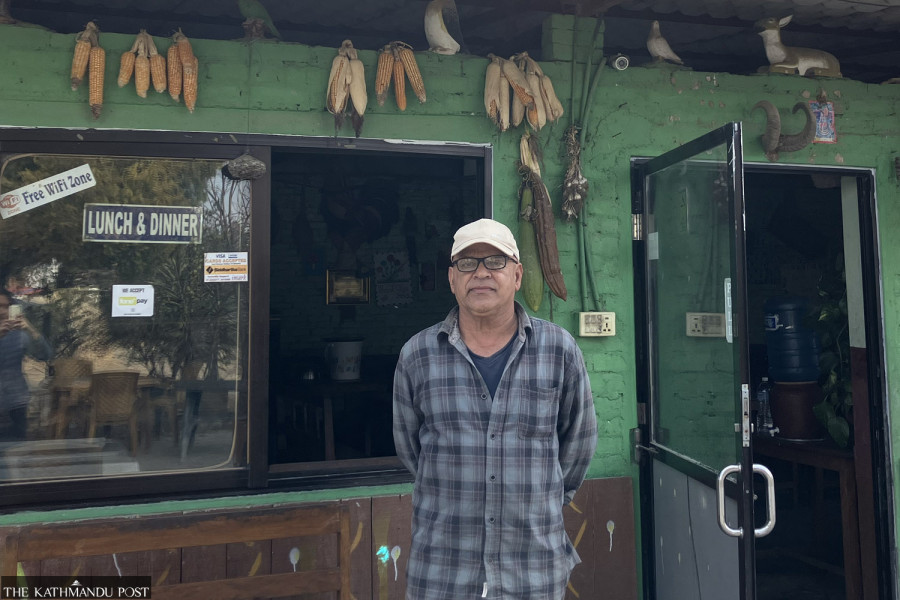
Founder of Tiger Lily Petting Farm Rajendra Upreti, a former biomedical inspector, teaches schoolchildren how traditional Nepali tools work—by letting children use them. Upreti returned to Nepal after spending two decades in the US. Mokshyada Thapa/TKP
Do you know what a dhiki does? Or have you ever used a janto to produce flour?
These traditional tools made people’s daily chores easier before modern technologies were introduced. Today, we are rarely aware of their use. With the objective of teaching children about Nepal’s traditional tools, the Tiger Lily Petting Farm and Hands-on Museum was built in March 2015.
It is located 2.5 kilometres away from the Araniko Highway in Suryabinayak-01. The museum has a quaint look, with large haystacks and dokos suspended from logs.
The owner, Rajendra Upreti, a biomedical device quality inspector by profession, returned to Nepal after spending two decades in the US. At first, he wanted to work with biomedical devices. But the market in Nepal was not as large as he had thought.
He then opted to start his own business at 53. Back in the US, in Ann Arbour, Michigan, on the opposite side of his residence, were a petting farm and a hands-on learning museum. “The museum had all sorts of displays of science-related devices; one was how a pulley could lift weights. Remembering this, I thought why not bring the concept of such a museum with a Nepali twist?” says Upreti.
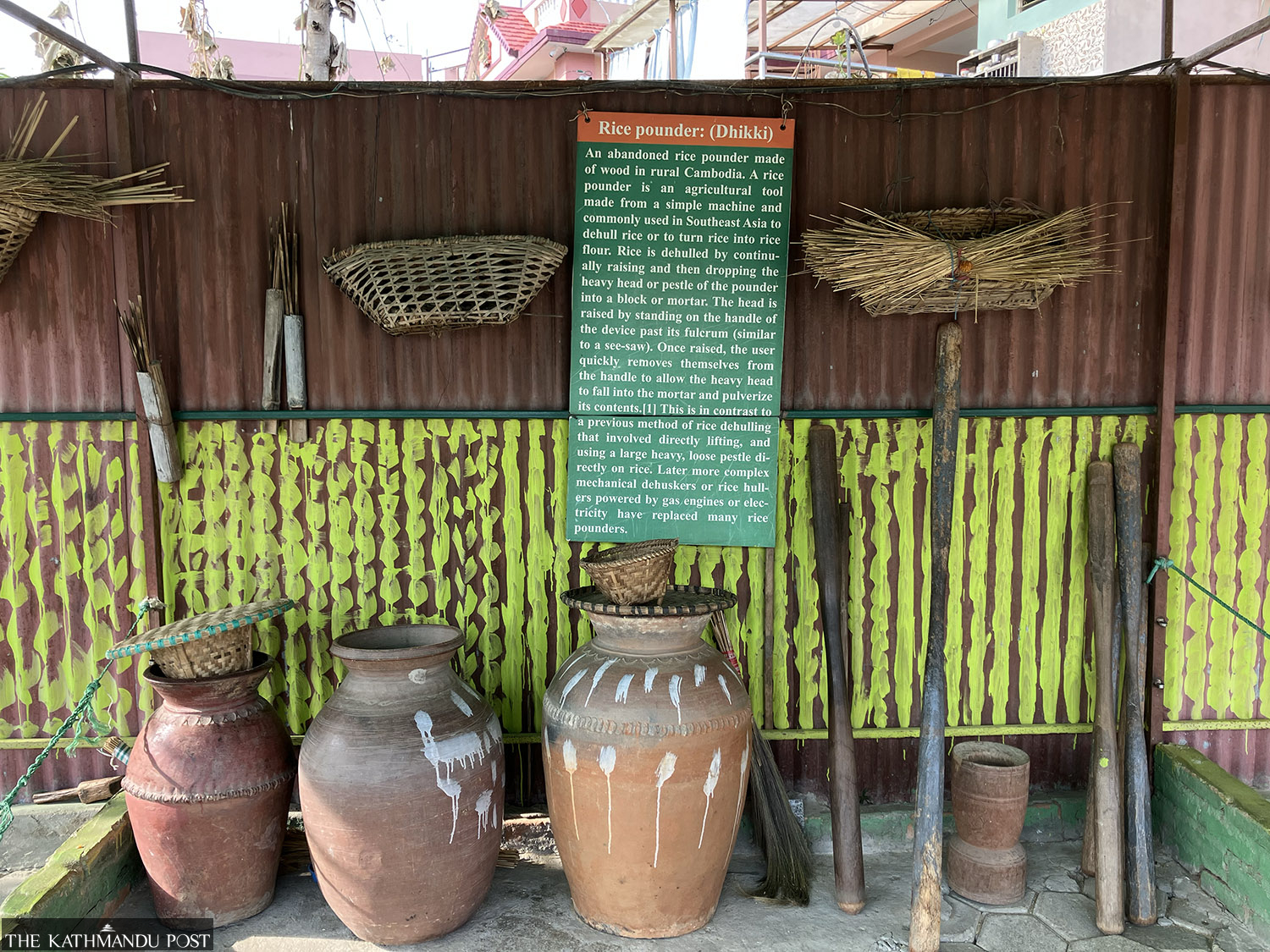
In the museum, you not only get a brief description of how the tools work. Visitors can actually put them to use. Mokshyada Thapa/TKP
Raised in Kavrepalanchok, he has always kept his childhood close to his heart. Over time, he noticed that memories and tools of the old way of life were slowly fading. Children were being taught what a janto does, but they could not understand its simple mechanism by reading textbooks alone.
This led him to propose learning through real-life experience. Like the devices he saw in the Michigan museum, Nepali traditional machines are also based on core scientific principles. The dhiki works on the lever principle, while the halo operates by distributing force. Demonstrating how these tools function sparks students’ curiosity and helps them better understand the science behind them.
He built the Tiger Lily Museum to bridge curriculum and culture. The use of traditional tools that once made people’s lives more convenient is disappearing in practice. Using and producing output from them requires additional effort, from their retrieval to their use. But preserving them in museums gives them life.
Inside the museum, the tools’ showcase does not stop at a brief description of how they work. Visitors and students can actually put them to use.
For the dhiki, real grains are placed at the bottom of the pestle, and a vertical wooden cylinder is attached to the end of the lever. Students can place their foot on the opposite end of the lever to raise and lower the pestle, pounding the grain.
Another interesting tool is theki and madani, used for butter churning. The theki is a cylindrical wooden flask used to store curd, and the madani is rotated back and forth by a rope. After some time, butter (nauni) is produced. The remaining water, also called mohi, is served as a drink.
When The Post reached Tiger Lily, students from a visiting school were waiting in lines to drink the mohi, a product of their own labour.
“Once, the animals and birds kept on this petting farm were commonly raised in households. Now, children don’t interact with these animals as much as we used to. When I was a kid, I remember sitting on top of a bull and holding its horns with all my strength,” says Upreti, laughing.
Watching children experience the warmth and joy of petting animals brings him deep contentment.
Along with the usual cattle and birds, there are some exotic species on the farm. Guineafowl (laukat in Nepali), kalij pheasants, and parrot species such as budgies and finches are found on the farm.
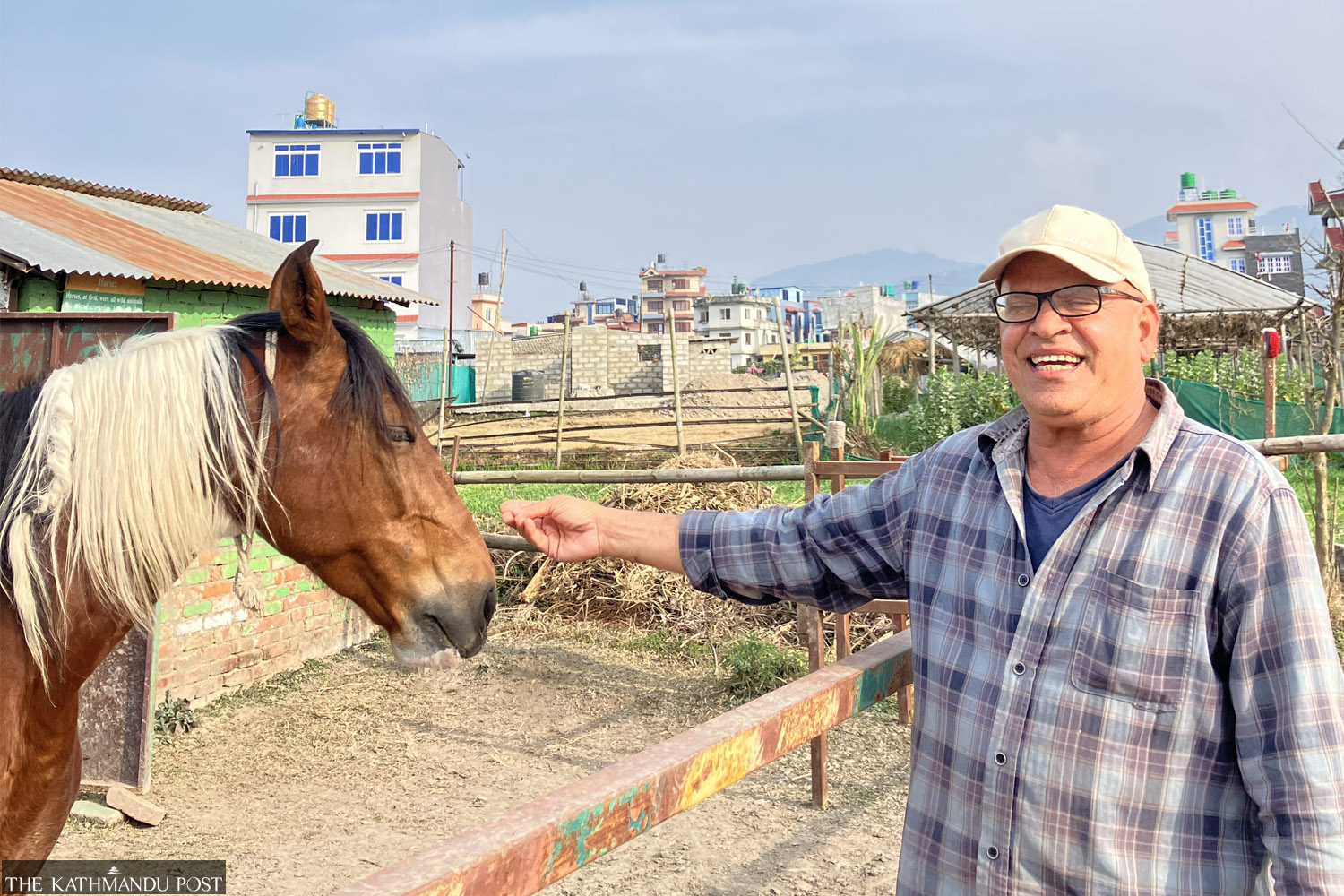
The horse at this place has its own personality. Basanti refuses to entertain anyone unless she is given a piece of carrot. Mokshyada Thapa/TKP
The horse at this place has its own personality. Basanti refuses to entertain anyone unless she is given a piece of carrot.
At the edge of the museum lies a hydroelectric power generator—built as a conventional model to explain the basics of hydroelectricity generation. “Hands-on learning leaves an impact on small minds. Children remember what they did on their own rather than learning from textbooks. Even though the materials I teach children about are on the verge of extinction, I hope they grow into a generation that cherishes and preserves our traditional values.”
In addition to educational content, the museum offers entertainment elements. One of them is a tractor ride that takes children through the area.
To date, more than 350,000 students from across Kathmandu have visited the Farm. “Per day, our farm can only give tours to 170 children; any number above that is beyond our working limit. This way we can emphasise providing individual time to each and every student so they actually learn, not just get a mere view of our museum,” says Upreti.
In other countries, governments provide tax incentives to businesses that help conserve national culture and traditions. Upreti notes that Nepal’s government has yet to introduce similar measures. He believes that, with support from government bodies, businesses whose objectives align with his could positively influence many people.




 28.31°C Kathmandu