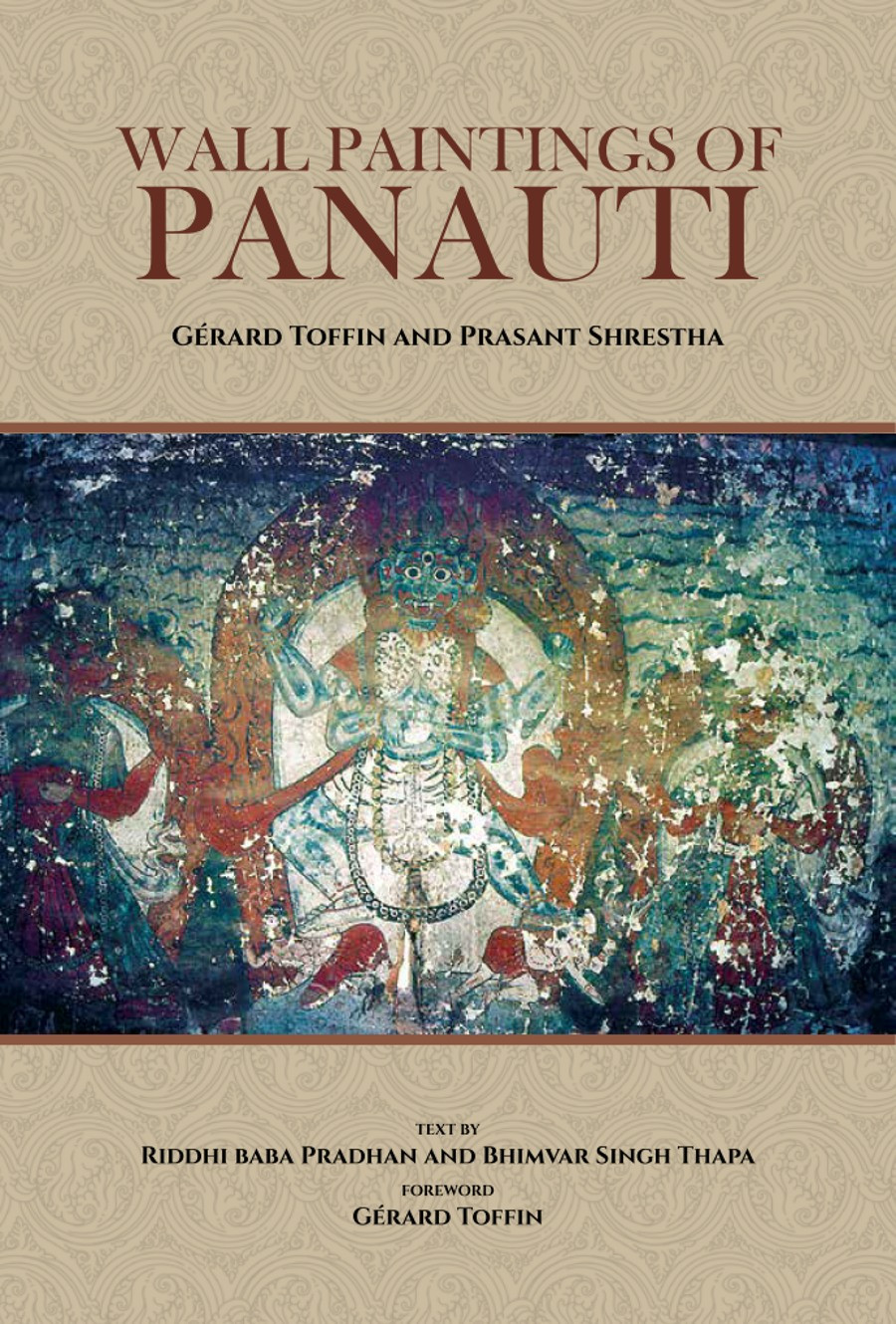
‘Wall Paintings of Panauti and Their Context’ is a research-based book on the 17th-century religious frescoes in Panauti, published by Panauti Municipality. The book is authored by Emeritus research director Gérard Toffin, former director of the Department of Archaeology Riddhi Baba Pradhan, and senior chemist at the Department of Archaeology Bhimvar Singh Thapa.
The book starts with a foreword from Toffin with a brief overview of Panauti’s paintings. In this segment, he also discusses the change of mural arts throughout time, quoting, “In contemporary times, especially after the 2008 transition from the centuries-old Nepalese monarchy to a federal democratic republic, political or purely ornamental murals have been taking over the walls.”
The highlight of Toffin’s section is the cult of Matrkas deities. The Matrkas, a group of goddesses, symbolise female action, prosperity, and even hostile forces, as well as death when their wishes go unfulfilled. These deities are also associated with Shakti Pith (sacred places where Sati Devi’s dismembered body parts fell).
Bhaktapur, as a whole city, is bordered by a ring of eight Asta Matrkas Pith. Of all eight, Brahmayani is the most important. The temple serves multiple functions: it is where the local people of Panauti are cremated, and it is also believed to protect the surrounding settlement.
Dedicated to Brahmayani, a jatra is organised every year, known as ‘Jyah punhi’, in which the statue of the goddess is carried from her original temple to her pitha shrine for a night. Matrkas are worshipped throughout Hinduism, especially prevalent in the Newa culture.
Riddhi Baba Pradhan, the woman behind the restoration of the Brahmayani Temple more than 40 years ago, signifies the history of Panauti and the types of paintings found in the settlement. Unknown to many, local belief holds that Panauti stands upon a huge stone, covered by Basuki Naag, the king serpent, as a protector. The locals do not use Dhikki to avoid disturbing the king beneath the settlement. Pradhan says, “The monolithic base could also be a reason why the town did not succumb to major damage during the two great earthquakes of 1934 and 2015.”
The book states that the earliest style of painting can be considered a manuscript. They date back to the 11th century and are still preserved in the government’s archives. Another painting form is Paubha. One painting that is publicly displayed each year on the full moon of Jestha is Krishnalila, a romantic scroll created by King Siddhi Narasingha Malla. This exhibit happens at Krishna Mandir, Patan.
Similarly, the third style of painting is wall paintings, the most prioritised form in the book. Wall paintings are executed on mud-plastered walls, where religious texts and motifs predominate. According to Pradhan, one notable example is the painting in the 55-window palace in Bhaktapur Durbar Square; in preservation efforts, it was also treated by Italian experts.
Panauti’s wall painting differs from others found in the Kathmandu Valley, as it is unconventional. During the restoration of the Brahmayani temple, the team discovered an additional layer of stone plaster beneath the wall painting. This was unlike the wall paintings present in the Kathmandu Valley.
Of the total of three paintings discussed, none of them has caught the attention of governmental bodies and may soon perish due to decay and direct air exposure.
Bhimvar Singh Thapa, who led his team in restoring the temple decades ago, recounts tales of the Malla kings of Panauti and expresses concerns about the recent inspection and preservation of the temple’s inner and outer structures. The temple roof leaked, and the adhesion materials in the painting were peeling off.
There were also animal sacrifices done in the temple. The shed blood of the animals covered the wall paintings, making them harder to remove. Thapa reports that the damaged areas were replastered, and chemicals were applied to clean the painting following the inspection.
This short book’s inclusion of images provides a clear sense of the subject matter. Its writing seeks to present the facts and figures of the wall paintings objectively. This makes the book an informative read that calls for immediate action to recover historically significant art forms. The stories of deities and Malla kings are the enthralling parts of this book.
Although the untranslated religious terms are explained in segments, adding a vocabulary list below each page would help readers better understand the overall context.
The French government was supporting the restoration of Panauti from 1991 to the end of the 1990s through bilateral cooperation. Panauti’s rich heritage drew the attention of Gerard, one of the book’s authors. The revival of Nepal’s heritage often gains momentum only when acknowledged from outside. This book reminds policymakers, heritage activists, and scholars that it is not too late to begin restoring Panauti’s paintings.
The authors emphasise that preservation measures should be undertaken as soon as possible. Readers can sense this urgency through photographs of partially erased and blurred paintings.
The consequences of inaction are clear: the paintings’ disappearance. As an essential part of Nepal’s art history, their loss would be permanent. Deeply tied to Panauti’s religious and cultural life, these wall paintings would also constitute a significant loss of heritage.
_______________________
Wall Paintings of Panauti and Their Context
Authors: Gérard Toffin, Riddhi Baba Pradhan and Bhimvar Singh Thapa




 26.08°C Kathmandu