Diversity is at the heart of Berlinale: Tricia Tuttle
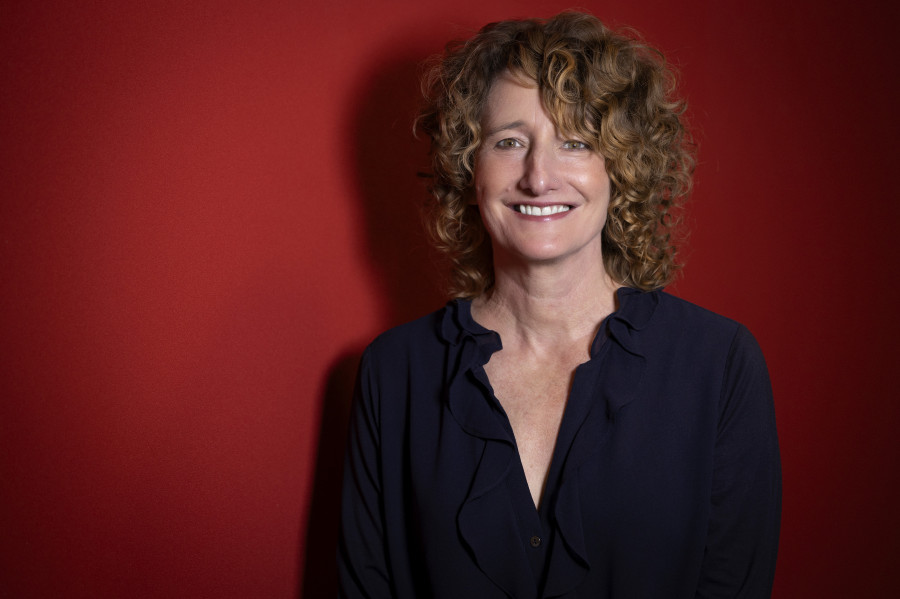
Berlinale’s creative director shares insights on inclusivity, political engagement, and the growing presence of Nepali filmmakers at the festival. Photo: Courtesy of Richard Hübner/Berlinale
At the world-renowned Berlin International Film Festival, if you see a woman walking confidently and greeting the audience with a smile on her face, you will recognise her as Tricia Tuttle. She has served as the creative director and manager of the Berlinale since 2024. Born in the US, she has more than 25 years of experience in film festivals and film education.
She has worked in senior roles at the British Film Institute (BFI), the British Academy of Film and Television Arts (BAFTA), and the National Film and Television School (NFTS). Most recently, she was the Head of Directing Fiction at the NFTS.
Before that, she worked at the BFI for ten years, where she helped lead the BFI London Film Festival and BFI Flare: London LGBTQIA+ Film Festival.
The Post’s Reena Moktan sat down with Tuttle virtually to discuss the Berlinale, its unique features and the connection of Nepali filmmakers and their representation there.
Each edition of the Berlinale brings new and unique changes. What distinguishes this year’s festival from previous editions?
Every year, nearly 280 new films are submitted, and discovering what cinema is, and can be, is at the heart of what we do. That has always been our focus.
This year, we’re excited about new ticket offers for audiences aged 18 to 25. We already have a loyal young-adult audience, but we also want to attract new attendees to the festival. We know ticket prices can sometimes be a barrier, so we are especially excited to make the festival more accessible.
Since you assumed the role of Festival Director, there appears to be an increase in women’s participation across the festival. Was this a deliberate curatorial decision, or a coincidental outcome?
This year, 41 percent of the films in the festival are directed by women! We do not set quotas, but we strongly value diverse programming that brings different perspectives to the screen.
We are always striving to improve, especially in gender balance across submissions. Around 35 percent of the films submitted to us are by women, and 41 percent of the selected films are directed by women, which is encouraging. Even more exciting is that some of the most interesting competition entries—by second- and third-time filmmakers—are from female directors.
At Berlinale, audiences continue to queue late into the evening, often at Potsdamer Platz, to attend screenings. What strategies or programming approaches help the festival maintain such strong and diverse public engagement?
You’ve reached the core of what makes the Berlinale exciting and unique, which attracted me to become festival director. A deep commitment to diversity and showcasing different voices has always been part of Berlinale’s DNA.
The fact that it has been 40 years since we launched the Teddy Award, an award for queer filmmakers, underscores that commitment.
Forty years ago, no major film festival highlighted queer filmmakers or stories as much. Some of those filmmakers have since become key voices in world cinema.
We screened ‘Tomboy’ by Céline Sciamma, which won the Teddy Award, and Pedro Almodóvar won with ‘Law of Desire’—the very first year the Teddy was awarded. We have also always been interested in representing a wide range of countries.
This year, films from 80 countries are represented in the public programme. We do not try to force a balance; we simply care deeply about different voices and are interested in hearing them.
The Berlinale is frequently described as the most political of festivals. Why do you believe political engagement remains an essential part of the festival’s identity?
This label is often assigned to us rather than something we assert ourselves. We have consistently supported films with strong perspectives. The Berlinale has always been willing to present films that could be controversial or that provoke discussion.
We also operate in a politically and artistically engaged city that shapes what we do.
I’m interested in how the festival brings together different kinds of cinema across its programme. In 1982, for example, we screened ‘Tootsie’ out of competition, and also Chris Marker’s ‘Sans Soleil’. The two films represent very different approaches to cinema, yet both sat comfortably within the Berlinale. That range is something I hope audiences will continue to see today.
Some of Berlinale’s sections are created to highlight marginalised and suppressed voices. How important is it for the festival to actively create space for these perspectives within its programming?
Absolutely, this is very important, and it doesn’t only happen in the Panorama section. Panorama is special because it is our most audience-focused programme. It is also the section where we present the Audience Award, making the public the festival’s largest jury.
Throughout the festival, we carefully consider audiences when we programme films—who is telling the story and whose story is being told. This year, Panorama features 37 films from 36 countries, highlighting the programme’s strong international diversity.
In recent years, Nepali filmmakers have been consistently selected for Berlinale Talents. How do you view the presence of Nepali talent and films at the Berlinale?
This is very important and aligns with the festival’s identity. We proudly embrace the fact that, yes, we are a German festival, and the world sees us as a European festival—but we are also deeply international.
I am proud that we have had a Nepali film in competition, ‘Shambhala’, and that Min Bahadur Bham is returning to serve as an international jury. It’s wonderful to see so much talent, and we love watching filmmakers develop their first features, hoping they return to the festival one day.
This is part of our ongoing commitment: between 2012 and 2014, seven films by Nepali filmmakers were selected for the official programme. This year, having Min on the jury continues that connection.
Do you want to add more on Bham? It’s a great achievement for the Nepali film industry.
He was the first Nepali filmmaker to have a film in the Berlinale’s main competition, and we admire his work. His short film ‘The Flute’ was seen at the Venice Film Festival and received great praise from programmers. When he returned with his second feature, ‘Shambhala’, it was wonderful to see him in the main competition.
I knew I wanted him to return to the festival at some point, and in 2024, that opportunity came. This year, he is lucky to serve on our international jury, selecting the Golden Bear and Silver Bear alongside Wim Wenders, our Jury President. His journey is an inspiring milestone for Nepali cinema.
Drawing on your 25 years of experience in the festival sector, why do you believe film festivals are important for communities, societies, and global cultural exchange?
I think festivals are more critical than ever right now. They help us connect as an international film industry. For the past decade, the industry has often been very nationally compartmentalised. Domestic production is, of course, important, but some of the greatest films come from co-productions between multiple countries. Collaboration is key to getting films seen.
Many of the films we have showcased in previous years have broken through internationally. A good example this year is ‘Sentimental Value’, which is competing at both the Oscars and the BAFTAs, among many other awards worldwide. It is a multi-country production. In fact, none of the films in our competition section is produced by a single country.
Festivals like the Berlinale respect and value each country’s film culture. They are spaces where these values can be celebrated and reaffirmed every year.
Film festivals in Nepal often face financial constraints due to limited government support. In 2025, the Berlinale itself experienced a €2 million reduction in funding from the Berlin Senate. How did this affect the festival, and how do you approach securing alternative sources of support when public funding is reduced?
This is very important for every film festival, because festivals exist on very different scales. The Berlinale, for example, is a huge festival, hosting nearly 20,000 professional delegates. Last year, we had 340,000 public attendees. We are large, but even smaller-scale festivals face similar challenges: balancing budgets and securing public support. Running a festival without sponsorship or support is extremely difficult, and securing sponsorship can be challenging.
My advice to any film festival would be to operate at a scale you can manage. Start smaller and grow gradually, rather than trying to become too large too quickly. There is real value in small, targeted festivals—perhaps with 7 to 10 films—which can bring people together around cinema just as effectively as a festival screening nearly 300 films.




 23.26°C Kathmandu