In a world obsessed with turmoil and spectacle, Vinod Kumar Shukla, who passed away last month, captured the quiet beauty of everyday life with lyrical prose.
Vinod Kumar Shukla passed away last month. A doyen of modern Hindi literature, Shukla is remembered for a large body of poems, stories, and novels, laden with poetic observation of ordinary lives.
My limited exposure to Hindi literature is mainly shaped by Munshi Premchand’s writings, Manto’s stories, and other novels such as ‘Tamas’, ‘Kitne Pakistan’, and ‘Mohandas’, which followed the realist tradition in depicting social, economic, and cultural motifs as major stimuli for character development.
Before reading ‘Dewaar Mein Ek Khidki Rahti Thi’, the last Hindi novel I had read was Shrilal Shukla’s ‘Raag Darbari’ and it had everything to offer—a thorough indictment of feudal life in post colonial rural India, manifestation of murky caste politics, generational family conflict, examination of bureaucratic labyrinth and the chaos in Indian rural landscape expressed through myriad of characters.
Having only explored the moral and social landscape of such Hindi novels, I assumed Vinod Kumar Shukla’s ‘Dewaar Mein Ek Khidki Rahti Thi’ to be filled with historically rooted characters buried within the rubble of social, political and cultural concerns. But I was in for a surprise.
Shukla sculpted his characters without the burden of historical continuity. Thus, they are not driven by social, economic and religious blinkers, but rather their actions and worldviews are shaped by basic human emotions and spirit. Shukla drew a world filled with simple characters living their lives tenderly.
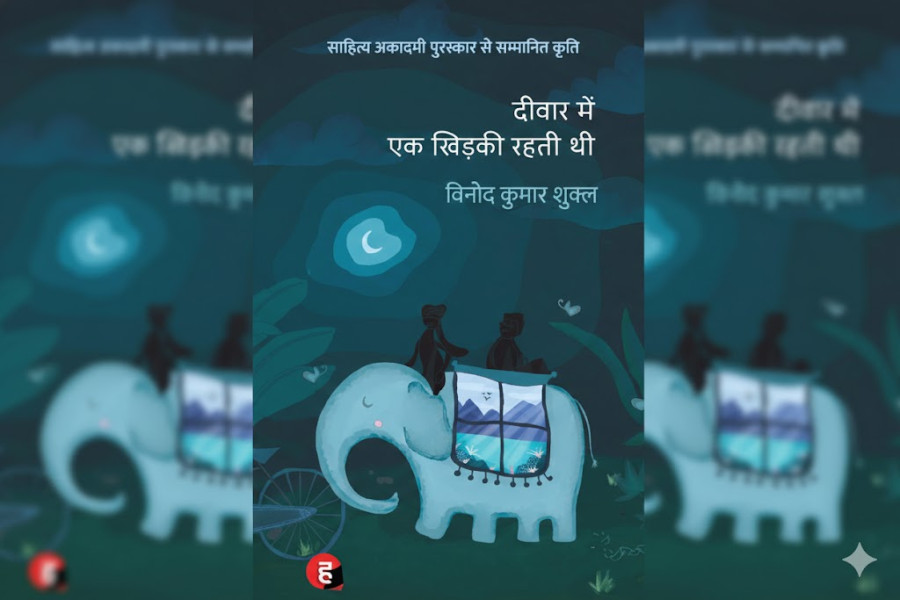
Published in 1997, the novel is set in a small Indian town and follows the life of Raghubir Prasad, a mathematics college teacher, and the various shades of his relationships with other characters, most intimately revealed in his bond with his wife, his parents, and his colleagues at his college. There is also an elephant in the scene, which becomes his regular companion for office rides.
The whimsical characterisation of the elephant’s presence in Raghubir Prasad’s life is rendered with sensual detail. The quiet, silent, nameless elephant becomes the centre of conversation between Raghubir Prasad and his wife, symbolising childlike innocence and curiosity.
Most importantly, the world beyond the window in Raghubir Prasad’s room allows readers to witness the blossoming marital life of Raghubir Prasad and Sonshi, set against a serene depiction of nature.
The world beyond the window hums with the bustling warmth of the morning sun, the gentle rustle of leaves, the river’s hymns, and cooing birds—brought alive through Shukla’s lyrical writing, which merges the rhythm of nature with the rising intensity of Raghubir Prasad’s conjugal life.
Shukla excelled at using poetic imagery to capture the various moods of his characters, often obscuring the line between poetry and prose.
The use of magical realism in describing the world beyond the window often spills over and engulfs Raghubir Prasad’s routine life, exemplifying the alchemy of Shukla’s writing in camouflaging the ordinary with the extraordinary to create something memorable.
Shukla did not yank his characters from one world to another but rather rowed them across the worlds with the ease and wisdom of an old boatman accustomed to navigating the same depth of water for ages.
However, a great novel is not always driven by plot or conflict. At its best, it reflects its readers by stripping away social and cultural façades and revealing the warmth of basic human emotions.
The sincere depiction of ordinary, everyday life, infused with imagination, also makes for a compelling novel. Shukla excelled at weaving a story out of nothing, with rich texture, sweet characters, and pleasant memories, as if he were a cotton candy seller at a local fair, keeping the children astonished with his deceptively simple yet magical way of concocting cotton candy out of thin air.
The prose is rich with poetic grammar that envelops each description, turning simple observations into lyrical moments. The narration moves fluidly between the magical world beyond the window and the realities of household chores and college life, marked by a clever variation in tone.
In the magical world beyond the window, Shukla used vivid imagery laden with pictorial depictions of leisure, nature, and peaceful conversations with family members. By contrast, as the spatio-temporal reality shifts to the real world, the writing becomes plainer and more descriptive, animated by witty dialogue. This transition does not weaken the rhythmic quality of the prose; rather, it highlights the malleability inherent in Shukla’s writing.
We live in a tumultuous time marked by global upheaval on political, economic, and environmental fronts, with growing polarisation and political violence in society. A writer was stabbed in the eye, a president was recently abducted from his bedroom, war is ongoing in Europe, and the Himalayas are melting. These are strange times, where reality often feels stranger than fiction.
No wonder this year’s Nobel Prize in Literature was awarded to László Krasznahorkai, a master of dystopian fiction. Amid this existential chaos and uncertainty, Vinod Kumar Shukla’s story in tender prose, shaped by the simplest observations and quiet magic, reminds us to pause in life’s Sisyphean pursuit and find solace in its smallest moments.




 13.68°C Kathmandu