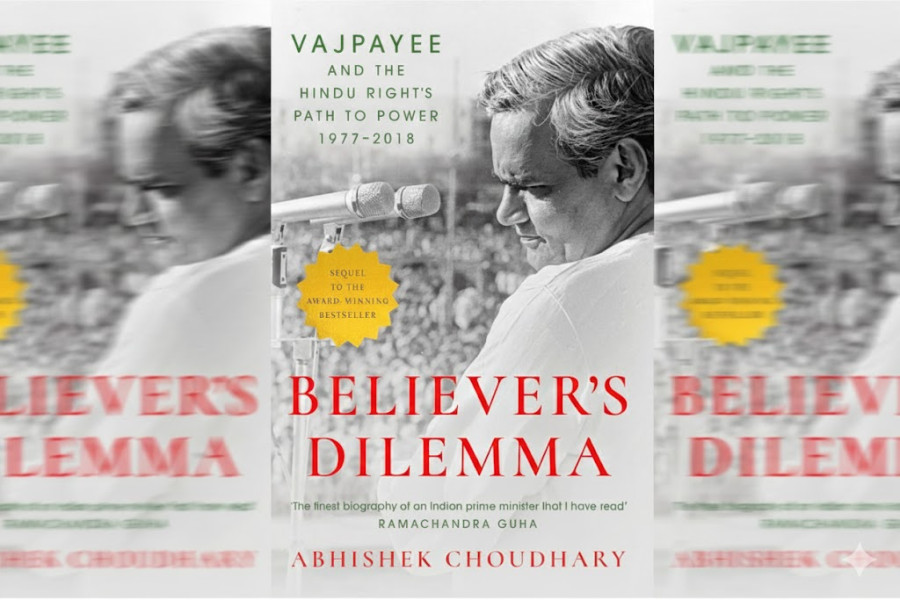
‘Believer’s Dilemma’, the second volume of a two-part biography of Indian politician Atal Behari Vajpayee by Abhishek Choudhary, picks up in 1977, a watershed year in Indian politics. For the first time since independence, voters decisively rejected the Congress, bringing in a non-Congress government in New Delhi. It was also Vajpayee’s first real taste of power at the Centre. The coalition led by Sangh Parivar would profoundly shape both Vajpayee’s career and the trajectory of India's Hindutva movement.
Vajpayee entered public office at the national level as the foreign minister. The aptly titled chapter ‘Sweet Intoxication of Power’ captures his formative years as India’s top diplomat, who delivered the speech in Hindi at the UN General Assembly, becoming the first Indian politician to do so. The chapter traces his dealings with the United States and his outreach to Pakistan. The author argues that to understand Vajpayee as a man at the centre of Indian politics over the decades up to the mid-2000s, one must understand his early encounters with power.
In the first part, the narrative moves through the crucial years after the Emergency. The Janata Party coalition, which brought together several parties including Vajpayee’s Bharatiya Jana Sangh, formed a coalition government under Morarji Desai, with Vajpayee serving as the foreign minister. After the coalition collapsed, Vajpayee emerged once again as a central figure: he became the founding president of the Bharatiya Janata Party in 1980.
Chronicling this early saga, Choudhary presents Vajpayee through his own words and those of his party. But crucially, he complicates the official narrative by offering his own assessment. Drawing on an impressive array of materials, including books, news reports and interviews with some of the players, he builds a portrait of a complex, often contradictory man, who shaped Indian politics for decades but was never entirely at ease with the forces he helped unleash.
Because Vajpayee was so deeply embedded in the country’s political life, the biography also doubles as a history of recent decades in India. Indira Gandhi’s assassination and Rajiv Gandhi’s sudden ascent are woven into the narrative, placing Vajpayee within a rapidly shifting political landscape. Yet these were also years of personal and political setback. In the 1984 elections, fought in the shadow of Gandhi’s killing, the Congress rode a massive sympathy wave. The BJP was electorally decimated. Vajpayee himself lost his Gwalior seat by a staggering margin of 170,000 votes.
Part two, titled ‘A Doublethinker’s Guide to Competitive Politics’, covers the long years of recovery and reinvention. This section focuses closely on internal party dynamics. It is here that the book’s central tension comes into sharp focus: how does a poet, a statesman, and a self-styled moderate restrain a party increasingly drawn to ideological extremism? Vajpayee’s political project, or the dilemma of the book’s title, revolved around his attempt to reconcile these competing impulses.
The rise of LK Advani, who came to embody the BJP’s harder ideological edge, is given sustained attention. Vajpayee’s brief first stint as prime minister during an era of parliamentary horse-trading contrasts sharply with his later achievement: he became the first non-Congress prime minister to complete a full term.
Choudhary also writes about Vajpayee’s personal life, such as the unusual domestic arrangement in which he lived with a married couple and their family while remaining publicly a bachelor. These passages are among the most compelling in the book. Here, Vajpayee appears not as an ideologue or negotiator but as a human being, with a personal interest in movies and poetry.
Choudhary narrates key moments of his political life in detail: his efforts to distance himself from the demolition of the Babri mosque, his persistent attempts to improve relations with Pakistan and his outreach to the United States at a time when Washington remained closer to Islamabad. The book does not shy away from irony. Vajpayee played a key role in elevating Narendra Modi to chief minister of Gujarat, paving the way for the rise of Hindutva politics he had long sought to minimise.
The BJP’s rise unfolded in the shadow of Ayodhya, which helped radicalise sections of the Hindu electorate. The period also reveals early signs of the party’s later playbook under Modi—anti-Pakistan rhetoric and the marginalisation of India’s Muslim minority. Vajpayee’s coalition government was perpetually strained by unpredictable allies such as Jayalalithaa. Yet it was also marked by audacity: the clandestine Pokhran nuclear tests, the Lahore peace summit with Pakistan’s prime minister Nawaz Sharif and the bitter irony of the Kargil conflict, planned even as Vajpayee was engaging Sharif in overtures of reconciliation.
In a country as complex and deeply divided as India—by region, religion, caste, and inequality—the prime minister navigated a political minefield. Crisis followed crisis, and the government often appeared to be tottering. But Choudhary captures these travails with clarity and aplomb.
While the first and second parts read like inside baseball—the author assumes a certain familiarity with Indian political history—it is only in the final chapters that Vajpayee, in all his contradictions and limitations, is portrayed in a way that evokes the man behind the political tapestry. As a result, Vajpayee appears a figure full of contradictions—a man torn between his moderate impulse, yet leading a party pivoting towards radicalisation.
Towards the end, his decade-long physical decline is treated briefly, with a cursory mention of dementia that robbed him of his voice and memory (he died in 2018).
In the US, the biographer Robert Caro has spent a lifetime chronicling President Lyndon B Johnson to illuminate the workings of power. With the two-volume biography of a consequential Indian prime minister, Choudhary achieves something similar. Through the prism of Atal Behari Vajpayee’s life, he offers a deeply researched and compelling history of India’s recent past and the forces that continue to shape its future.
Adhikari is a freelance journalist based in Kathmandu.




 23.57°C Kathmandu