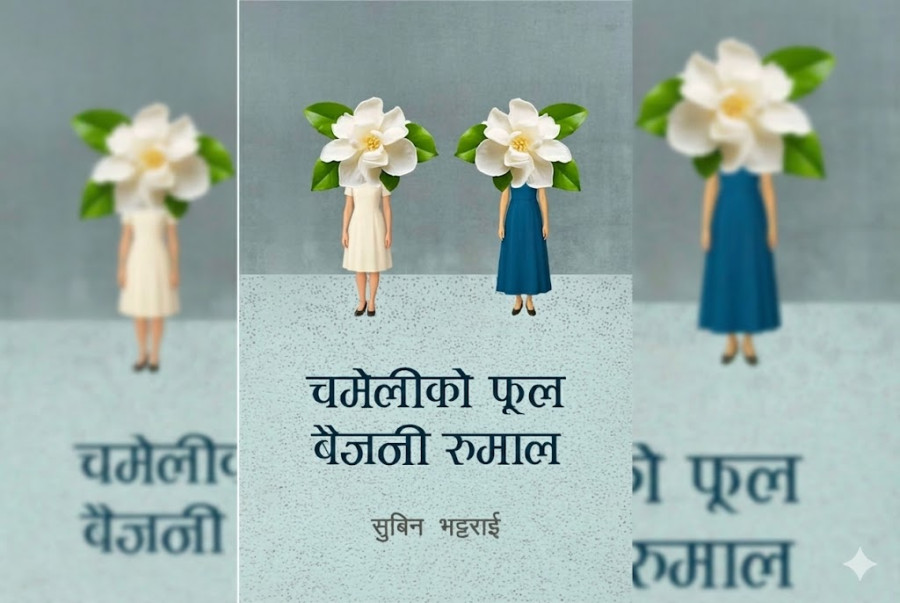
Subin Bhattarai says that his new book, a story collection, ‘Chameliko Phool Baijani Rumal’, is a rainbow convergence—unlike ‘Summer Love’ and ‘Saya’—reflecting limited shades of life. Each story embodies the weight of layered motifs and emotionally rich characters. Every story is vastly distinctive yet beautifully bound by the undefined principle of love and relationships.
The collection explores unconventionality, female sexuality, and complex human psychology. These themes emerge from ordinary, homely settings, showing the beauty of mundanity. The book also discusses how relationships are atypical, how societal expectations impact mental health, how love influences our decisions, and how pride can break harmony in an instant.
As much as relationships are discussed, individuality is prioritised greatly within the compilation. The theme of independence and singularity is boldly illustrated in the fifth story, ‘Sajha’. The story revolves around a girl who finds her voice while resisting societal conventions. With the theme’s progressive ideologies intertwining with cultural relevance, the plot narrates the varied journeys of life.
The characters’ inner turmoil, whether known or unknown, manifests in actions and outcomes. In the second story, ‘Chameliko Phool Baijani Rumal’, Shirisha, discontented with her lavender marriage, silently diverts her attention to a girl she has just met. Events in the book, such as this, seem to unfold mundanely. Yet, they underpin the torment of repression, guilt and the fight for independence.
Additionally, the narration does justice to the reality of how relationships form and break. At times, a few angry words are enough to destroy them; at others, the quiet, unspoken presence of someone is what builds them.
The book’s writing style resonates strongly with Nepali youth today. Conversations among the characters reflect reality with sarcasm. Whether they are complaining about unemployment or contemplating studying abroad, the characters’ introspection is comic. This narrative balances the portrayal of the book’s intense themes. Similarly, these characters’ monologues spark thought-provoking questions, inviting readers to reflect on themselves and their surroundings. Every element actually gives soul to each story. Readers can expect to feel the characters’ emotional dissonance.
“A person always manages to find themselves in others’ stories. People have learnt to be happy and sad through this quality,” quotes the main character from the first story. The quote is said when he is learning about a person’s romantic history, who happens to be distantly connected with him. The setting quietly observes the nature of humans; they can connect through shared life stories. The mentioned quote solely captures the essence of the entire story compilation.
At first glance, the title itself seems to puzzle readers. The white jasmine flower and the purple handkerchief are not mere elements; they subtly refer to what the characters are thinking.
White jasmine signifies love, new beginnings, and human innocence. The purple handkerchief represents the hidden, the mysterious, and even the subconscious. Paired together, they become an emblem of concealed desire and emotional contradiction, reflecting the characters’ inner struggles. They can be deciphered in many ways; however, they leave an unforgettable imprint anyway.
Among all the stories, ‘Bhui’—which centres on a grandfather and his grandson—portrays the most complex relationship. Their bond is not estranged; instead, it reflects the bittersweet reality of intergenerational love. The grandson, Nitesh, remains unaware of his grandfather’s lifelong care and sacrifices. He realises this only at a critical moment, when he can no longer return that love. The story ultimately urges today’s generation to be more understanding and empathetic towards parental figures.
The duality of characters’ past and present in the narration can leave the readers momentarily disoriented. While the section breaks refer to time jumps, the back and forth of a character’s life stages can be unclear. Nonetheless, they have created momentum, making the compilation more engaging.
Often, issues related to reproductive health are treated as taboo. However, Bhattarai explicitly includes these elements in his work. Along with the physical changes linked to reproductive health, he also highlights the immense mental pressure that comes with them. The narrative shows how characters navigate these challenges. As conversations around such stigmatised topics increase, Nepali literature is slowly breaking traditional barriers and moving forward.
Completing all seven stories draws readers into the journey of Bhattarai’s writing. More than just entertaining, the stories act as mirrors, reflecting where we stand as individuals and as a society.
‘Chameliko Phool Baijani Rumal’ is a unique read for those who turn to literature to find comfort in their unconventionality and to learn a new language of love.




 26.19°C Kathmandu