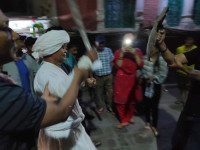
‘Guilt and Glory: Climbing with Sherpas’ is written by Jon Gangdal, who has been climbing and collaborating with Sherpas for more than 35 years. The book opens with a Sherpa wedding ceremony in Kathmandu. The bride, Pasang Diki, takes the author’s hand, thanks him for attending, and says, “My family is complete”.
In this moment of joy, he reflects on the past, remembering how her father, Mingma Norbu Sherpa, lost his life in an avalanche during the author’s first expedition to Mount Everest in the fall of 1994.
He feels responsible for this tragedy and blames his obsession with climbing Everest. A lingering sense of guilt has haunted him for a long time, and this marriage represents letting go of that guilt. It’s amazing to read how such guilt can translate into a story of glory and forgiveness.
In the book, the author discusses the history of the Sherpa, highlighting their migration from Kham in eastern Tibet nearly 500 years ago to the fertile valleys of northern Nepal. The term ‘Sherpa’ etymologically derives from ‘shar’, meaning ‘east’, and ‘pa’, meaning ‘people’. Thus, a Sherpa is not merely an Oriental term for a porter or a builder of stone steps; it refers to someone belonging to the ‘eastern people’ or ‘people from the east’.
The book becomes more intriguing when the author discusses Guru Rinpoche, the lotus-born master who introduced Vajrayana, or Tantric Buddhism, to Tibet and other regions of North Asia.
The narrative becomes cinematic when the author employs the storm metaphor to represent the yeti, a figure steeped in myth to this day. “Inside the storm, he believed there was a yeti hand that pushed him so hard in the chest that he lost his balance and fell.”
In another context, the author juxtaposes the Gorkha and Sherpa to highlight their courage and bravery, with the Gorkha known for their valour on the battlefield and the Sherpa recognised for their mountaineering skills. While Sherpa refers to the population, Gorkha (soldiers) refers to a profession that encompasses individuals from various ethnic backgrounds.
Similarly, the book discusses how the colonial and asymmetrical dynamics of the past between master and servant have become more balanced. To support this argument, the author provides context for the evolving dynamics between Sherpas and foreign climbers in the chapter ‘When the Sherpas Couped K2’.
The chapter reads that during the 2019/2020 winter, the expedition was called off after reaching above Camp 2 at 6,800 metres, partly due to Mingma G’s health issues. Snorri, one of the climbers, noted on Instagram that summiting K2 in winter is a formidable challenge that requires teamwork. However, Mingma G and three other Sherpas from Nepal, along with one Chinese climber, indicated they were not fully prepared to attempt the climb for personal reasons.
Reflecting on the situation, Mingma G noted that when expeditions succeed, people are quick to claim credit, but when they fail, blame is often shifted onto others. This incident highlights a larger truth: almost every major expedition depends heavily on Sherpa expertise and labour.
The book also explores the complex relationship between Tenzing Norgay and Edmund Hillary, as well as Hillary’s contributions to the Sherpa community. Tenzing was particularly hurt by Hillary’s portrayal in his book, ‘The Conquest of Everest’, of the final steep section just below the summit, later known as the Hillary Step.
Hillary’s account made it seem as if Tenzing had done most of the climbing and had practically pulled Hillary to the top. Hillary wrote that he “finally collapsed exhausted at the top, like a giant fish which had just been hauled from the sea after a terrible struggle.” Tenzing did not like this imagery. He said, “Since then, I have heard plenty about the ‘fish’, and I admit I do not like it.”
Over the years, Sherpas have gained greater recognition for their contributions to climbing expeditions compared to earlier periods when they were often denied the opportunity to summit, preserving the illusion that the sahibshad reached the top solely through their efforts. For the author, this chapter signifies a pivotal turning point for the Sherpas. They now lead the expeditions, having acquired additional education and experience.
During a conversation at Vajra Books, the author explained the chapter ‘With Maslow to Manaslu’. In it, Maslow’s theory is used as a metaphor: reaching the summit represents self-actualisation, the highest level in Maslow’s hierarchy of needs. The chapter also notes that Sherpas manage around 80 percent of the expedition business, placing them at the very top of this metaphorical pyramid, highlighting their essential role in mountaineering success.
The book also highlights the people-to-people relations between Norway and Nepal. It notes that the author is Norwegian and often visits Nepal. Additionally, Sherpas from Nepal travel to Norway to work as seasonal workers during the summer. Furthermore, the Norwegian government has been contributing to Nepal’s development process. “USD 135,000 through the Development Fund to carry out a feasibility study for the development of the Gauri Shankar Conservation Area, which is a holistic project where tourism is also a significant component.”
First published in Norway in 2023 in the Norwegian language and later released in 2025 in English by Vajra Publications in Nepal, it explores the everyday reality of the Sherpas as a whole. Through rich historical material and the author’s own experiences with life and death at altitude, he elevates the Sherpas from the shadows of Himalayan climbing.
Illustrated with pictures, maps, and references, it is rich in content—abundant like a mountain—while the language flows smoothly like a river across its six hundred pages.
BK is a PhD scholar at the School of International Studies, Sichuan University, China.




 24.74°C Kathmandu