Repeated fines forced ride-hailing driver to set himself ablaze, family alleges
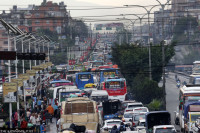
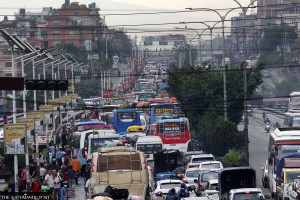
Ganesh Nepali sustained serious injuries after setting himself ablaze outside the Department of Passports in Kathmandu. People stage a protest at Maitighar, Kathmandu, demanding justice for Ganesh Nepali. Dipesh Darshandhari/TKP
Ganesh Nepali, who set himself on fire outside the Department of Passports in Tripureshwar, Kathmandu, on Thursday, appears to have been distressed by repeated encounters with Kathmandu Metropolitan City police, according to his family and messages he sent a week before the incident.
On June 27, Ganesh had sent a message to his nephew Mann Nepali. It read: “The city police put a lock on my motorcycle when I went to collect goods yesterday. Now, I have to pay Rs1,000.” The message ended with two crying emojis.
Mann said Ganesh had often complained about troubles caused by the metropolitan police while working as a ride-hailing driver. At times, he said, Ganesh had to pay fines twice on the same day.
Ganesh’s elder brother, Madan Nepali, was in his rented room at Balaju Heights when he received a call from an unknown number. A Nepal Police official was on the line with news that left him stunned.
Madan rushed to Bir Hospital, where he found that his 26-year-old brother had already been taken to the emergency ward.
“I was left stunned. I only realised what had happened after I reached here,” Madan said, breaking down outside the hospital.
Ganesh worked as a ride-hailing driver. Although he lived in Bhaktapur with his wife and their nearly three-year-old daughter, he had gone to stay at his elder brother’s rented room on Wednesday.
“He had left for work at 5am. Then, all of a sudden, we received this news,” Madan said.
Originally from ward 1 of Soru Rural Municipality in Mugu district, Ganesh had been living in Kathmandu for several years. According to his brother, he was preparing to seek foreign employment in Dubai while also studying for government service examinations.
“And now he has ended up in this situation,” Madan said.
When Madan reached Bir Hospital, he said he could not bear seeing his brother’s condition. He was able to exchange only a few words with Ganesh in the emergency ward.
“He told me to look after our parents and blamed the metropolitan authorities for what happened. After that, he could not speak anymore,” Madan said.
According to Superintendent of Police Dilip Ghimire, chief of the Kathmandu District Police Range, Ganesh had parked his motorcycle outside the Department of Passports, where Kathmandu Metropolitan City police had placed a wheel lock on it.
Ghimire said Ganesh siphoned fuel from his motorcycle and set himself on fire after metropolitan police placed a wheel clamp on the vehicle.
“The police immediately rescued him and took him to Bir Hospital,” Ghimire told Kantipur.
Bishnu Prasad Joshi, chief of Kathmandu Metropolitan City police, said he had gathered details from officers deployed at the site.
“We put wheel locks on vehicles when they obstruct public movement or block footpaths,” Joshi said. “A metropolitan police team had also placed a wheel lock on his motorcycle. The incident occurred when a vehicle arrived to remove the motorcycle after he refused to pay the fine.”
According to Joshi, Ganesh refused to pay the fine even two hours after the wheel lock had been placed on his motorcycle.
“He said he would not pay the fine and told them to take the motorcycle wherever they wished,” Joshi said.
Following instructions from officers at the scene, a joint team of metropolitan police and traffic police arrived in a vehicle to remove the motorcycle.
“Our officers were in front of the vehicle and were engaged in other work when we heard that Ganesh had taken petrol from his motorcycle, poured it over himself and set himself on fire,” Joshi said. “They noticed the incident only after some time.”
Joshi said owners of two-wheelers whose vehicles are wheel-locked are required to pay a Rs1,000 penalty.
Asked whether the dispute with city police was a factor in the incident, Joshi said the authorities had only acted according to the law.
“We don’t engage in disputes; we only follow the legal process,” he said. “A Rs1,000 fine alone cannot be considered the sole reason for such an incident. There may have been other factors involved.”
Superintendent of Police Naresh Raj Adhikari, spokesperson for the Kathmandu Valley Traffic Police Office, said his office had no information about the incident and that vehicle removal in such cases was handled by the metropolitan police.
He added that traffic police impose a lower penalty for wheel-lock cases, charging Rs500 for a two-wheeler offence.
After learning about the incident, Ganesh’s wife, Ek Maya, rushed to the hospital carrying their young daughter. However, amid the crowd at the hospital, she was not allowed to enter the emergency ward to see her husband.
“I don’t know how this happened. I am not in a position to say anything,” she said, struggling to hold herself together.
Ek Maya said she did not have exact details about the motorcycle’s purchase price or how many installments Ganesh had paid.
“I think he bought it for around Rs300,000. He used to say that he had paid about half of the installments,” she said.
Ganesh’s brother-in-law, Padam Nepali, blamed what he described as excessive fines imposed on economically vulnerable people for the tragedy.
He said the family also struggled to arrange money for immediate medical treatment after Ganesh was brought to the hospital.
“I used my citizenship card to obtain medicines on credit. I don’t know how we will pay for the rest of the treatment,” he said.
Dhan Karna Malla, ward 1 chair of Soru Rural Municipality where Ganesh’s family lives, said the family was economically vulnerable and that Ganesh had moved to Kathmandu several months ago in search of work.
“There are no opportunities to earn a living in the village. Farming does not produce enough food to sustain a family for an entire year,” Malla said. “This incident has happened to a family already struggling with hardship.”
According to Dr Peeyush Dahal, head of the burns unit at Bir Hospital, Ganesh was initially treated in the emergency ward.
“He was able to speak a few words intermittently at that stage,” Dahal said.
A doctor involved in his treatment said Ganesh had suffered burns to around 70 percent of his body and that his condition remained critical.
Arjun Poudel is a health reporter for The Kathmandu Post. Before joining the Post, he worked for Sagarmatha Television, Naya Patrika, Republica and The Himalayan Times.




 14.72°C Kathmandu