Kathmandu Valley steps up CCTV-based traffic enforcement
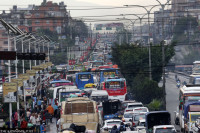
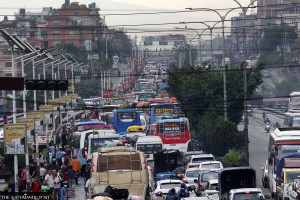
Traffic police use real-time camera feeds to detect violations and are preparing to introduce a fully digital system that will issue fines remotely. AI-generated image
Running a red light because there is no traffic police officer in sight? Riding a motorcycle onto the pavement or crossing lanes to bypass a traffic jam? Overspeeding on city roads late at night, assuming no one is watching?
If so, the chances of escaping punishment are rapidly diminishing.
Traffic police in the Kathmandu Valley are now monitoring roads around the clock through a network of CCTV cameras linked directly to the central control room. The system allows officers to detect traffic violations in real time and initiate enforcement action without being physically present at the scene.
The technology-driven surveillance system marks a shift towards a more automated model of traffic management. Officials say it will eventually allow fines to be issued directly to vehicle owners through a fully digital, “faceless” enforcement system.
“Many motorists assume they can break the rules when they don't see a traffic officer,” said Senior Superintendent of Police Suresh Kafle, chief of the Kathmandu Valley Traffic Police Office. “But even if our officers are not standing on the road, we are still watching.”
Hundreds of cameras monitor traffic violations
Kathmandu Valley has around 950 CCTV cameras installed in public places. Of these, 297 are directly connected to the Traffic Police Control Room, where officers monitor vehicle movements and road conditions 24 hours a day.
The live feeds enable officers to detect traffic offences as they occur, including motorists running red lights, overspeeding, riding on pavements, making illegal turns and committing other violations of Nepal's traffic regulations.
Once an offence is detected, officers at the control room coordinate with personnel in the field to take enforcement action. According to traffic police, between 4,000 and 5,000 vehicles are penalised every month based solely on CCTV evidence.
Authorities say the system is transforming traffic rule enforcement by reducing reliance on officers stationed at intersections while making policing more consistent.
AI-assisted surveillance strengthens enforcement
Kafle said traffic management in the Valley is increasingly being supported by smart traffic lights and artificial intelligence-assisted camera systems.
“Traffic management inside the Valley is gradually being handled through smart traffic light systems and AI-generated camera technology,” he said. “Whenever any road user violates traffic rules, action is taken accordingly.”
He said traffic police are moving towards a system under which notices of traffic violations can eventually be delivered directly to offenders' homes or mobile phones.
“It is becoming increasingly difficult to evade technology-based monitoring,” Kafle said. “Technology does not discriminate. It records every violation equally.”
Among the 297 cameras connected to the control room, six are specialised Automatic Number Plate Recognition (ANPR) cameras capable of identifying vehicle registration numbers and measuring vehicle speeds.
Traffic police say the cameras have become an important tool in reducing crashes caused by overspeeding by allowing officers to detect violations without having to physically stop vehicles.
Deputy Superintendent of Police Amarendra Singh of the Kathmandu Valley Traffic Police Office said officers continuously monitor live footage before coordinating with personnel deployed on the ground.
“We monitor the live feeds in real time and direct our field officers accordingly,” Singh told Kantipur. “Continuous monitoring allows us to intervene quickly and helps reduce the risk of potential road accidents.”
Towards a fully digital traffic management system
As technology assumes a greater role, the number of traffic police officers deployed at road intersections has gradually declined.
Traffic police say they are preparing to implement a fully technology-based, “faceless” traffic management system under which most enforcement activities will be carried out remotely rather than through direct interaction between motorists and officers.
The control room also operates pan-tilt-zoom cameras capable of rotating 360 degrees and zooming in on specific vehicles or locations. Officials say these cameras allow operators to respond quickly to changing traffic conditions and congestion across the city.
Traffic police are also working to automate the entire enforcement process by integrating their surveillance database with that of the Department of Transport Management.
Once the integration is completed, motorists who violate traffic rules will automatically receive notifications of fines and enforcement actions on their registered mobile phones, eliminating much of the existing manual process.
Authorities are simultaneously expanding the Traffic Police Control Room into a modern traffic management centre equipped with integrated software and digital monitoring systems.
Officials say the long-term objective is to bring Kathmandu Valley's traffic management under a fully digital command-and-control system capable of monitoring traffic, detecting violations, managing congestion and enforcing regulations with minimal human intervention.
They believe the system will improve compliance with traffic rules, ensure more consistent enforcement and make traffic management more efficient across the Kathmandu Valley.




 24.73°C Kathmandu