Newcomers to the city say finding a room has become costly and stressful, with unregulated brokers charging fees while offering no guarantees. Post file photo
Last December, after leaving their jobs in Morang, Jeebika Sapkota and her sister arrived in Kathmandu hoping for a fresh start. But their room search became more exhausting than the Capital’s pollution: a group of middlemen, empty promises, and fees paid for nothing.
At Jadibuti in Koteshwar, street brokers approached them within minutes.
‘‘They would ask, ‘Are you here to find a room?’ Pay Rs500, and we’ll help’,” Sapkota recalled. Suspicious of the offers, they instead visited a rental office, filled out a form, paid the fee and were told they would be informed when rooms became available.
The calls never came.
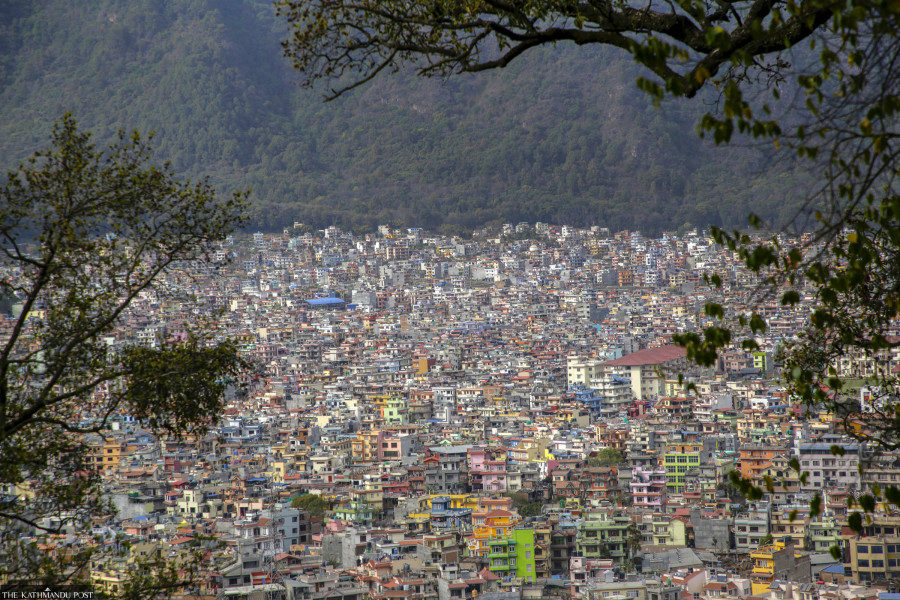
Their experience reflects a larger, structural problem: Kathmandu’s rapid population growth is straining a rental market that operates with little regulation.
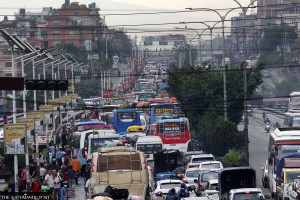
The Capital city’s population has expanded from just 104,000 in 1950 to an estimated 1.72 million in 2026, growing at around 3 percent annually. Much of this growth is driven by internal migration. The 2021 national census recorded more than 2.1 million inter-provincial migrants nationwide, with Kathmandu Valley among their main destinations.
People continue to arrive for many reasons. Students come for education and for preparations to go abroad. Medical education aspirants relocate to prepare for entrance exams. Patients travel seeking specialised healthcare. Job seekers move in search of opportunities unavailable in smaller towns.
Despite federalism’s promise to decentralise development services, higher education, advanced healthcare and formal employment remain heavily centred in Kathmandu.
The city may be infamous for traffic jams, pollution and rising living costs, but for many, it remains a viable option.
As demand for housing rises and supply remains limited, renters increasingly rely on brokers operating in a grey regulatory space.
For Sapkota and her sister, the gaps in the system (rental regulation) became glaringly obvious.
After paying Rs500 (service fee), they waited for updates that never came.
‘‘Later, we were told to call them ourselves to know the status,’’ Sapkota said. ‘‘If a customer pays for the service, isn’t it their duty to call us?
When brokers did take them to view rooms, details were often not given until the last moment. The rents they were shown ranged from Rs13,000 to Rs15,000 for a single room.
‘‘My friends had rented two rooms elsewhere for the same amount,’’ she said. ‘‘It was clear the broker was trying to overcharge us.’’
Despite paying the service fee, the sisters wandered for days. Eventually, on December 22, they posted a TikTok video sharing their experience.
The video quickly gained attention.
‘‘Most of the comments were from victims like us,’’ Sapkota said.
Some landlords reached out, offering rooms. The sisters visited several properties, but none met their expectations in terms of amenities.
Meanwhile, communication with the rental office deteriorated further.
‘‘They kept our calls on restriction for almost two months,’’ she claimed. With no solution, the sisters stayed with relatives.
Others describe similar experiences.
Chandan (pseudonym), who moved to Kathmandu from Janakpur for undergraduate studies, found a rental shop through TikTok and Facebook. The procedure was similar: pay a service fee, receive contact details, wait.
Unlike the Sapkota sisters, Chandan eventually secured a room. But it did not match the description. ‘‘It was not as described, but I went with what was available as I had already waited for weeks,’’ he said.
In total, he paid Rs3,000 to the broker in addition to the landlord payment.
Such accounts suggest that the issue is not simply about dishonesty but a system that lacks clear standards and accountability mechanisms.
Landlords say they, too, operate under constraints.
Shubham Parajuli, a house owner at Pepsicola, a locality named after the Pepsi bottling factory, said he has paid Rs2,000 per tenant to room finders for five years. ‘‘If I don’t, the room will remain vacant for a long time,’’ he said. ‘‘That would be a huge loss compared to the Rs2,000 I have to fork out.’’
Parajuli added that he was unaware that he might not be legally obliged to pay brokers. ‘‘There are a few of my friends who don’t pay room finders at all, but they live in other areas. Here at Pepsicola, I do have to pay them,’’ he said.
For both the landlord and the room seekers, it is clear that they are at a disadvantage, but they have no other option.
Rental brokers, however, reject allegations that they exploit clients.
Ganesh Shah of the ‘Mama and Bhanja Room Service’ said that running a rental office requires registration with the local ward office and a Permanent Account Number. ‘‘Not everyone can start one easily,’’ he said.
Responding to landlords’ claims that brokers charge them, Shah denied it. ‘‘I don’t take money from landlords, and no one inside the Kathmandu Valley can do so,’’ he said. He added that although ward offices do not specify the exact service charges, brokers across the Valley should maintain uniform rates. ‘‘Whatever is written in the form is the same everywhere, and if not, it should be,’’ he said.
According to Shah, the Rs500 fee covers a one-month service charge and safeguards against later refusal to pay. ‘‘If we don’t make them fill out a form first, they may refuse to pay later,’’ he explained.
The Rs500 in fee allows tenants to view multiple rooms for up to a month. If they decide to rent a room after inspection, they pay an additional service fee: Rs2,000 for one room, Rs3,000 for two rooms, and Rs4,000 for a flat.
“You have to pay the service fee after you select a room,” Shah said. He added that his shop provides receipts with registration numbers and even displays a contact number for complaints. ‘‘We cannot offer any warranties or guarantees,’’ he said. He advised renters to be cautious of brokers who operate without a registered office or proper receipts.
Despite brokers’ explanations, tenants and landlords feel the system does not fully protect their interests, a gap that legal experts attribute to a lack of regulation.
Jaya Prasad Poudel, a consumer rights expert and lawyer at the Consumer Welfare Federation, said the situation reflects a significant gap in Nepal’s consumer protection framework.
Under the Consumer Protection Act, 2018, anyone who pays for a product or service is legally defined as a consumer. Since room-finding is a paid service, tenants fall within this definition. However, current laws do not recognise ‘‘rental brokerage’’ as a distinct legal category, leaving brokers without clear guidelines on fees.
‘‘As there is no government-mandated standard based on location, area or room size, brokers often charge arbitrary and inconsistent amounts,’’ he said. In prime areas such as Kalimati, there are more extreme cases of exploitation, with individuals paying high fees for small spaces and then sub-leasing them at higher rates.
“Laws must be enacted to address these practices,’’ Poudel said, describing the issue as a ‘‘burning problem’’ that lacks detailed legislative attention.
By law, every service provider must be registered; operating without registration is unlawful. Yet many rental shops operate without proper registration, leaving them open to legal action.
As Kathmandu continues to attract students and job seekers from across the country, tenants like Jeebika Sapkota remain vulnerable in a system that lacks clear rules and oversight. With landlords and tenants seldom dealing face-to-face, brokers control the negotiation and take advantage from both sides.
‘‘Until the government defines and regulates rental brokerage, the burden will always fall on the consumers: students, newcomers, and everyday renters, while exploitation quietly carries on,’’ said Poudel, the consumer rights expert. ‘‘It’s high time this invisible market was brought into the light.’’
Aarya Chand is a reporter at The Kathmandu Post covering social issues. Before moving to the social beat, Chand was an intern covering culture and lifestyle for the Post.




 22.94°C Kathmandu