Women serve as election police, men handle home duties
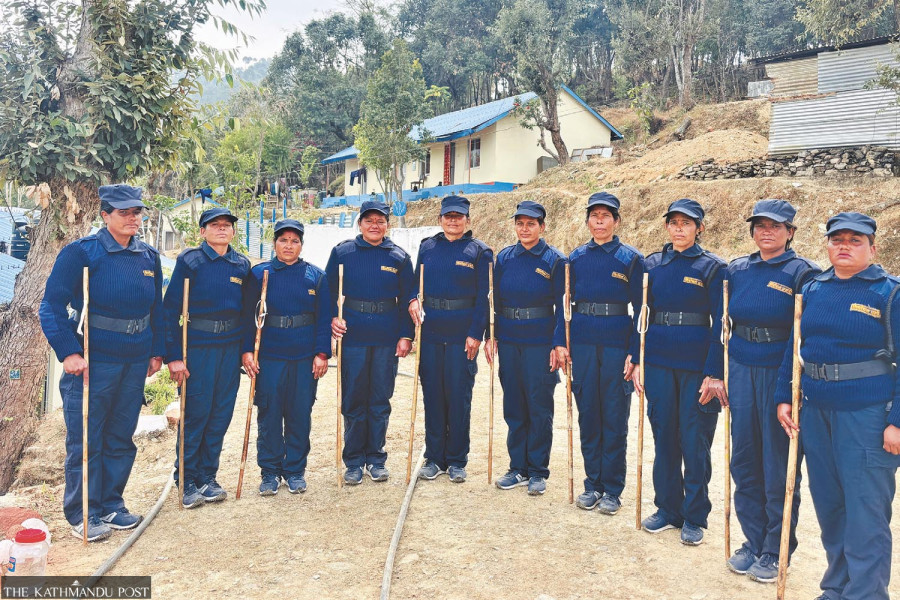
In Achham, temporary election work has given women both a source of income and a boost in confidence. Traditional gender roles are slowly changing. A group of female recruits of election police pictured in Mangalsen, Achham, this week. Menuka Dhungana/TKP
When Rajya Bhul, 52, from ward 4 of Mangalasen Municipality, leaves home at eight each morning dressed in police uniform, it marks a quiet but profound shift in her life. For the next six weeks, she and her daughter are serving as election police personnel while her husband Padam Bhul takes care of cooking, cleaning and other household chores.
“I had never worn anything other than a traditional gunyu cholo, not even a kurta-suruwal,” said Rajya, smiling shyly. “Wearing a police-style uniform now feels awkward, even embarrassing. But at the same time, it gives me courage.”
Rajya, who is barely literate, had applied to join the temporary police force during the 2022 elections but failed the written test. This year, she succeeded alongside her daughter, Soban. Together, they attend daily drills and security briefings as part of the election security arrangements overseen by the Nepal Police.
For Rajya, joining the election police was less an ambition than an economic hardship. She and her husband, a daily wage labourer, have eight children—six daughters and two sons. Two daughters are already married, while the rest still depend on them. Years of financial hardship, coupled with the social stigma of having six daughters in a row, left her isolated.
“In the hope of having a son, we kept having children and ended up with six daughters. With each one, the taunts grew louder. Relatives and neighbours would speak badly of us. There were times we felt we could not even stay in our own house, so we built a small temporary hut and lived apart,” said Rajya. Only after the birth of two sons, she said, did social attitudes soften. “That’s when I truly felt my husband’s love and support. Now I feel stronger.”
Padam admits his own thinking has evolved. “Earlier, I believed such work (election police) was not for women. I would get angry when she talked about joining. This time, I encouraged her. Seeing my wife and daughter in uniform fills me with pride,” said Padam.
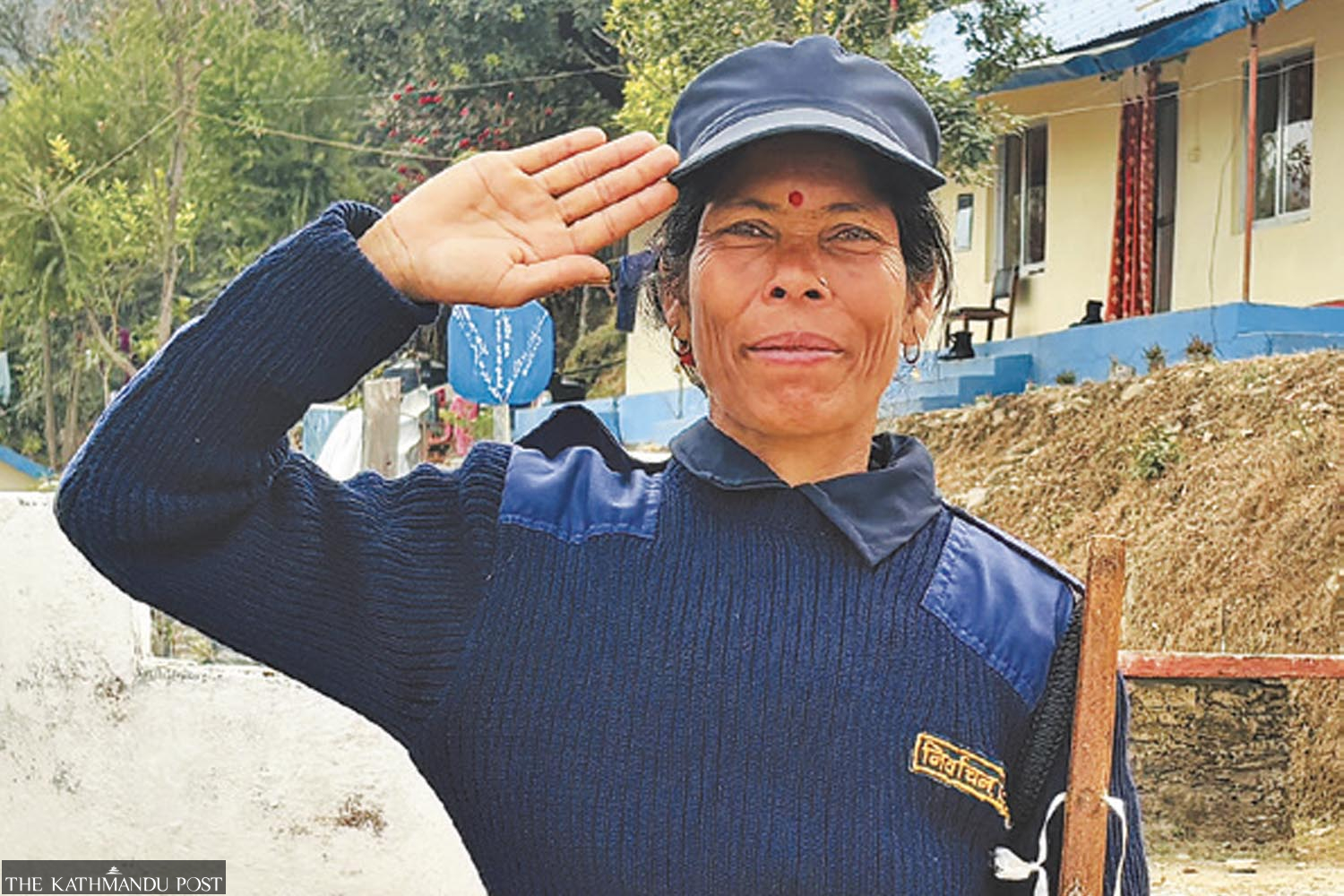
Rajya Bhul, 52, strikes a salute for the camera. Menuka Dhungana/TKP
With both wife and daughter away from 8am to 6pm each day, Padam has assumed nearly all domestic duties. “I cook before they return. In the morning, I prepare breakfast myself. Now I realise how difficult it is to run a household. They come home exhausted. I try to help as much as I can,” he said.
Scores of women have enrolled as election police in Achham district, reflecting both economic need and a gradual shift in gender roles. Temporary police recruitment during election provides short-term employment and modest income to rural families, especially in hill districts where job opportunities are scarce and male outmigration is quite high.
Bindra Bhatta, 42, of ward 5 in Mangalasen, is on her second stint as election police. Her routine, however, has been quite difficult. “I wake at 3am. I clean the cowshed, cook and finish housework before leaving for duty at eight. After returning home at six in the evening, I work until eleven at night,” said Bindra.
Bindra cares for three buffaloes, two cows and three oxen, in addition to her five children. Her husband is ill, leaving her as the primary breadwinner. “I barely slept for three hours. But the money will help us manage household expenses, even if only for a few days,” she said.
Temporary election police are typically deployed for around 40 days, covering pre-election security, polling day and post-election duties. Though the remuneration is modest, for families like Bindra’s it offers huge relief.
Sita Dhungana, 40, also from Mangalsen-5, describes her enlistment as a transformative experience. “It may be only for 40 days, but I am proud to serve in a government role. There is income and I am learning new things,” said Sita.
Like Rajya, Sita had never worn trousers or a T-shirt before. “On the first day, I felt too embarrassed to wear the uniform from home. I changed on the way,” she said, laughing. “Now the shyness is gone.” She said the experience has changed her outlook. “Earlier, even visiting my parents for a day made me anxious about housework. Everything depended on me. Now I see that others at home can manage too,” she said. “Stepping outside teaches you many things. I understand why daughters need jobs.”
In Achham, where traditional gender norms remain strong, women’s participation in security roles—however temporary—signals subtle social change. For Rajya, the uniform represents more than a job. “When people call me ‘police’, I feel respected. It is something I never imagined,” she said.




 13.8°C Kathmandu