Daily bread beats ballot for Nepali youths on seasonal migration
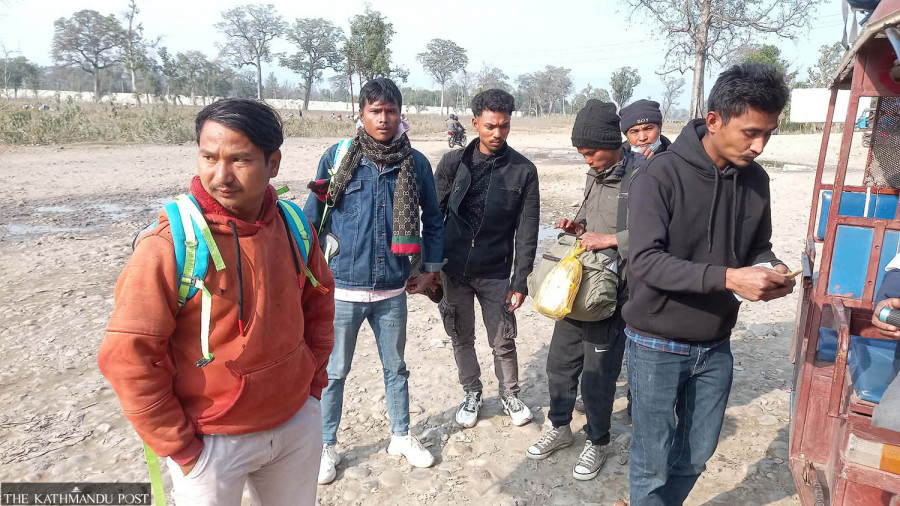
Most say they would vote if they could, but missing work in India could cost them a year’s income. Youths from Bardiya crossing the Gaddachauki checkpoint in Kanchanpur district on their way to India, last week. CHITRANGA THAPA/TKP
As campaigning intensifies in villages and towns across the country ahead of the House of Representatives elections scheduled for March 5, political parties and candidates are busy canvassing votes.
Yet at the border crossings in Sudurpaschim province, a different scene unfolds. Instead of election enthusiasm, men and women are hurrying across the Nepal-India border in search of work, unsure if they will return on election day to cast their ballots.
At Gaddachauki border point in Kanchanpur district, groups of young men carrying small bags waited to cross, their concerns centred less on politics than on survival. For most of them the choice is not between candidates but between earning and staying unemployed at home.
“I wish I could vote before leaving. But everyone from the village is going now. If we don’t reach on time, we may lose the work,” said Sushil Chaudhary from ward 4 of Geruwa Rural Municipality in Bardiya who was travelling with five other youths to Mandi in India’s Himachal Pradesh state.
“Farming work remains unfinished at home. Mustard plants are yet to be harvested and corn are yet to be sowed. But missing the construction season in India means losing crucial income for the whole year,” Sushil said.
Sushil and his companions had returned home in the first week to celebrate Maghi (on January 15), the biggest festival of the Tharu community. But they were now heading back to India for daily wage labour on bridge construction sites. According to Subas Chaudhary, one of Sushil’s friends in the group, more than 150 Nepalis from Dhukaniya and Shantipur settlements of their ward alone are working in Mandi.
“We earn between IRs 500 and 700 a day,” he said.
He and his friends plan to return home only during the paddy transplanting season in June-July.
For many migrant workers, the timing of the election has deepened a familiar dilemma. “We want to stay and vote in our own village. But leaders have not created jobs here. If we could earn in Nepal, we wouldn’t have to go to India or countries in the Gulf,” lamented Sohanlal Chaudhary, also from ward 4 of Geruwa. He said that despite facing harsh working conditions and verbal abuse abroad, labour migration remained the only way to sustain household expenses.
For the past few months, the Armed Police Force (APF) has been maintaining records at border crossings in Kailali and Kanchanpur of those people travelling to India, particularly workers heading to distant destinations in search of employment. APF officials say the flow of labour migrants has increased in recent weeks despite the election fever gripping the country.
APF records at the Gaddachauki check post show that between 130 and 160 Nepalis have been crossing the border daily this week to travel to Indian cities such as Delhi, Punjab, Bengaluru, Mumbai, Himachal Pradesh and Uttarakhand, mostly for short-term labour work.
The number is even higher at Trinagar-Gauriphanta border in Kailali. According to officials stationed there, around 300 to 400 Nepalis cross daily in search of employment, while overall daily cross-border movement—including for shopping and medical visits—exceeds 2,000 people.
Deepa Bista, counselor at Shanti Rehabilitation Home located near the Gauriphanta crossing, said the profile of migrants has also changed in recent years. “Earlier it was mostly men travelling alone. Now women and relatives are going together. When asked, they say they have been called by family members or are going for work in big Indian cities,” she said.
Among those heading to Bengaluru on Thursday was Himal BK, a permanent resident of ward 8 in Gauriganga Municipality in Kailali, accompanied by a teenage relative. Like many others waiting at the border, he appeared more anxious about securing employment than about the election. “Work comes first,” he said briefly before boarding a vehicle.
The migration of workers from western Nepal to India is neither new nor temporary. Labour migration to India has a history stretching back more than two centuries, with an estimated one to three million Nepalis working across various Indian cities, mostly in informal sectors such as construction, agriculture, security and hospitality business. These workers often lack formal contracts or social protection, making them vulnerable to exploitation.
Research and field reports have also shown that migration from Sudurpaschim, Karnali and Lumbini provinces is largely driven by poverty and limited local opportunities. In many communities of Sudurpaschim, a majority of households have at least one member who has worked in India at some point, highlighting how migration has become embedded in local survival strategies rather than a pathway to economic mobility.




 15.26°C Kathmandu