Livestock farming in crisis as China tightens cross-border grazing
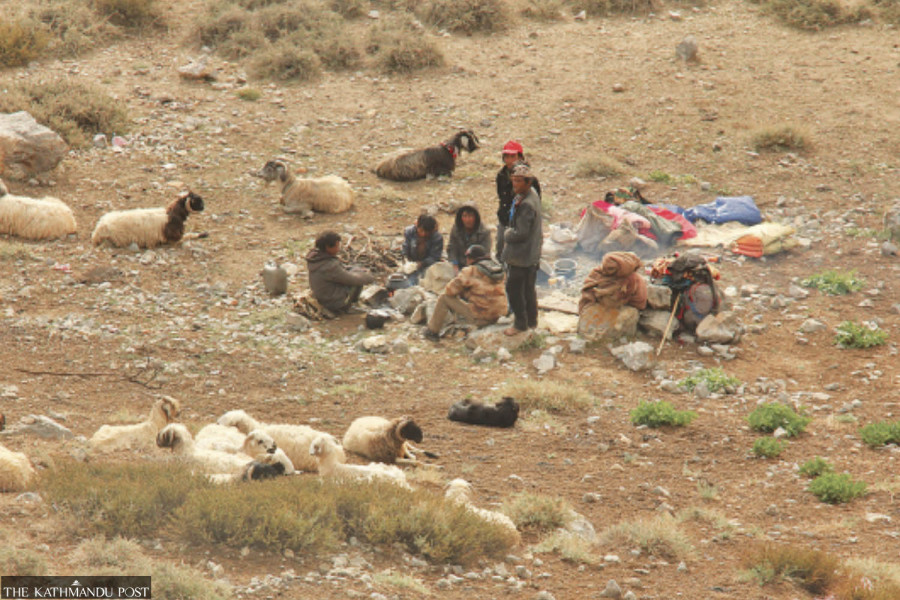
Nepali herders are facing harassment in Tibet despite a 2012 deal to allow grazing within 30 km on both sides. Herders from Bajhang at a stopover while taking their livestock to Tibetan pastures, in this undated photo. Basant Pratap Singh/TKP
On July 20 last year, Bir Bahadur Bohara of Kanda in ward 3 of Saipal Rural Municipality and Pasang Tamang of ward 4 had taken their horses and mules to graze at Bains across the border in Tibet. The Chinese security personnel misbehaved and beat them.
The incident occurred even though the Trans-Frontier Pasturing by the Border Inhabitants signed by Nepal and China in 2012 allows residents of border areas in both countries to graze livestock. Clause 2 of the agreement, signed on January 14, 2012, permits border residents to use pastureland within 30 kilometres of the international boundary.
Bains, where the two men were grazing animals, lies about 17 kilometres from Boundary Pillar No 2 at Urai Bhanjyang, well within the distance specified in the agreement. Nevertheless, Bohara and Tamang said they were abused by Chinese security personnel. According to the herders, the security forces set fire to the tents they had erected for shelter. Inside the tents were bedding, clothes, food supplies and cooking utensils. The officials also burned horse gear, including reins, saddle blankets and saddles.
“They smashed the utensils outside the tent. They also snatched my mobile phone and hit me twice on the head with it. A lump formed on my head, and the phone’s display was damaged,” said Pasang Tamang. After the assault, according to the victims, the security personnel escorted the two men, along with their horses and mules, to the Nepali side of the border at Urai. They warned them not to bring livestock to the area again and threatened that it would not be good if they entered Chinese territory again.
“They were extremely angry. They came and started beating us without saying anything and set our tents on fire. We asked what mistake we had made, but they did not understand our language and became even more aggressive,” said Bir Bahadur Bohara.
A day after the reported assault on two herders, Chinese security personnel allegedly mistreated another Nepali pastoralist from Jima in ward 2 of Saipal. A team of Chinese security personnel arrived at a grazing site where Sabbalya Raut, aged 68, was staying with more than 550 sheep. Raut had been camped around 11 kilometres from the border. He said the security personnel attempted to manhandle him, forcing him to flee after pleading for mercy.
“I folded my hands and begged them not to beat an old man. They had also brought two men from Humla who could understand the language. They explained something to the security personnel. I was not beaten, but they did not allow me to stay there,” said Raut. Following the incident, Raut moved his flock to a place called Tauwen in the neighbouring Humla district. He said this was not his first experience grazing sheep in Tibet. For the past 52 years, since the age of 16, he has taken his sheep across the border every monsoon season.
Until seven or eight years ago, Raut said he was able to graze his animals openly. After learning that Chinese authorities had tightened controls, he began taking his flock to remote forests with little human movement in recent years. “This has never happened before. Now we are afraid to even graze secretly,” said Raut.
These two incidents, according to local residents, are not isolated cases. Over the past few years, Chinese security personnel have increasingly restricted entry into Tibetan areas, citing forest degradation caused by grazing. As a result, herders from Bajhang who have traditionally taken livestock to Tibet for seasonal grazing say they face harassment and intimidation almost every year.
Each winter, from November to March, Bajhang’s herders move their flocks through lower hills of Bajhang, Baitadi and Doti. During summer, from April to September, they follow the same route back north, crossing Urai Pass at 5,220 metres into forests of Burang County in the Tibet Autonomous Region. Areas such as Taligumpha, Machhagad, Lokot, Khocher, Jhoigaun, Gugaun, Bains, Bhelk and Hangsi in Tibet have long been seasonal grazing grounds.
While horses, mules and yaks can survive on limited pasture, sheep and goats require vast areas. Large flocks, often ranging from 200 to 1,500 animals, exhaust a forest within days. “If the flock is big, a small forest is finished in one or two days. We must keep moving. Someone will see us somewhere. Hiding is impossible,” Raut explained.
The imbalance in monsoon rains between Nepal and Tibet makes cross-border grazing crucial. From June to September, rainfall is high on the Nepali side, causing outbreaks of disease among sheep and goats. “If we graze here (Nepal) during monsoon, half the flock dies of disease. In Tibet, there is less rain. The animals remain healthy, strong and fat even in winter,” said Arjun Singh of Pimi in ward 1 of Jayaprithvi Municipality. Not only from Bajhang but also the farmers from Humla, Jumla, Mugu, Kalikot, Bajura, Darchula among other districts take their animals to Tibet.
According to Singh, excessive rain causes fever, mouth sores, hoof rot, diarrhoea and wool loss among sheep and goats, leading to devastating losses. “If we don’t take them there, 40 to 50 animals die in a single monsoon. If we do, we live in fear of being chased away. Either we abandon sheep rearing altogether or cross into Tibet, trembling with fear, to protect our flock,” said Singh.
Before the Covid pandemic, the restrictions were far looser. Each summer, eight to ten thousand sheep and goats from Saipal alone would graze in Tibetan forests, tended by more than a hundred herders. “There were no restrictions. Wherever we went felt like our own village. I have mit (ritual friend) in every village there. Now it is not like that,” said Kalu Dhami of ward 1 of Saipal, who has been herding in Tibet since 1983.
Traditionally, herders carried rice, lentils, Sichuan pepper and bamboo products to Tibet and returned with clothes, shoes, salt and Tibetan liquor from the Taklakot market. “Now they don’t even let us enter villages. If I want to meet my mit (sworn friend)I have to call them to Taklakot,” said Dhami.
According to local farmers, Chinese authorities have installed CCTV cameras along border areas such as Thadadhunga, near Bajhang, to monitor cross-border movement. The clampdown has also severed deep-rooted ritual kinship ties, known as miteri, that link almost every household in Saipal with families in Tibetan villages. Similar ties exist among herders from Talkot, Masta, Khaptadchhanna, Chhabisa, Durgathali, Bungul and Jayaprithvi areas.
Until 15 or 20 years ago, these relationships sustained vibrant cross-border trade. In summer, Nepali herders carried local produce north. In winter, Tibetans travelled south with wool and salt, returning with rice, wheat, chilli and Sichuan pepper. That trade has now collapsed after China barred Tibetans from entering Nepal. “Even seven or eight years ago, my mit spent every winter at my home. Now they are not allowed to come,” recalled Dhami.
According to elderly residents of northern Bajhang, Tibetans also used to graze livestock in Saipal every year. “They brought mostly horses and yaks. They had fixed pasture sites. Those places still exist. But they stopped coming long ago,” said Kamman Bohara, age 70, of Dhalaun.
Historians say transhumant grazing, miteri relations and trade between Bajhang and Burang of Tibet date back nearly a thousand years. Archival records show that when the Bajhang principality existed, Tibetan traders paid taxes in wool, salt and gold. Historian Bishnu Bhakt Shastri, former professor of Jayaprithvi Campus, recalled witnessing a dispute over such taxes circa 1958 that even reached Doti court.
Seasonal markets once flourished at Chora, Kalanga and Graphu in Saipal, drawing crowds for months. “People going up or down would gather there,” recalled Aphilal Bista, aged 77, of Talkot Rural Municipality-6. Maoist conflict later disrupted these markets as Chinese traders feared insecurity.
The crisis is even more severe for herders from Bajura. Samnel Gurung, aged 69, of Himali Rural Municipality first walked to Taklakot at age ten, exchanging Sichuan pepper and chilli for salt. Over decades, he built close ties with Tibetans, even forming ritual kinship (mit) with Pema Tundup of Sitishyang village near Taklakot. In recent years, however, Tibet authorities barred residents of non-border districts from entering Taklakot.
Gurung used to graze his animals in Tibetan pastures. But three years ago, he and 11 other herders were assaulted near Lubu for entering without permits. “Earlier, we had our own camps and grazing grounds. Now we go like thieves. It hurts deeply that China has stopped us from lands our ancestors used,” said Gurung.
Experts say the displacement of Nepali herders reflects weak diplomacy. Former Nepali ambassador to China Rajeshwar Acharya said Nepal has failed to raise people-centric issues effectively. “China’s policies change with its national interests. But Nepal should have recalibrated its engagement to safeguard traditional practices. That did not happen,” he said.
Officials at the Ministry of Foreign Affairs often describe the matter as “bilateral” and refuse to comment over the issue. A senior official, preferring anonymity, admitted that despite the agreement remaining in force, Nepal has failed to secure concrete solutions. “These issues are known. Reports come in. But we have fallen short in making strong diplomatic interventions,” the official said.




 15.34°C Kathmandu