From battlefield to ballot: Former Maoist fighter vies for Kapilvastu-1 seat as independent
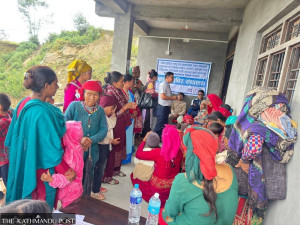
Ravina Khan, once a frontline combatant, now campaigns door-to-door on a shoestring budget, seeking to represent the poor and marginalised after being sidelined by her party. Manoj Paudel/TKP
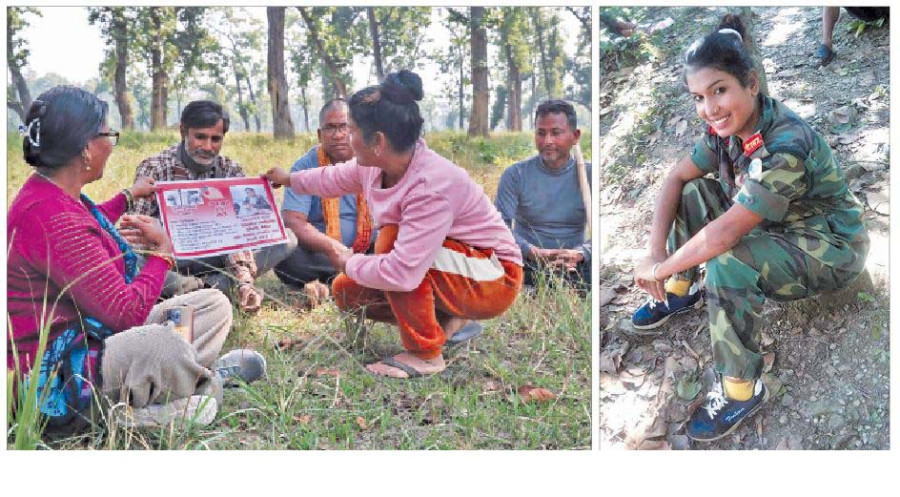
A black bag of pamphlets and a hand-held microphone in hand, 33-year-old Ravina Khan, a resident of a squatter settlement, goes door-to-door campaigning in villages and markets. While other candidates travel with teams and vehicles blaring music, the former Maoist fighter hitches rides from cyclists and motorcyclists to reach one village after another. Known for carrying guns and bombs during the insurgency, she now asks for votes with folded hands, symbolically setting aside the weapons she once bore.
Known during the armed conflict as a skilled fighter, Khan handled guns and explosives. Today, the hands that once bore weapons are extended for votes. She was the only Muslim woman in her unit and rose to the rank of platoon commander.
Khan joined the Maoist armed struggle in 2003 at the age of 10. She said her family’s growing ties to the insurgents drew her into the conflict, despite coming from a settled, ‘prosperous’ household. Today, she campaigns quietly, without music or convoys, aided only by two to four local supporters and former comrades who take turns riding her from village to village.
Since joining the Maoists, Khan lost contact with her family and has not been able to return home. Rejected by them, she now lives in a squatter settlement near Patna in Banganga Municipality. During the armed conflict, she spent her days in shelter houses, supporting locals through farming and wage labour.
Initially, the Nepali Communist Party included Khan on the proportional representation list as the first Muslim woman in her cluster. She received congratulatory messages and began dreaming of representing her community in Parliament. But when the list was revised, her name was removed and replaced by a businesswoman from Nepalgunj, leaving Khan disappointed. Denied both proportional and direct election tickets, she said, “Leaders ignored the struggle and sacrifice of party workers. After exchanging posts for money, principles and ideology no longer mattered.” She is now contesting the March 5 parliamentary election as an independent candidate.
Khan spent years in the Maoist Fourth Division in Jhyaltung Danda, Nawalpur. Friends funded her campaign materials—including posters, visiting cards, and sample ballots bearing her election symbol—allowing her to begin a grassroots campaign. She stays at the home of a local Tharu family, leaving in the morning and returning only in the evening. “Seeing former comrades while canvassing gives me energy,” she said.
Within a year of joining the party, Khan enlisted in the People’s Liberation Army. “I was on the frontline making weapons,” she said. She worked in an 11-member technical team producing explosives, grenades, and bullets, melting brass and iron to make ammunition. When manpower was low, she carried weapons herself to the battlefield, leading attacks in Beni, Sunwal, Taulihawa, Syangja, and Khara.
During the peace process, many of Khan’s former comrades were integrated into the army. She opted for voluntary retirement and moved to the party’s political wing, eventually becoming a central committee member. She expressed frustration that the opportunities she had earned were claimed by others. “This is my grievance. When the time comes, I will reveal everything,” she said.
Rejected by the patry she once fought for, Khan now wages a new form of rebellion. Where she once carried a pressure cooker bomb, she now carries a ballot, campaigning to promote development and upliftment in her community. “I have entered the election with literally zero funds,” she said. “I am running on the resources of the poor and marginalised, to show that elections can be fought without money.”
Khan said her campaign is gradually gaining momentum. Friends, relatives, and supporters she lost touch with during the conflict are joining her efforts, and the community that shelters her is rallying behind her. She has made no grand promises to voters but has prioritised six issues: fertiliser access, squatter rights, women and children’s welfare, free healthcare and education, youth sports facilities, and rights for backward and marginalised communities.
The conflict severed Khan’s ties with her family. As a Muslim woman, her community denied her education and marriage, and her personal life suffered. She received her citizenship only in 2012, after the district administration officer intervened.
Khan said the armed struggle consumed her adolescence and youth, but she remains committed to helping the poor and marginalised. Of 34 candidates in Kapilvastu-1, she is one of just two women. Her campaign blends her experience as a former fighter with grassroots activism, aiming to give a voice to the voiceless.




 14.82°C Kathmandu