Two generations in a makeshift home under a boulder
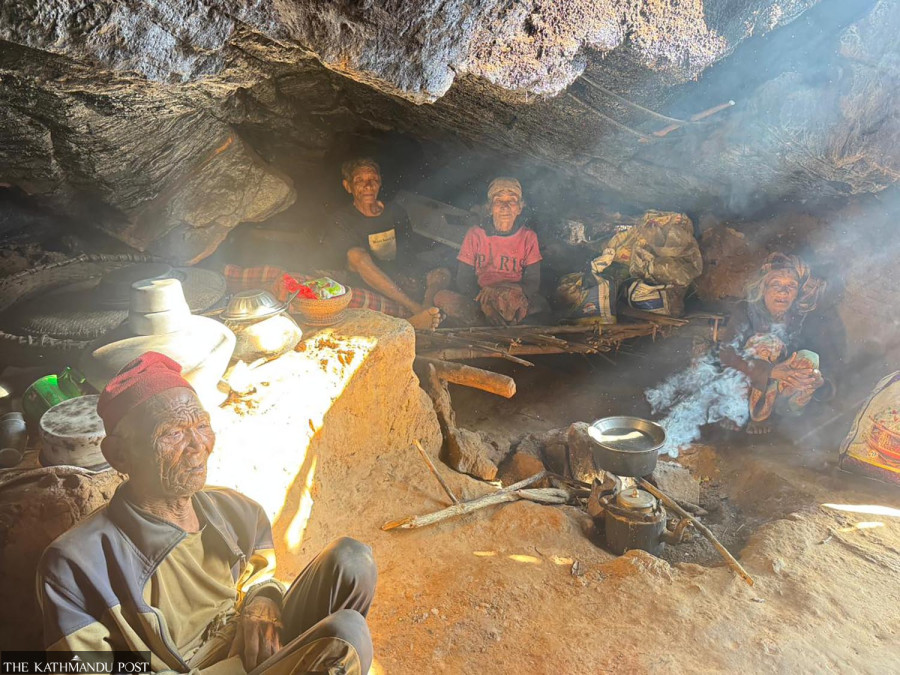
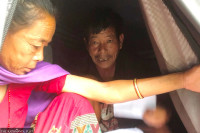
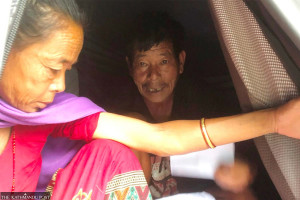
A Chepang family in Dhading has been living in a tiny, natural shelter, enduring elements, and foraging wild tubers. The family is seen cooking in their cave home on a hillside in Maiwang, Dhading, with Istaram Chepang on the left, recently. Poshnath Adhikari/TKP
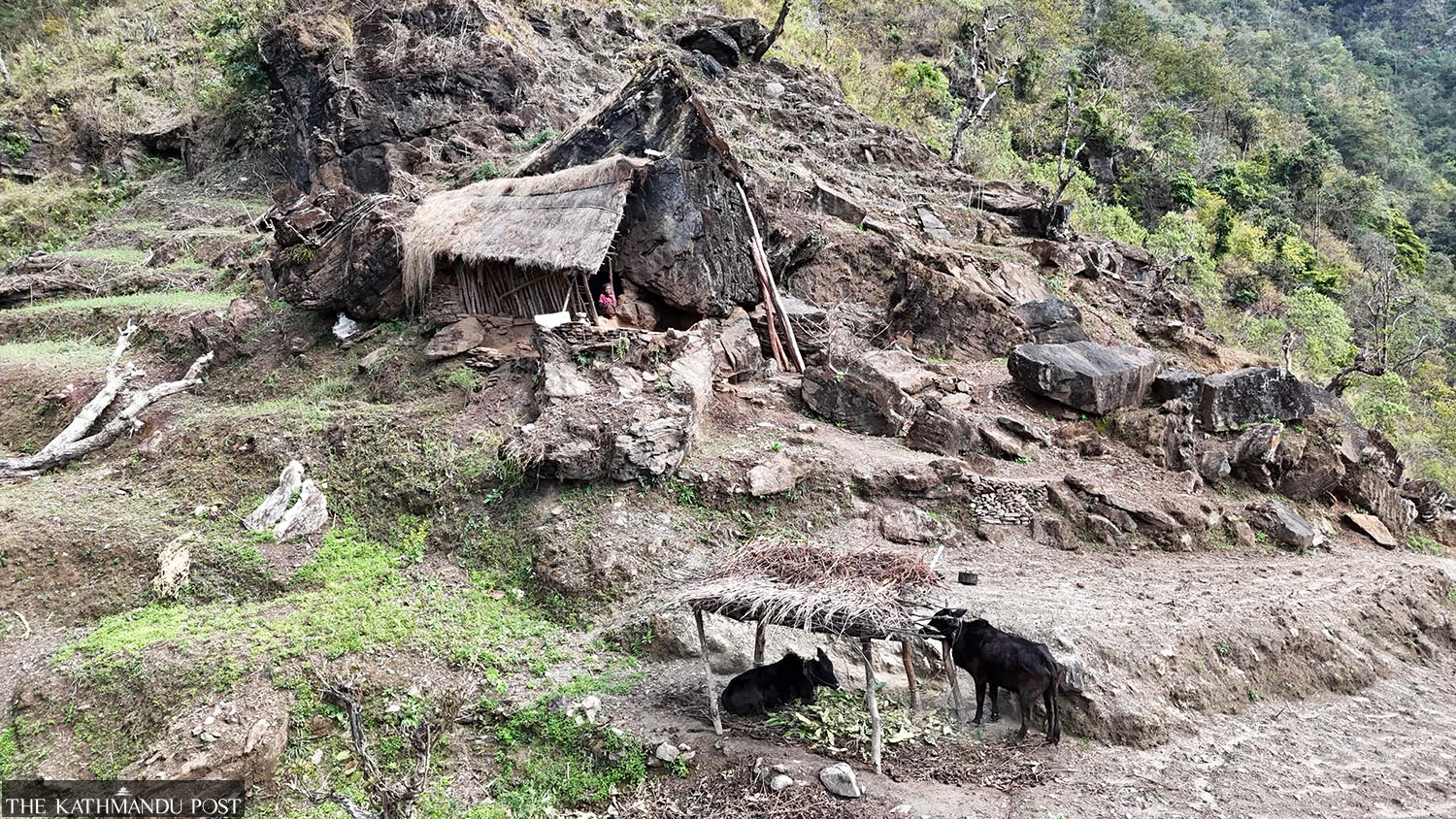
In the rugged terrain of Maiwang in ward 9 of Benighat Rorang Rural Municipality, Dhading, a Chepang family has spent two generations living beneath a massive boulder. Though the constitution guarantees the right to safe housing, Istaram Chepang, his wife Bikhimaya, their son Subba and daughter-in-law Bishnumaya survive in a cramped, cave-like shelter, tucked on a hill slope at the edge of the forest.
"My father brought me here to work for a local landlord when I was just a child," recalled Istaram, gesturing towards the cold stone ceiling. "Eventually, we moved into this cave for shelter. We stayed and now my son and his wife are growing old here too. This rock is the only home we have ever known,” he said.
The family’s daily existence is a gruelling battle against the elements. While they manage somehow during the dry winter, the monsoon turns their shelter into a damp trap. Water seeps through the porous rock, making it impossible to light a fire for days, leaving them cold and hungry. Their diet consists primarily of foraged wild tubers locally called gittha (wild yam) and bhyakur (air potato). "We grew up on wild roots. Having a meal of rice and vegetables is a rare, joyous celebration for us,” said Istaram.
Despite Article 37 of the Constitution of Nepal ensuring the right to appropriate housing, the reality for the Chepangs—one of the country’s most marginalised indigenous groups—remains grim. Various reports have frequently highlighted how the People’s Housing Programme fails to reach the most vulnerable due to landlessness and lack of documentation. Without land titles, the Chepang community remains perpetually displaced and largely ignored.
An overview of the cave dwelling and surroundings. Poshnath Adhikari/TKP
Istaram and Bikhimaya do not know their ages and lack citizenship certificates, which excludes them from vital social security benefits. However, their son Subba, born in 1962, and Bishnumaya, born in 1968, possess documentation. Subba even voted in the March 5 election, yet feels abandoned by the current democratic process.
"We went to cast our votes, but nobody looked back at our problems with food and shelter. The leaders come asking for our votes, then they disappear back into the cities,” Subba lamented. Bishnumaya remains hopeful but weary. "I still wish for a real house, but as I get older, I wonder who would ever build one for us?" she asked.
While three tiers of government exist, the family relies on sporadic charity. Tulsi Shrestha, a resident of Bauddha in Kathmandu, who frequently provides supplies, expressed his deep frustration. "It is a tragedy that in this era, citizens are still forced to live in caves. The state has completely ignored them,” said Shrestha.
The Chepang community mainly lives in the districts of Chitwan, Makawanpur, Dhading and Gorkha. The Chepangs have one of the highest illiteracy rates, lowest access to basic public services such as drinking water, electricity, education and health care. As the subsistence agriculture on which most of them depend does not produce sufficient food to last them for a year, most of them survive with additional income as daily wage earners.
According to the 2021 national census, Nepal is home to 84,364 Chepangs.




 15.33°C Kathmandu