From the Himalayas to the islands, Nepal calls for a united climate response
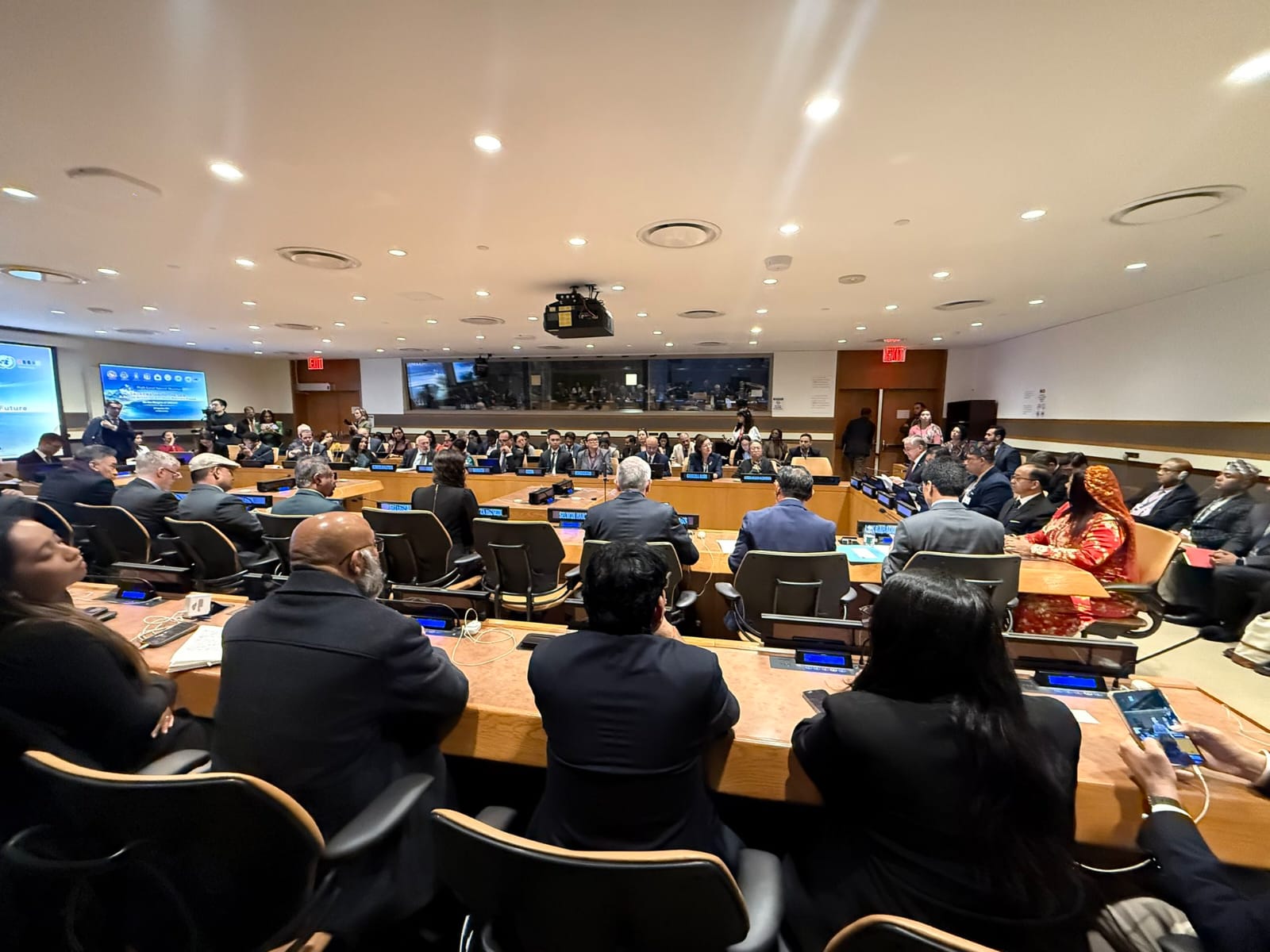
Nepal brings mountain and island nations together under its “Sagarmatha to the Sea” banner to push for climate finance, stronger early-warning systems and deeper cooperation. Nepal hosted a high-level special event, “Sagarmatha to the Sea: A Call to Action for a Climate-Resilient Future”, at the United Nations headquarters to highlight climate change and call for stronger global action. Courtesy of Rajan Kaphle
Nepal brought together an unusual coalition of mountain and island nations at the United Nations on Saturday, seeking to turn the country’s recent climate disaster into a broader push for international cooperation stretching from the Himalayas to some of the world’s lowest-lying countries.
Foreign Minister Shisir Khanal convened representatives from Bhutan, the Maldives, New Zealand, Samoa, Tajikistan and other countries alongside senior UN officials for a high-level meeting titled “Sagarmatha to the Sea: A Call to Action for a Climate-Resilient Future,” held on the sidelines of the UN General Assembly.
The Nepal-led gathering was built around a simple premise that borders may divide countries, but water does not.
“The climate system does not recognise the boundaries through which we organise our politics,” said Khanal.
At one end is Sagarmatha, or Mount Everest. At the other are island nations such as the Maldives and Samoa, where rising seas and coastal erosion are already threatening communities.
Through the event Nepal sought to bring the two into the same conversation, arguing that melting glaciers, changing river systems and rising seas are not separate crises, but different consequences of the same warming planet.
“The mountain and the sea may appear far apart on the map, but nature tells us otherwise,” Khanal said. “The water that leaves our glaciers continues its journey, so do the consequences of the choices we make today.”
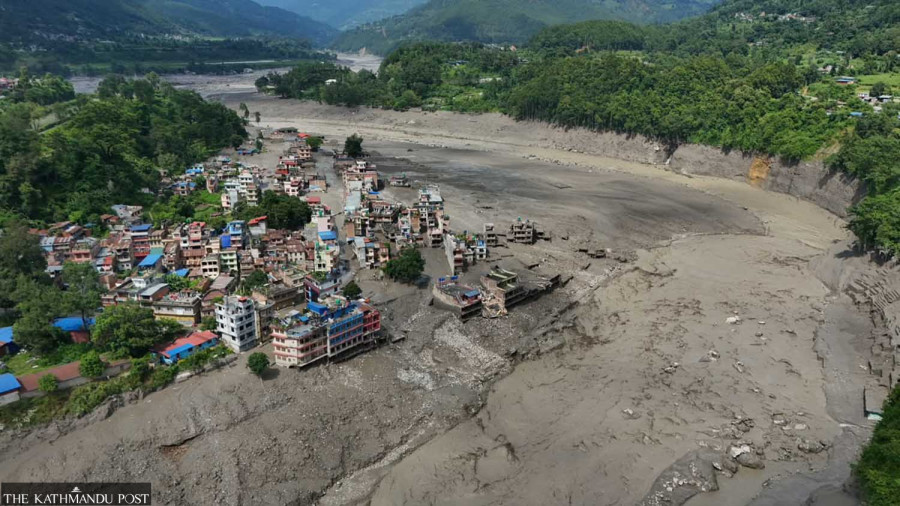
The meeting came exactly one month after a massive collapse of rock and glacier ice along the Nepal-China border on August 26 triggered devastating flooding, killing hundreds of people and destroying homes and critical infrastructure.
“The wounds are still fresh,” he added. “There could hardly be a more timely moment for this conversation.”
The disaster loomed over much of the discussion, with one speaker after another offering condolences to Nepal and China before returning to a common question: whether vulnerable countries have the resources to see the next disaster coming.
Ambassador Tenzin Rondel Wongchuk, a representative from Bhutan, pointed to two glacier disasters to illustrate the stakes.
In May 2025, a glacier and rock mass collapsed above the Swiss village of Blatten, largely destroying it. But scientists had been monitoring the mountain for years, and when sensors detected signs of an imminent collapse, authorities evacuated residents days in advance. Livestock were flown out by helicopter, including cows, nearly 200 sheep and even rabbits. Only one person was killed.
Then, this year, a similar disaster unfolded in the Himalayas just a month ago.
“Two glaciers failed. Two valleys flooded with rocks and ice,” Wongchuk said. “In one, cows, sheep and rabbits were saved. In the other, thousands of people were not.”
For Bhutan’s representative, the contrast came down to access to the tools that can turn an approaching disaster into an early warning.
“This is a story about asymmetry in the tools nations have to see danger coming,” he said. “The physics of a warming planet does not discriminate, but our capacity to predict, to warn and to respond remains sharply and unfairly divided along lines of wealth and geography.”
That disparity, and the effort to close it, emerged as a central theme of the meeting Nepal convened.
Khanal called for stronger early-warning systems, climate-resilient infrastructure, scientific cooperation and greater access to climate finance and technology for developing countries. He also urged greater international attention to mountain regions in global climate negotiations and called for the Fund for Responding to Loss and Damage to be adequately financed and accessible to vulnerable countries.
“Climate justice is tangible when responsibility, capacity and vulnerability are reflected in the support countries receive,” he said.
Nepal has lost close to a third of its ice in recent decades, according to Khanal. The wider Himalayan region contains more than 63,000 glaciers and represents the largest concentration of snow and ice outside the polar regions.
However, those glaciers are not only a Nepali concern. Mountains provide between 55 and 60 percent of the world’s annual freshwater flowers, the president of the UN General Assembly Khalilur Rahman told the gathering, while around two billion people depend on mountain water for their lives and livelihoods.
In 2024, glaciers worldwide lost approximately 450 billion tonnes of ice—enough to raise global sea levels by around 1.2 millimetres in a single year, he said. All monitored glaciers in High Mountain Asia lost mass in 2025.
“Climate change respects no borders, and its impacts do not remain confined to the places where they begin,” he said.
The connection allowed Nepal to find common ground with countries whose geography could hardly look more different.
“What happens in the mountains does not stay there; its consequences travel downstream, across borders, and ultimately to our coasts,” said Iruthisham Adam, Maldives foreign minister.
For the Maldives, that means rising seas, coastal erosion and increasing pressure on island communities. For Samoa, it means saltwater entering freshwater supplies, changing ocean conditions and growing threats to infrastructure and livelihoods.
Tajikistan brought another mountain perspective. Around 1,300 of the country’s glaciers have disappeared over the past 50 years, a representative of the country said. Globally, the world’s 19 assessed glacier regions lost more than 6,500 gigatonnes of ice between 2000 and 2023.
The gathering allowed Nepal to turn attention on the Himalayas into a call for cooperation among climate-vulnerable countries that face different threats but share demands for better forecasting, technology and access to climate finance.
New Zealand, itself both mountainous and surrounded by ocean, praised Nepal for bringing those constituencies together.
A riverside community buried in mud and debris after severe flooding along the Bhotekoshi river. Post photo
“Nepal has shown important leadership in bringing attention to the connections between climate impacts in mountain regions and those experienced far beyond them,” its representative Ministry of Foreign Affairs Deputy Secretary Gabrielle Rush said.
New Zealand also announced that it had contributed $3.5 million toward humanitarian organisations supporting Nepal’s response to the August disaster.
The Fund for Responding to Loss and Damage has separately received a request for support from Nepal, one of its representatives told the meeting. The fund remains in a pilot phase, but its board is considering Nepal’s request.
Norway has provided 10 million Norwegian kroner in humanitarian assistance following the floods, including support for shelter, clean water and health services.
China, which was also affected by the August cross-border disaster, said it had dispatched rescue experts and shared satellite imagery and hydrological data with Nepal.
“China and Nepal are a community linked by mountains and rivers,” its representative said.
But several speakers argued that international assistance after disasters was not enough, and that countries needed the tangible ability to act before catastrophe arrived.
A UNDP official pointed to advances in satellite imagery, artificial intelligence and climate modelling that can help identify danger earlier. “The real test is whether we can use this before disaster strikes, not after,” she said.
UN Environment Programme officials similarly argued that investment in monitoring, early-warning systems and resilient infrastructure could substantially reduce future losses.
The Hindu Kush Himalayan region feeds 10 major river systems that support the lives and livelihoods of as many as two billion people, a UNEP representative said. Changes to a glacier or watershed can therefore travel hundreds or thousands of kilometres downstream.
The UN Economic and Social Commission for Asia and the Pacific and Nepal will convene another regional meeting in Bangkok next month to advance cooperation on early-warning systems, data sharing and coordinated climate adaptation, officials announced Friday.
For Nepal, the New York gathering also marked an attempt to keep mountain countries more firmly on the international climate agenda. The country convened the first Sagarmatha Sambaad in 2025 around climate change, mountains and the future of humanity, and Khanal said Nepal plans to host a second edition next year. He presented “Sagarmatha to the Sea” as another platform through which Nepal hopes to build cooperation among governments, scientists, financial institutions and vulnerable communities.
Khanal also highlighted Nepal’s own climate efforts, noting that forests cover around 46 percent of the country and that hydropower and electric mobility are expanding.
But Nepal used the meeting to make a larger case that the forces reshaping the Himalayas do not stay there.
Mountain nations spoke of retreating glaciers, while island nations warned of shrinking coastlines. Others pointed to the rivers that connect the mountains to the sea.
Throughout the discussion, speakers returned to the August disaster in Nepal as an example of the future at stake.
“It is not a Nepali tragedy alone,” Bhutan’s representative said. “It is a Himalayan warning.”




 17.57°C Kathmandu