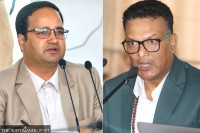
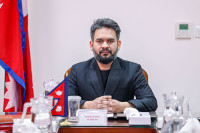
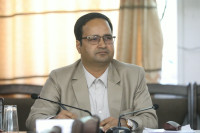
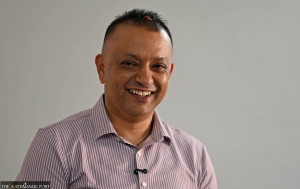
In New York, Foreign Minister Khanal introduces Nepal’s new political order
Shisir Khanal discusses the Gen Z movement, the rise of a new political class and the government’s economic and foreign policy priorities. Foreign Minister Shisir Khanal Handout photo
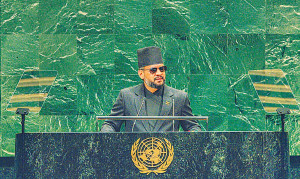
Less than a year after a Gen Z-led movement toppled Nepal’s government and six months after an election dramatically reordered the country’s politics, Foreign Minister Shisir Khanal took to a stage in New York on Thursday to explain Nepal’s new political order to an international audience.
Speaking at the Asia Society on the sidelines of the United Nations General Assembly, Khanal offered a wide-ranging account of the forces that brought Prime Minister Balendra “Balen” Shah and the Rastriya Swatantra Party (RSP) to power — from frustration over corruption and political instability to slow economic growth and the continued exodus of young Nepalis abroad.
For much of the hour-long Asia Society conversation, Kevin Rudd, the former Australian prime minister and the organisation’s president, played the role of an outsider trying to make sense of a political transformation that unfolded remarkably quickly.
“You’ve got three minutes to explain Nepali domestic politics to us,” Rudd said to Khanal. For “foreign barbarians like myself,” he joked, Nepal’s politics could be “more complex to understand than American politics.”
“Three minutes are probably not enough,” Khanal replied.
Khanal briefly walked the audience through Nepal’s political transitions before arriving at what he described as years of unstable governments, political patronage and “rampant corruption”. Those failures, he argued, produced a “deep distrust of political order”, particularly among young Nepalis.
But much of Khanal’s explanation focused on what was happening beyond politics. Nepal’s median age is around 26, he said, and young Nepalis have watched economies elsewhere in Asia expand while opportunities at home remained limited. At the same time, leaving the country has increasingly become part of young adulthood, with Nepalis travelling to the Gulf and East Asia for work and, increasingly, Eastern Europe.
“There’s been a huge outward flow of Nepali young people who have seen the world grow in front of their eyes, but have seen stagnation and rampant corruption at home,” Khanal said.
That frustration helped propel the Gen Z movement and, eventually, the RSP. The party, founded only in 2022, went from the fourth-largest force in Parliament to close to a two-thirds majority in the lower house following the March election, Khanal said.
When Rudd referred to Shah as “Nepal’s Mamdani”, Khanal agreed. But he argued that the outsider character of the new government extends beyond the prime minister.
“Pretty much all of us come from very non-political backgrounds in Nepali politics,” Khanal said. “We come from businesses, social sectors, and do not have a long history of being in politics.”
Khanal himself came from the education sector, having helped establish Teach for Nepal before later working as an education adviser to a local government. He entered Parliament with the RSP in 2022 and took on the fledgling party’s international affairs portfolio because, as he recalled Thursday, “nobody else was doing it.”
Now foreign minister, Khanal used his New York appearance to explain not only how the new political class arrived in government, but what it intends to do with power.
“Our focus is on strong social justice, but at the same time, pragmatism on economic policy,” he said. Khanal described the RSP as the first Nepali party to openly identify itself as economically liberal, favouring market liberalisation, reduced bureaucratic barriers and greater investment while pursuing progressive policies on education, healthcare and social security.
That economic agenda also sits at the centre of Khanal’s vision for Nepal’s foreign policy.
The government has set a goal of achieving middle-income status within a decade and high-income developed status by 2050, Khanal said. Foreign policy, in his telling, should help achieve that ambition by building productive industries, attracting investment and creating high-wage employment at home. Doing so, however, requires Nepal to think differently about its geography.
“Nepal is routinely described as a small country,” Khanal said. “But scale is purely relational.” Sitting between India and China makes Nepal appear small, he argued, but the size of its neighbours “must never become the ceiling of our ambition”.
“Nepal is not small,” he said. “Nepal is strategically positioned.”
Khanal described the government’s approach as “development autonomy”: using Nepal’s relationships with its neighbours and other partners abroad to expand the country’s economic options and create more opportunities at home. Instead of framing Nepal primarily as a small country caught between two larger powers, he argued that its location could itself become an economic advantage.
“Our question in this rising century is no longer how Nepal survives between two giants,” he said. “Our question is how does Nepal create value between them and beyond them?”
India is central to that calculation. Nepal shares more than 1,700 kilometres of open border with five Indian states—Uttarakhand, Uttar Pradesh, Bihar, West Bengal and Sikkim—which together are home to more than 400 million people. Nearly two-thirds of Nepal’s trade is with India, Khanal said, while around 65 percent of its imports come from its southern neighbour.
Khanal described relations with New Delhi as “excellent”, while acknowledging their historical “ebb and flow”. He said the new government is trying to take a more pragmatic approach to Nepal’s neighbours, placing less emphasis on ideological differences and more on areas of economic cooperation. “Instead of focusing on where the challenges are, our approach right now is: where are the opportunities?” he said.
Hydropower is one. Nepal has around 43 gigawatts of economically viable hydropower potential, Khanal said, and the government hopes to expand electricity exports to India and Bangladesh. It also hopes that access to relatively inexpensive green energy and the vast market across the southern border can attract manufacturers to Nepal. Khanal described the strategy as one of “thick connectivity and thin borders”.
To the north, China offers another major market, but the Himalayas make physical connections considerably more difficult. China is Nepal’s second-largest trading partner, and Chinese investors are among the country’s largest foreign investors, Khanal said. His government hopes that better physical connections across the mountains can expand that economic relationship.
Nepal wants to improve roads across its northern frontier while pursuing tunnels, dry ports, aviation and digital links and, eventually, cross-border rail. But Khanal argued that the success of those projects should be measured by more than kilometres of infrastructure. What matters is whether they increase the movement of “goods, services, investment, tourists, and opportunity” and help transform Nepal “from a landlocked economy into a land-linked economy”.
Nepal signed a Belt and Road Initiative memorandum with China in 2017 and a framework agreement in December 2024, though Khanal said projects under the initiative have yet to enter implementation. His government, he added, would pursue cooperation with China based on “transparent financing, rigorous feasibility, and value for money principles” while preserving Nepal’s autonomy.
For Khanal, deeper ties with China need not come at the expense of Nepal’s relationship with India. “We do not see our northern and southern corridors as competing directions,” he noted repeatedly, stating that the country has the ability to turn its geography into a “gateway for commerce and opportunity”.
The United States fits differently into that vision. Khanal described Washington as a longstanding development partner, but said his government is particularly interested in attracting more US investment. He argued that significant economic potential between the two countries has yet to be fully realised, while also pointing to Europe, Japan, ASEAN countries and the Gulf as partners Nepal hopes to engage more deeply.
On security, however, Khanal was more cautious. When Rudd asked about the security dimension of the US relationship, Khanal was more cautious, pointinged to Nepal’s geography and foreign policy sensitivities. “Security alliance or security cooperation is something we do not strongly pursue,” he said, while noting that the two countries have historically cooperated in security-related areas.
Following the talk of Nepal’s relations with India, China and the United States, Khanal returned to what those relationships could actually deliver at home. “Foreign policy is always an extension of domestic policy,” he said.
Khanal said he hopes Nepal can become a more active economic corridor in South Asia, better connected to India and China while building relationships beyond its borders. But after an afternoon discussing trade, hydropower, investment,spent talking about trade, hydropower, investment and great-power politics, Khanal expressed hope for a future where Nepalis themselves saw a future in Nepal.
“Our hope and aspiration is for Nepal to be known as a country that is economically vibrant,” Khanal said. “That is where people want to live, work, and invest in.”




 13.82°C Kathmandu