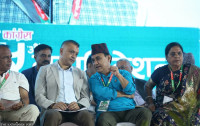
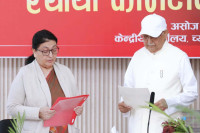
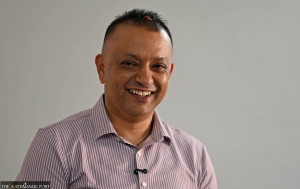
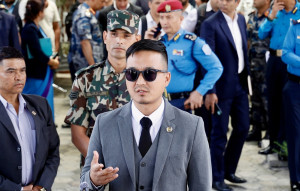
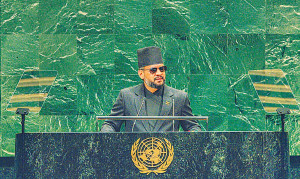
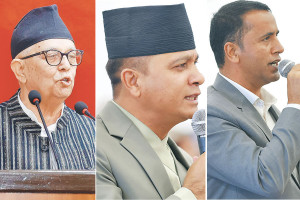
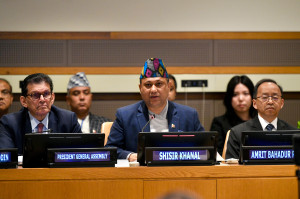
Calls for organisational and generational change expose a deeper divide over KP Sharma Oli’s leadership, with senior figures who once backed him now pushing for a rethink. CPN-UML chair KP Sharma Oli and General Secretary Shankar Pokhrel attend a central secretariat meeting at the party office in Chyasal. Photo: CPN-UML Facebook
The CPN-UML’s internal debate over leadership has moved from a discussion on organisational reform to a direct challenge to party chair KP Sharma Oli.
The dispute intensified following the party’s poor performance in the March 5 elections and the political upheaval that followed last year’s Gen Z-led protests. Senior leaders, including vice-chair Bishnu Paudel and general secretary Shankar Pokhrel, have argued that the party needs changes in its policies, organisation and leadership.
The issue is not entirely new. But it became more contentious after Pokhrel proposed that Oli should take the initiative to hand over the leadership as part of a broader party reorganisation.
Oli has rejected the idea. The debate has since produced competing reports within a party task force, disagreements among senior leaders and speculations about whether the UML could eventually be forced to hold a special general convention.
For now, however, the leadership issue has been removed from the task force’s consolidated report.
The task force agreed on Sunday to drop the proposal for leadership restructuring from the report and instead attach suggestions received from provincial committees and other party bodies as an annex. The issue will be discussed by the Central Committee, while the party secretariat has decided to propose a meeting of the National General Convention Representative Council.
Deputy general secretary Lekhraj Bhatta said the leadership issue would be discussed by the Central Committee rather than included as a recommendation in the report.
“The issue of leadership change has been removed from the report for now and will be discussed in the Central Committee,” Bhatta said. “A proposal has been made to call a meeting of the General Convention Representative Council.”
How did the dispute begin?
The debate intensified after the UML suffered a major setback in the March 5 election. Party leaders subsequently held 13 provincial and organisational meetings to gather views on the election results and the party’s future.
Pokhrel, who was the member-secretary on a task force led by vice-chair Ram Bahadur Thapa, prepared a report based on the discussions. The report called for broader party reorganisation and argued that Oli should take the initiative on leadership handover.
Most provincial units, with the exception of Bagmati, reportedly submitted suggestions calling for changes to the party’s policy and leadership.
The dispute is significant especially because several senior leaders who support some form of restructuring had backed Oli at the party’s 11th general convention in December 2025. They included vice-chairs Paudel and Prithvi Subba Gurung, general secretary Pokhrel, and deputy general secretaries Raghubir Mahaseth and Yogesh Bhattarai.
Their consensus is that the party cannot recover from its recent setbacks without changes in both policy and leadership.
Pokhrel has framed the issue as part of a longer-term effort to bring younger generations into the party leadership.
“The party needs to develop a concrete plan for combining three generations,” he wrote in his report, based on suggestions from provincial units. He argued that the UML needed a system through which leadership could be developed and transferred in an orderly way.
The issue has therefore become broader than a question of whether Oli should remain chair. It has also raised questions about how the UML develops its next generation of leaders and how much authority should remain concentrated in its current leadership.
Two reports, two approaches
The internal disagreement became clearer when Thapa, the task force coordinator, prepared a separate report that took a different view of the leadership question.
Thapa argued that raising the issue of leadership transfer while the party was dealing with a crisis was premature. He rejected the attempt to link party restructuring with Oli’s removal.
Pokhrel, Paudel, Gokarna Bista and Bhattarai, among others, disagreed with parts of Thapa’s position.
A third report was later prepared by Pradeep Gyawali in an attempt to reconcile the competing positions.
The task force ultimately moved towards a single report, but the central disagreement remained: whether organisational restructuring should spell out the process for changing the party leadership.
On Sunday, UML secretary Mahesh Basnet said the task force had agreed not to seek Oli’s resignation or removal and would not criticise him in the final report.
The final report is expected to be considered by the party secretariat before the Central Committee meeting scheduled for September 21-23.
Why can’t Oli simply be replaced?
The main obstacle is the party statute.
The UML’s current leadership was elected by its 11th general convention in December 2025. Oli argues that he was given a mandate by that convention and that the party leadership cannot be changed simply because some leaders now demand restructuring.
A formal attempt to remove him would require a special general convention.
Under Clause 72 of the UML statute, a special general convention can be demanded in writing, with specific reasons and an agenda, by two thirds of the party’s district committees or a majority members of the National General Convention Representative Council. If the requirements are met, the Central Committee must call the convention within six months.
The 11th general convention had 2,263 representatives, meaning that at least 1,132 would be needed for a majority of the representative council to demand a special convention.
That makes an immediate leadership change difficult even if dissatisfaction with Oli has grown within the party.
The dispute also unfolds against the backdrop of the UML’s recent attempt to revise its internal rules.
The age limit that disappeared
At the UML’s second statute convention, held in September 2025, the party removed the 70-year age limit for senior party positions. The change cleared the way for Oli to seek another term as chair. The convention also endorsed reports presented by Oli, Paudel and Pokharel.
The removal of the age bar had already been contentious within the party. Earlier debates over the statute had also involved a proposal to remove the rule limiting leaders to two terms in the same executive position.
Those changes were discussed alongside speculations about former President Bidya Devi Bhandari’s possible return to active UML politics. Some of her supporters argued that the proposed provisions could prevent her from returning to the party leadership.
Bhandari has remained largely silent as the current leadership dispute has intensified.
The National General Convention Representative Council provides another institutional route for discussing the dispute without immediately calling a special general convention.
Under Article 12 of the UML statute, representatives elected to a national general convention remain members of the representative council until new representatives are elected for the next convention. A meeting is normally held once between two national general conventions.
The council can discuss and approve reports from the Central Committee and other central bodies, review the party leadership’s overall performance and issue necessary directions.
The UML secretariat has now decided to propose such a meeting to the Central Committee.
For leaders seeking change, this could provide a formal forum for continuing the debate even though the latest task force report does not call for Oli’s removal.
A challenge from within Oli’s own camp
What makes the current dispute particularly significant is that some of the leaders pushing for change were once among Oli’s strongest allies.
Paudel and Pokhrel are now among the most prominent figures arguing for organisational and leadership reform. Their position does not necessarily amount to an immediate demand for Oli’s resignation, but it represents a significant shift within the party’s establishment.
Pokhrel has said the debate over leadership development and transfer will continue as part of efforts to rebuild the UML.




 25.89°C Kathmandu