Left parties weigh unity amid investigations, policy clashes and shifting political ground
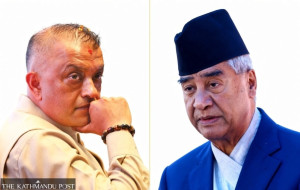
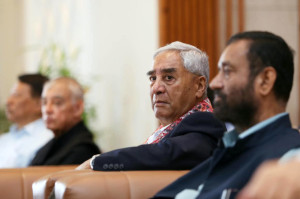
With investigations targeting former leaders and political tensions rising, UML and NCP leaders move toward coordination in parliament, on the streets and possibly in elections. Leaders say UML chair KP Sharma Oli and NCP coordinator Pushpa Kamal Dahal have already reached an informal understanding to explore an alliance for the upcoming local and provincial elections. Post Photo
As the government led by the Rastriya Swatantra Party (RSP) moves to reopen investigations into decisions taken by previous administrations, senior leaders of the CPN-UML and the Nepali Communist Party (NCP) have begun seeking common ground. Both parties are laying the groundwork for a coordinated front in parliament and on the streets to counter recent government actions.
Leaders say UML chair KP Sharma Oli and NCP coordinator Pushpa Kamal Dahal have already reached an informal understanding to explore an alliance for the upcoming local and provincial elections. According to them, discussions are also underway on immediate cooperation within provincial governments.
The renewed push for coordination between Oli and Dahal comes as the RSP-led government intensifies investigations and arrests targeting leaders of parties that dominated governments for most of the past years, citing alleged criminal links. The government has already initiated money-laundering investigations involving both former prime ministers. On March 28, Oli was arrested for questioning over the alleged suppression of Gen Z protests and later released following a court order. UML vice-chairman Bishnu Paudel remains in police custody, while financial audits of assets belonging to several former public officials are ongoing.
Since taking office, the RSP-led government has introduced a series of controversial measures, including the ban on political student unions in universities, the dissolution of civil service unions and the removal of political appointees from several public positions. More recently, it has proposed making local bodies and the National Assembly fully non-partisan and has also advocated abolishing provincial assemblies, a structure established under the constitution by the traditional political establishment. Leaders say these developments have pushed Oli and Dahal toward considering cooperation as unavoidable.
An alliance between Oli’s UML and Dahal’s NCP, formerly the Maoist Centre, is not new. The two sides have shared power multiple times. In 2017, their electoral alliance secured a near two-thirds majority in the House of Representatives, leading to a formal merger that created the Nepal Communist Party (NCP). However, internal power struggles soon fractured the unity.
The dispute between Oli and Dahal eventually split the party back into UML and Maoist factions, ending all political communication between the two leaders for a period. After the 2022 general election, they reunited to form a government under Dahal’s leadership, but the arrangement collapsed within two months when Dahal aligned with the Nepali Congress. Their public exchanges continued until recent months, when the March 5 election results again pushed them back into dialogue.
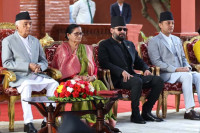
On Sunday, Oli and Dahal appeared together at an event marking the 75th birth anniversary of former UML general secretary Madan Bhandari, issuing a joint call for leftist unity. Alongside NCP co-coordinator Madhav Kumar Nepal and leader Jhalanath Khanal, they stressed the need for cooperation to safeguard nationalism, the constitution and democracy. While they framed unity as a response to what they called the government’s “unconstitutional activities,” the broader aim appears linked to consolidating the left vote ahead of upcoming elections.
Oli said that after the Gen Z movement, the September 9 protests and the March 5 elections, democracy had effectively disappeared, making cooperation between leftist and democratic forces necessary.
“Where is the space to build socialism right now? The government is exhausting the country with its regressive actions. Halting this regression is our primary duty,” Oli said. “There is a coordinated effort to weaken leftist forces. To stop this regression, leftist and democratic forces must come together. Any constitutional amendment must favour the public.”
He suggested that external forces had contributed to the earlier split of the unified communist party after 2017. “There will always be attempts to prevent democratic forces from uniting and to break others apart. We managed to unite with great difficulty, only to watch it fracture,” he said. “If anyone tries to interfere within our party, we will recognise and defeat them. The UML stands united and strong.” He added that the focus was on functional cooperation rather than a full merger.
Addressing Dahal directly, Oli called for a pragmatic approach to partnership. “We do not support pseudo-revolutionary narrow-minded ideology, nor are we pseudo-flexible,” he said. “We will not be rigid in practical matters; we must pursue what is achievable.” He also pointed to past cooperation between leftist forces and the Nepali Congress, including the 1990 democratic movement and constitution drafting, as examples of workable alliances.
Dahal, who initially supported the RSP government’s anti-corruption and governance agenda, has recently become one of its sharpest critics, accusing it of authoritarian tendencies.
“Keeping in mind the latest circumstances, the left must unite immediately against authoritarianism and foreign pressure. Delaying this would be a catastrophic mistake,” Dahal said. “I am not suggesting an outright merger. But let us begin cooperating now—the sooner the better. Let us cooperate in parliament, on the streets, and in elections. If we delay, a serious crisis awaits.”
He said any future alliance should be based on a review of past mergers and splits. “In 2017, we came together for the sake of socialism, and the public gave us a two-thirds majority. I want to review that period now. I will not enter a merger without a thorough review,” he said. “We must not marry in haste and repent at leisure.”
Dahal also alleged a broader attempt to weaken leftist politics. “Counter-revolutionary shifts are rising, and national sovereignty is under threat. The government is intent on attacking the core principles of the constitution and oppressed groups,” he said. “There is a coordinated effort across South Asia to dismantle the communist movement.”
Reflecting on his political journey from armed conflict to peace and communist unity, Dahal said he remains open to strategic shifts. “The situation has changed, and we will change with it. We must adapt our ideas to the times.” He and Oli had held confidential discussions on leftist cooperation two weeks earlier.
NCP co-coordinator Madhav Kumar Nepal and former prime minister Jhalanath Khanal also stressed unity based on past experience. “Let the leftists align their hands, hearts and perspectives. In the past, even mentioning another leader’s name caused discomfort. That must change. Let us define our strategy and political line and unite the communists,” Khanal said. “For now, let us move forward with functional unity. The country, the republic and the constitution are under threat.”
Co-coordinator Nepal said unity would only be sustainable if differences on rules and working methods were resolved through open debate. “Where did we go wrong? Why did a communist party that held absolute power weaken so significantly? Let us review this,” he said.
Former president Bidya Devi Bhandari, still influential in UML politics, said the communist movement faces serious challenges and needs renewal through people-focused policies. “It is unwise to judge the future of the communist movement based on a single election,” she said. “We need self-reflection to align our policies, working style and organisation with changing times.”
While leaders publicly push for unity, some within both parties see it as a tactic to divert attention from growing demands for leadership change. Calls for generational transition have intensified, particularly within the UML. Despite Oli’s re-election at the party’s national convention last December, poor election results prompted senior leaders including Gokarna Bista, Bishnu Paudel, Raghuji Pant, Prithvi Subba Gurung, Shankar Pokharel and Yogesh Bhattarai to demand organisational restructuring.
Former Maoist leader and political analyst Ram Karki said Oli and Dahal act primarily out of pragmatism rather than ideological commitment. “Leadership changes are being demanded within the UML, and the government is simultaneously investigating the assets of top politicians. Both leaders likely believe a unified front will help them secure external backing,” he said. “They are pragmatists. No one can stop them from uniting or splitting based on their interests.”
Their shifting relationship has been widely documented. On July 1, 2024, Oli visited Baluwatar amid rumours of a UML-Congress deal while UML was still part of Dahal’s government. When questioned, Oli reportedly said, “Be it in heaven or hell, we go together.” That same night, he finalised a power-sharing deal with the Congress, collapsing Dahal’s government.
Although communists reject the concepts of heaven and hell in ideology, the phrase has become symbolic in Nepali politics, reflecting the unpredictable alliance cycle between Oli and Dahal. Their history of abrupt shifts has contributed to a steady decline in the leftist vote base, now reduced to around 21 per cent.
Currently, the UML and NCP hold a combined 42 seats in the House of Representatives. In proportional representation, UML secured 1,405,885 votes (13.44 per cent) and NCP 811,057 votes (7.49 per cent).
This marks a sharp fall from 2017, when the UML and Maoist Centre won 174 seats with nearly 47 per cent of the proportional vote. By 2022, their combined share had dropped to about 42 per cent, continuing a longer decline from around 60 per cent in 2008 to roughly 42 per cent in 2013.




 25.12°C Kathmandu