Calls grow for probe after 35,257 minors found in RSP membership list
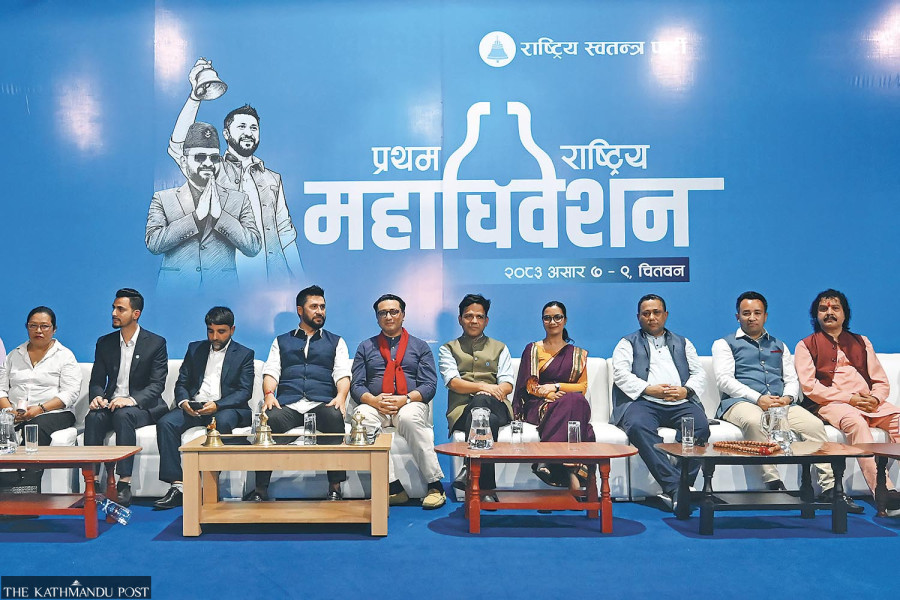
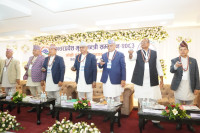
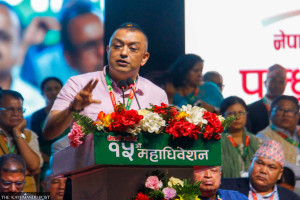
Child rights activists, Congress demand probe and action after thousands of members of the party found to be under 18. Rastriya Swatantra Party leaders pictured at the start of the general convention’s closed session in Chitwan. Angad Dhakal/TKP
The ruling Rastriya Swatantra Party (RSP) has come under criticism from opposition parties and child rights advocates after admitting that it has granted party membership to more than 35,000 children, despite a legal prohibition on enrolling minors.
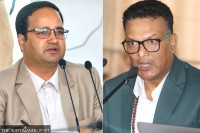
The issue surfaced during the closed session of the RSP's first general convention on June 23, when the party's former general secretary, Kabindra Burlakoti, presented an organisational report showing that 35,257 members are below the age of 18.
The RSP, however, attributed the figures to a technical error, saying some applicants mistakenly entered birth years in the AD format instead of the BS system used in Nepal, and that any underage memberships would be cancelled following verification.
According to Burlakoti, the RSP has a total membership of 523,465. Of those, 13,001 underage members are from the Bagmati province, the highest among the seven provinces, while Karnali has the fewest with 1,414. The report also lists 6,235 minor members in Koshi, 3,030 in Madhesh, 5,116 in Gandaki, 3,648 in Lumbini and 2,813 in Sudurpashchim.
The main opposition Nepali Congress accused the RSP of violating both the Constitution and the Political Parties Act by enrolling children as party members.
Speaking during Sunday's meeting of the House of Representatives, Nepali Congress lawmaker Renuka Kauchha congratulated the RSP's newly elected office-bearers and central committee members before questioning the legality of the party's membership records.
“The membership records show that there are 35,257 members below the age of 18. I want to draw the attention of this House to a fact officially acknowledged by the party itself,” Kauchha said.
“Under the Constitution of Nepal and the Political Parties Act, 2017, individuals below 18 cannot become members of a political party. Is the ruling RSP exempt from the Constitution and the law, or does it consider itself above them?”
Milan Dharel, former executive director of the National Child Rights Council, said the RSP's actions were unlawful.
“Our laws clearly prohibit political parties from granting membership to children. In that sense, this amounts to violence against children under Section 64(2) of the Act Relating to Children,” Dharel said.
“Political parties need to understand that children have the right to political participation, but that right must be exercised within legal limits. They can be educated about political ideologies, democratic values and governance, but they cannot be formally enrolled as party members. Children are free to support a political party, but that does not entitle the party to issue them membership.”
Article 39 of the Constitution guarantees children's rights, including protection from exploitation and abuse. The Act Relating to Children, 2018 defines a child as anyone below the age of 18. Section 7(7) of the Act explicitly prohibits the use of children for political purposes, stating that no child shall be recruited into the army, police or armed groups, or be used directly or indirectly in armed conflict or for political objectives.
Anyone violating the provision can face a fine of up to Rs50,000, imprisonment for up to one year, or both.
The Political Parties Act also sets the minimum age for party membership at 18 under Section 14. Likewise, the Electoral Roll Act permits citizens to register as voters only after they reach 18 years of age.
Despite these legal provisions, the RSP, which commands a near two-thirds majority in the House of Representatives and leads the government, reported that minors account for 6.7 percent of its total membership.
The Children as Zones of Peace National Campaign (CZOP), an advocacy group, strongly criticised the move.
“Educating children about democracy, the Constitution and civic responsibility is positive,” the group said in a statement. “However, enrolling them as formal members of a political party violates the law, child rights principles and the best interests of the child.”
CZOP urged the RSP to immediately remove all underage members and also called on the Election Commission, the National Human Rights Commission, the National Child Rights Council and other relevant agencies to investigate the matter.
The UN Convention on the Rights of the Child (UNCRC), to which Nepal is a state party, also requires governments to protect children from political exploitation.
Dharel said the RSP should immediately cancel the memberships issued to minors.
He added that the Election Commission could seek an explanation from the RSP under the Political Parties Act, while the National Human Rights Commission, the National Child Rights Council and the Ministry of Women, Children and Senior Citizens could take suo moto (on their own initiative, without waiting for a formal complaint) cognisance of the issue and begin legal proceedings.
Election Commission spokesperson Narayan Prasad Bhattarai said the commission became aware of the matter through media reports.
“No formal complaint has been filed with the Commission,” he said. “If a complaint is lodged, the Commission will investigate the matter and proceed in accordance with the law.”
Meanwhile, Kauchha questioned the RSP's stance on student politics, saying the party was sending conflicting signals by recruiting minors while advocating restrictions on political activities in educational institutions.
“On the one hand, there are efforts to dismantle student unions and discourage politics in schools. On the other, the ruling party itself is enrolling minors as members,” she said. “Is this acceptable? Should young children be made to carry political flags?”
The ruling party claims the figure was the result of a technical error caused by applicants entering their dates of birth incorrectly.
Chief whip Burlakoti said the discrepancy arose because some applicants entered their birth years in the AD instead of the BS used in Nepal.
“We have not manually verified whether a handful of people under 18 actually received party membership. When we reviewed the data, we found that some applicants who were well over 18 had entered their birth year in AD instead of BS, which distorted the figures,” Burlakoti said. “I had simply asked for the raw data to be extracted for the report, and it was presented in that form. I corrected the error the very same day.”
Burlakoti said that if any applicants below the age of 18 had inadvertently been granted membership, their memberships would be cancelled immediately.
“Sometimes 16- or 17-year-olds do apply. Gen Z was actively involved in our movement, and many young people want to join politics. If minors apply, we don’t accept their applications,” he said. “If any underage applicants have mistakenly been inducted, our position is clear. We cannot grant them party membership because they are below the legal age. They will have to wait until they turn 18. We welcome their support and goodwill, but they cannot become official members. Enrolling minors only invites unnecessary scrutiny and puts the party in a position where it has to answer legal questions.”




 14.4°C Kathmandu