RSP proposes non-partisan vote for electing local governments, National Assembly. How much water does it hold?
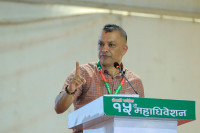
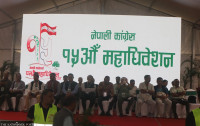
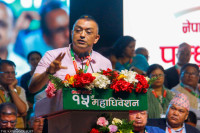
The party, despite leading the government with a near two-thirds majority in the House, has no representation in the Assembly. Rastriya Swatantra Party Chair Rabi Lamichhane shakes hands with senior party leader and Prime Minister Balendra Shah during the opening ceremony of the party’s first general convention in Chitwan on Sunday. Angad Dhakal/TKP
The ruling Rastriya Swatantra Party has sparked a fresh debate by proposing non-partisan formation of local councils and the National Assembly.
The proposal, endorsed at the party’s maiden national convention in Bharatpur, reflects the RSP’s broader push for constitutional reform. While party leaders argue that the existing political system has failed to deliver effective governance and accountability, constitutional experts and political observers say the ideas face formidable legal and political obstacles.
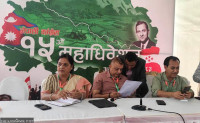
The agenda is contained in two separate convention documents. The political report presented by party chief Rabi Lamichhane proposes converting the upper house of parliament into a non-partisan expert body and making the Vice President its chair. The party’s economic and political document, presented by RSP Vice-president Swarnim Wagle, advocates non-partisan local governments alongside several other constitutional changes.
The RSP had already proposed non-partisan local elections in its 2022 parliamentary manifesto. The idea of a non-partisan federal Assembly, however, has now been formally incorporated into the party’s agenda through the convention.
Wagle’s proposal notes that the party has already waged debates on issues such as preventing lawmakers from simultaneously serving as ministers. The document states that the party intends to revise the current constitution when it gains sufficient political strength for that.
“Our day will come when we have the numbers and capacity to amend the present constitution,” says the proposal.
The debate comes at a time when the RSP, despite leading the government with a near two-thirds majority in the House of Representatives, has no representation in the National Assembly, where constitutional amendments would also require a two-thirds majority.
The 59-member Assembly has 56 elected members and three members nominated by the President on the recommendation of the Council of Ministers. The members are chosen by an electoral college of provincial assembly members and local government chiefs and deputy chiefs of the respective province.
Because political parties dominate both provincial assemblies and local governments, candidates endorsed by parties almost invariably secure seats in the upper house. Although the constitution and existing laws do not prohibit independent candidacies, aspiring candidates must obtain a proposer and a seconder from among members of the electoral college, making it extremely difficult for independents to compete successfully.
Radheshyam Adhikari, former National Assembly member and senior advocate, says the practical realities of the electoral system leave little room for independent representation. “Almost all voters in the electoral college belong to political parties. Without party backing, an independent candidate has virtually no chance of entering the National Assembly,” he said.
Adhikari believes the RSP is introducing multiple constitutional proposals without adequately examining existing constitutional arrangements, democratic practice and institutional outcomes.
“The party is bringing one new issue after another into public debate. Whether it is abolishing provincial assemblies, making the National Assembly or local governments non-partisan, or preventing lawmakers from becoming ministers, these proposals require constitutional amendment,” he said.
According to Adhikari, the RSP’s growing list of reform demands risks complicating efforts to build broader consensus on constitutional amendment among major political parties.
Krishna Khanal, a professor of political science, says the RSP has harboured reservations about the constitution since its inception. According to him, signs of that scepticism were evident during the 2022 elections and have continued through the party’s first general convention. He views the party’s desire to revisit a wide range of constitutional provisions as a reflection of its own internal contradictions.
“The RSP was not involved in constitution-making. For that reason, it sometimes appears reluctant to take full ownership of the constitution,” said Khanal.
“At the same time, it came to power through elections held under this constitution. There is a contradiction. It has had to operate through the constitutional process while also trying to demonstrate that it represents something new.”
Khanal believes the party may be raising popular reform agendas because it lacks political strength to unilaterally change the constitutional framework.
The debate over non-partisan local elections is not new. During the constitution-writing process a decade ago, several parties, particularly Madhesh-based groups, argued that local governments should function outside partisan politics. The proposal, however, was not accepted by major political parties.
The RSP has now revived the issue. Its election manifesto identified non-partisan local government as one of several constitutional reform agendas. Other proposals included a directly elected executive, a fully proportional parliament, a ban on lawmakers becoming ministers and restructuring provincial institutions.
In his political report, Lamichhane reiterated support for a directly elected executive, a fully proportional electoral system, a non-partisan National Assembly and restructuring provincial assemblies and governments.
Support for non-partisan local governments is not limited to the RSP.
Upendra Yadav, chairman of the Janata Samajbadi Party Nepal, said his party had advocated such a system during constitution drafting.
“Local governments are primarily institutions for development and service delivery. They can function more effectively if freed from partisan political competition,” said Yadav. He argues that local governments should operate under provincial authority and conduct elections without party involvement.
Janamat Party chair CK Raut has also expressed sympathy for reducing party influence in local elections, although his reasoning differs. According to Raut, current laws fail to hold local representatives accountable to the parties that nominate them.
“Representatives get elected through political parties but often act independently afterwards. Parties have limited means to discipline them even when they engage in wrongdoing,” said Raut. He argues that local elections without party symbols could be introduced without amending the constitution because the constitution does not explicitly require party-based competition in local governments.
Not everyone agrees.
Rajendra Prasad Gautam, head of the CPN-UML’s local development department, rejects the proposal outright. “We are operating under a competitive multiparty democratic system. In such a system, the idea of non-partisan elections simply does not fit,” he said.
Gautam also points out inconsistency in the RSP’s position. While advocating non-partisan local elections, the RSP has already begun preparing candidate selection criteria for the next local polls.
The RSP’s central committee held on April 20 decided to formulate guidelines and standards for selecting candidates for the local elections next year.
“On one hand, the party is preparing to nominate candidates. On the other, it is talking about non-partisan elections. That is contradictory,” said Gautam.
Interestingly, the Election Commission has also floated the possibility of non-partisan local elections. Last month, the commission submitted suggestions to a government task force preparing constitutional amendment proposals. Acting Chief Election Commissioner Ram Prasad Bhandari said the recommendation was based on experience from two local election cycles and the subsequent practice.
“Local government is the primary unit for development work and public service delivery. It is better not to encourage excessive politicisation at that level,” Bhandari told Kantipur.
He noted that several democratic countries have adopted similar practices and argued that local governments could deliver better results if granted greater independence from party structures.
Bhandari further contended that constitutional amendment may not be necessary. “The constitution does not prevent such a system. Amendments to laws, including the Local Level Election Act, could be sufficient,” he said.
Bipin Adhikari, a constitutional expert, remains unconvinced. “Local governments can be made non-partisan. The real question is what would be achieved by doing so,” he said.
According to Adhikari, political parties provide organisational support, policy continuity and accountability mechanisms that individual candidates cannot easily replicate. “In a party-based system, responsibility does not rest only with the individual candidate. The party also bears responsibility,” he said.
Adhikari argues that major development programmes and policy commitments are often easier to implement when elected representatives have organisational backing. He also raises concerns about accountability. If an independently elected local representative engages in misconduct, determining who should enforce discipline becomes more complicated.
He believes Nepal’s democratic evolution has moved too far towards political openness and organisational freedom for a return to non-partisan elections.
“It is not enough for the RSP leadership alone to support the idea. What about party workers? If they are denied opportunities to organise politically at the local level, where will they practise politics?” he asked.
“We have made significant advancements in democratic culture. Except during the Panchayat era, Nepal has never had a sustained tradition of non-partisan elections.”
For Adhikari, meaningful implementation would ultimately require constitutional amendment limiting political parties’ role in local elections. Until then, the debate may continue, but turning the RSP’s proposals into reality will remain a far more difficult task than placing them on the political agenda.




 20.85°C Kathmandu