Rabi Lamichhane’s paper portrays RSP as a mature political force
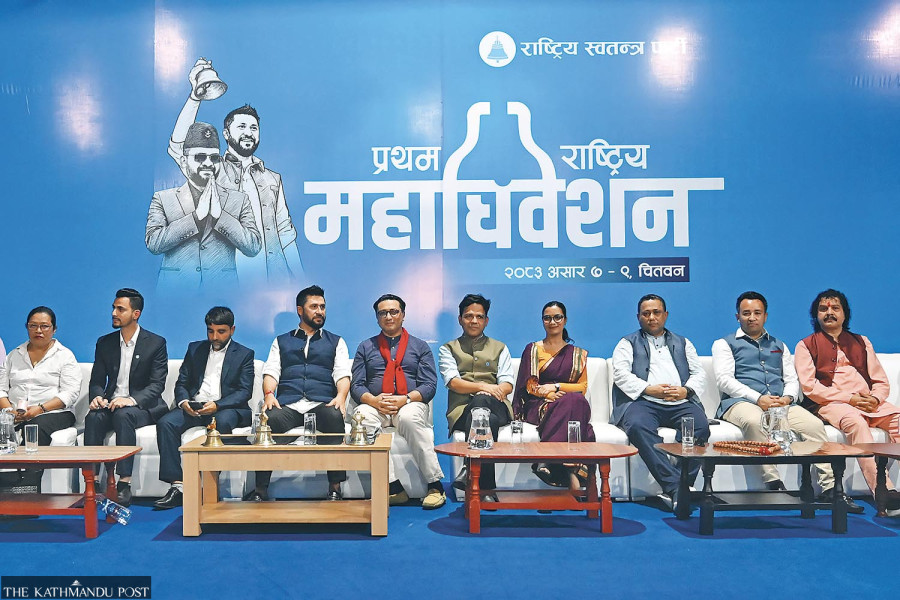
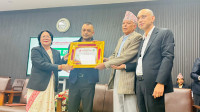
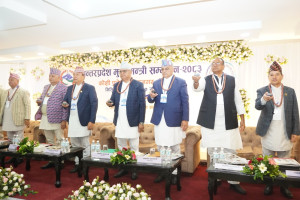
Lamichhane’s political paper calls for constitutional reforms through broad consensus, while outlining the party’s social democratic outlook. Rastriya Swatantra Party leaders pictured at the start of the general convention’s closed session in Chitwan on Tuesday. Angad Dhakal/TKP
The Rastriya Swatantra Party has proposed transforming the National Assembly into a non-partisan chamber of experts and making the Vice President its chairperson. Presenting his political paper during the closed session of the party’s general convention on Tuesday, party president Rabi Lamichhane said his party also supports a directly elected executive.
The ruling party has come up with the idea of transforming the upper house and changing the governance system at a time when a government panel led by Prime Minister’s political adviser Ashim Shah is working to develop a discussion paper for constitutional amendment.
“The RSP supports a directly elected executive with stable leadership and clear accountability,” reads Lamichhane’s political paper.
Presenting the paper in the closed-door session of the party’s general convention, Lamichhane emphasised that constitutional amendment should not be the agenda of a single political party but a shared national objective. He said the amendment process should be guided by the country’s long-term needs, citizens’ experiences, and democratic practice.
Stating that the Constitution of Nepal opens the door for revision after a decade of implementation, Lamichhane said the RSP supports an open, honest, and responsible debate on both the achievements and shortcomings of the constitution, as well as the reforms sought by citizens.
“The basis for constitutional amendment now should be good governance, stability, representation, and citizens’ interests. We support broad national dialogue, expert recommendations, citizen participation, and, where possible, all-party consensus,” he said.
Through the political report presented at the convention, Lamichhane also sought to answer long-standing questions about the party’s ideological orientation. He said critics often claim that the RSP lacks an ideology without reading its documents, and argued that the report addresses such criticisms.
“We are neither traditionally left-wing nor right-wing, and we have consciously chosen not to confine ourselves within that political polarisation. Instead of rigid ideological boundaries, we prioritise practical, rational, need-based, and reality-driven approaches,” he said.
“We respect the historical contributions, experiences, and positive practices of older ideological frameworks, but also evaluate them through the lens of practical utility and social justice.”
Lamichhane said the party may appear “right-wing” when it advocates for private-sector growth, an investment-friendly environment, and competition, while it may seem “left-wing” when it argues that the state should guarantee basic healthcare and education for all citizens. “Encouraging startups, private enterprise, and market freedom may not look left-wing, but supporting workers’ rights, minimum wages, and social security guarantees may appear so,” he said.
“We believe that the state, society, and economy should not be guided by any single ideology but by a balanced, mixed, and context-specific approach. We should get our eyes examined before making glasses, not shape our eyes to suit the glasses.”
He said, after the convention, “social democracy” will be the party’s principal political doctrine. The party’s proposed statute had earlier referred to constitutional socialism. However, Lamichhane said the party had concluded that it would be inappropriate to adopt the constitution itself as an ideology or doctrine.
“This should by no means be interpreted as a rejection of the constitution. The constitution of the country and a political party’s policies, ideas, and principles are two separate matters,” he said.
Describing the constitution as a document born out of a political compromise at a particular point in time, he questioned how it could itself be adopted as an ideology when amendments become inevitable as circumstances change over time.”
The party’s immediate past general secretary, Bhoopa Dev Shah, said the political report answers most ideological questions that have been raised about the party. “The report addresses many of the concerns and questions that have been raised about the RSP in the past,” Shah told Kantipur.
Lamichhane’s report also states that the RSP supports building an inclusive and equitable society based on equal opportunity.
Foreign policy
The report says the party’s foreign policy will focus on “development diplomacy and an active presence in global forums”.
Lamichhane said the RSP is committed to an independent, balanced, and national interest-oriented foreign policy, guided by the national interests defined in the Constitution of Nepal
“Our relations with neighbouring countries will be based on mutual respect, equality, trust, and shared interests,” he said. “Maintaining balanced, stable, and practical relations with both India and China, while expanding cooperation in trade, infrastructure, energy, tourism, education, technology, and regional connectivity, will be our priority.”
He said issues related to border management, border disputes, and historical treaties should be resolved through facts, evidence, international practice, and institutional dialogue, rather than emotional debates.
Lamichhane also referred to Nepal’s commitments to the principles of the United Nations Charter, Panchasheel, the spirit of the Non-Aligned Movement, international law, and universally accepted norms of peace, while adapting to the realities of a changing global order.
“In our view, foreign policy is not merely about managing diplomatic relations. It is also a means of national development, economic transformation, attracting investment, expanding trade, transferring technology, and building international partnerships,” he said. “Therefore, the RSP seeks to place ‘development diplomacy’ at the centre of foreign policy rather than traditional power-centred diplomacy.”
Relations with other political parties
Lamichhane said the RSP does not view other political parties as enemies.
“For decades, politics has been viewed through the prism of friends and foes. But in the task of nation-building, political parties are not enemies; at most, they are competitors with differing ideas, programmes, and priorities,” he said. “In a democracy, electoral competition does not preclude consensus on fundamental national issues.”
He argued that the country’s real enemies are poverty, corruption, poor governance, illiteracy, and weak healthcare services.
“Youth migration, economic dependency, an unproductive economy, declining public trust in the state, social divisions, and intolerance are the true enemies of this country,” he added.
Lamichhane said all-party consensus has been discredited because of power-sharing arrangements, but the RSP wants to restore its dignity by using consensus to serve the national interest.
“For example, what kind of citizens do we want to nurture? What kind of education system do we need? These are not merely questions for the government—they concern the future of society. Therefore, education policy should be a matter of national consensus,” he said.
Internal challenges
Lamichhane said that the RSP, established only four years ago, is still transitioning from a political campaign into an institutionalised party.
“The party has accomplished an impressive parliamentary presence through public support, but popularity alone cannot be the foundation of a long-term political force,” he said in a self-assessment.
He recognised tendencies within the party such as divisions between “old” and “new” members for personal gain, factional thinking, efforts to expand individual influence, and personality-driven politics, saying these trends undermine organisational unity and trust.
“There is a lag in developing a culture of cooperation and mutual respect based on the understanding that, regardless of our origins, we are all part of the same mission,” he said.
He also noted complaints that group-based protectionism has discouraged capable and committed members. Some members, he said, seek special privileges based on their early contributions to the party, while others try to prevent competent people from joining because they may be challenged.
Warning that a lack of regular communication, engagement, and capacity-building could increase frustration and inactivity among members, he said concerns are growing that the organisation may become dependent on individuals rather than institutional processes.
Lamichhane said the party must prove critics wrong by demonstrating that it is not “a force of temporary popularity but a long-term institutional and transformative political movement”.
“The mandate we have received from the people is not the destination—it is only the starting point of a much longer journey,” he said. “Turning that support into lasting public trust will require strong institutions, transparency, discipline, and commitment.”
Lamichhane said meaningful reform within the party would be possible only if it fostered a culture that placed institutions above individuals, collective purpose above personal ambition, and shared goals above self-interest.
He said that as the RSP matures and evolves, its support base has continued to expand.
“Our determination, persistence, and enduring connection with the people are our greatest strengths,” he said. “There is no reason to panic or lose heart. We should see criticism and even attacks as a reflection of our growing relevance and strength.”




 25.92°C Kathmandu