RSP at 4: How Rabi Lamichhane conceived and nurtured an alternative political movement
The national jamboree of the party formed four years ago begins Sunday, where it will define its policy line and elect new leadership.The venue for the Rastriya Swatantra Party’s first general convention that starts in Chitwan on Sunday. Angad Dhakal/TKP
Having walked away from his television programme “Sidha Kura”, Rabi Lamichhane announced the formation of the Rastriya Swatantra Party (RSP) on June 20, 2022, declaring, “We will ring the bell in the minds of the corrupt.”
Even before approaching the Election Commission to register the party’s proposed name and election symbol, Lamichhane declared the beginning of a campaign for good governance. Within six months of its formation, the party secured an unexpected electoral mandate and joined the coalition government led by Pushpa Kamal Dahal immediately after the elections.
On December 26, 2022, the day Dahal took the oath of office, he appointed Lamichhane as deputy prime minister and home minister. RSP lawmakers Shisir Khanal, Dol Prasad Aryal and Toshima Karki also joined the Cabinet.
The party’s rapid rise, however, was soon interrupted. Barely a month later, a citizenship dispute stripped Lamichhane of his positions as deputy prime minister, home minister, Member of Parliament and party chairman simultaneously.
Soon after stepping down, Lamichhane declared that the party’s ambition in the next election would extend beyond reclaiming the home ministry to securing the prime minister’s office. Following a by-election in Chitwan-2, he returned to Parliament with an overwhelming victory and was reappointed deputy prime minister and home minister on March 6, 2024.
From then on, calls intensified in Parliament for an investigation into Lamichhane’s alleged involvement in a cooperative fraud scheme. A parliamentary inquiry committee, with representation from the RSP, was formed under the leadership of UML lawmaker Surya Bahadur Thapa.
Four months later, the Dahal-led government lost UML’s support, giving way for a coalition of the UML and the Nepali Congress. The RSP was pushed into the opposition. On October 18, 2024, Lamichhane was arrested from the party’s central office at Banasthali, Kathmandu.
Cooperatives fraud cases were filed against him in Kaski before investigations also began in Kathmandu, Chitwan, Butwal and Rupandehi. Prosecutors later added charges of organised crime and money laundering.
With its chairman behind bars, the party entered one of the most difficult periods in its short history. Lamichhane directed party affairs from prison for an extended period, while then vice-chairman Dol Prasad Aryal handled day-to-day leadership.
From every crisis the party has faced, it only came out stronger, said RSP general secretary Kabindra Burlakoti.
The political landscape shifted following the Gen Z movement of September 8-9 last year against widespread corruption and governance failures.
Lamichhane briefly left prison on September 9 citing security concerns, but returned within days after mounting public criticism of his move. Later, after an interim government was formed under the leadership of Sushila Karki, the High Court ordered his release on December 18, 2025 after he posted bail equal to the claimed amount.
Even while Lamichhane remained in custody, party leaders began exploring ways to position the RSP as the centre of Nepal’s alternative political movement. A committee led by Pukar Bam first initiated discussions, which were later continued by a high-level dialogue committee headed by Swarnim Wagle. The committee held talks with figures including Balendra Shah and Kulman Ghising.
The party initially proposed Ghising as its candidate for prime minister, but negotiations stalled after he declined the offer. Following his release, Lamichhane personally initiated one-on-one discussions with then-mayor of Kathmandu, Balendra Shah.
Those negotiations culminated in a seven-point agreement on December 28, 2025, under which Shah would lead the government while Lamichhane would head the party.
Although attempts to bring Kulman Ghising into the RSP ultimately failed, the alliance between Lamichhane and Shah transformed the party’s electoral fortunes. In the March 5 elections, the RSP secured 183 seats, giving it nearly a two-thirds majority.
The result fulfilled Lamichhane’s pledge of February 5, 2023 that the RSP would eventually lead the government. Under the agreement reached before the election, however, Shah, rather than Lamichhane, assumed the office of prime minister.
Having emerged as the largest political force after the Shah-Lamichhane alliance, the RSP is now preparing to define both its leadership and future directions at its first general convention, beginning Sunday in Bharatpur, Chitwan.
“Chitwan is the birthplace of the party,” said RSP general secretary Bhoop Dev Shah. “We are gathering here to send a message that the party stands united.”
After registering with the Election Commission, the RSP held its first public mass meeting in Chitwan.
How the RSP was formed
Long before entering politics, Lamichhane had built a national following through his television programme. In 2017, he launched a campaign to build a 15-bed hospital in Raskot, Kalikot.
The campaign, carried out through the Rabi Lamichhane Foundation at the suggestion of Dr Mukul Dhakal, became the setting for regular discussions between the two about Nepal’s political situation and the need for a new political force.
Although Lamichhane gradually became convinced that he should enter politics, he did not immediately decide to establish a party.
The dissolution of the House of Representatives by then-prime minister KP Sharma Oli in December 2020, followed by prolonged political instability, further eroded public confidence in traditional political parties.
Parliament remained obstructed from August 2021 to May 2022. Meanwhile, the May 2022 local elections produced victories for independent candidates including Balendra Shah in Kathmandu, Harka Raj Rai in Dharan and Gopal Hamal in Dhangadhi, demonstrating that public support could be mobilised outside established political parties.
“While we were working on the Raskot Hospital project, we often discussed the need for a new political party. But Rabi Dai always felt the time had not yet arrived,” recalled Dr Mukul Dhakal, the RSP’s founding general secretary. “Balen Shah’s victory convinced him that the environment had changed. After that, we agreed it was time to move forward.”
Following the local elections, groups of young independents across the country also began exploring ways to unite ahead of the parliamentary polls.
It was during one such gathering at the Indreni Banquet in New Baneshwar that the name “Rastriya Swatantra Party” was first proposed.
The meeting brought together various groups, from the one led by retired deputy inspector general of Nepal Police Ramesh Kharel to campaigners associated with the Lauro (walking stick) movement. The walking stick had been Balendra Shah’s election symbol during his successful campaign for the mayor of Kathmandu Metropolitan City.
Participants discussed the need to unite before the November 2022 parliamentary elections and convert the support secured by independent candidates in the local polls into representation in the House of Representatives.
According to Dhakal, he proposed the name to Lamichhane and then checked with the Election Commission whether it was available. Once it was confirmed that no one had registered the name, the group agreed to adopt it.
With the party’s name settled, attention turned to choosing an election symbol.
Around mid-June 2022, Lamichhane, Dhakal, Bipin Acharya, DP Aryal and Khusbu Sarkar Shrestha exchanged ideas in a WhatsApp group named “Election Announcement”, discussing symbols including a “fist holding a microphone”, “mandala”, “whistle” and “boat”.
The discussion ended after Dhakal proposed the “bell” (Ghanti), with Lamichhane replying: “The bell is the right choice.”
According to WhatsApp chat records obtained by Kantipur, Dhakal explained how the idea emerged: “After Bipin Acharya repeatedly suggested the whistle as our symbol, the thought of the bell came to mind. In a way, the bell is the traditional form of a whistle.” One image shared in the group carried the message: “Now the bell will ring across the country.”
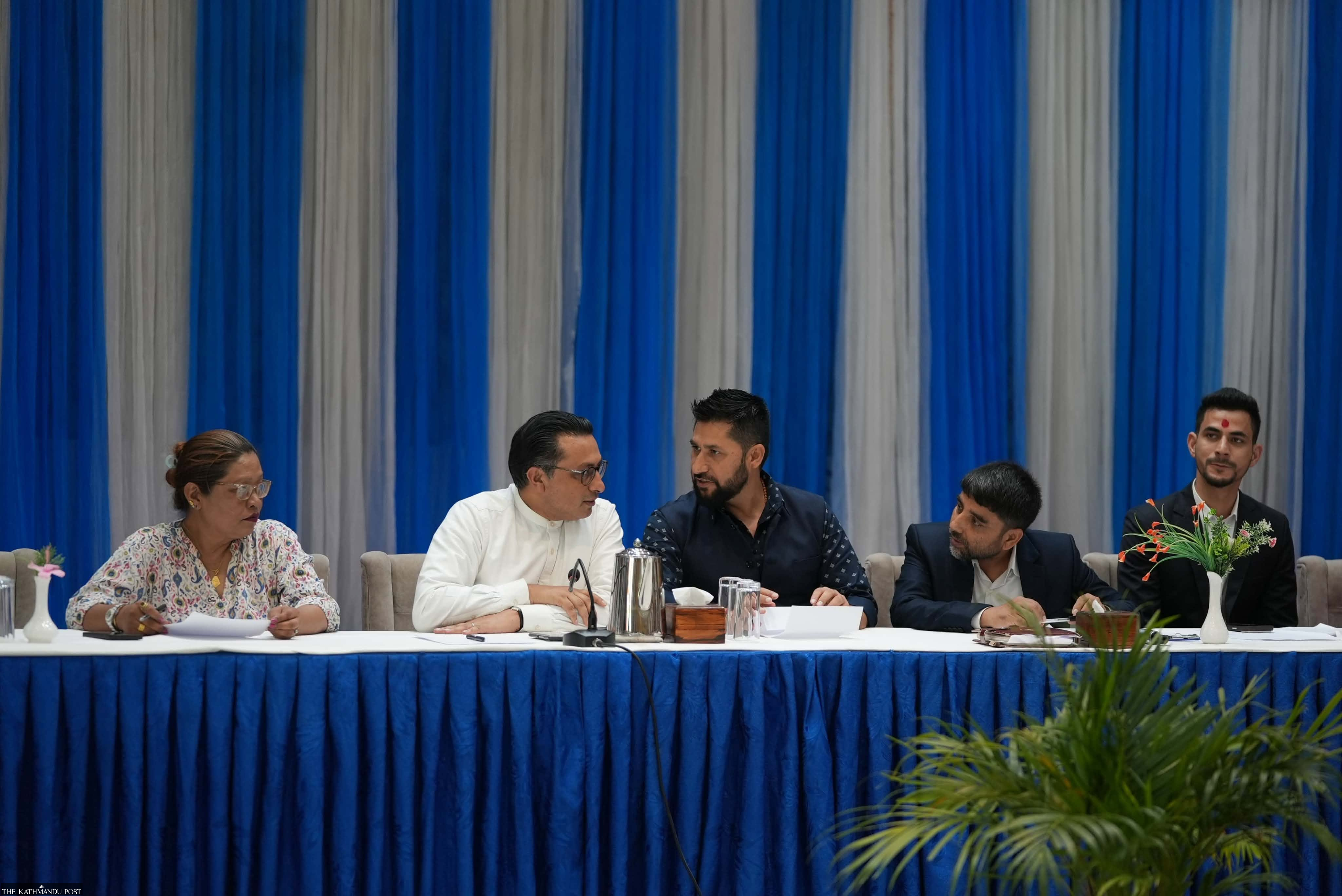
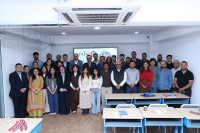
Top leaders pictured during the Rastriya Swatantra Party’s final central committee meeting in Chitwan on Saturday. Post Photo
Dhakal also wrote that he had visited the Election Commission at least three times to review available election symbols and was surprised that no party had claimed the bell. Nekita Poudel, Lamichhane’s wife, also participated in discussions over the party’s name and election symbol.
Once both had been finalised, Lamichhane outlined what he expected from prospective candidates, writing: “To become a candidate, you need honesty in your heart, vision in your mind and one rupee in your pocket.”
Registered with the Election Commission on July 1, 2022, with the bell as its election symbol, the RSP sent shockwaves through the traditional political establishment in the general elections held just four months later. Chairman Rabi Lamichhane and Hari Dhakal won convincing victories in Chitwan, while the party secured 21 seats in total, including proportional representation.
“At that time, the public had grown weary of the traditional parties. The RSP capitalised on that frustration and began its parliamentary journey,” said youth political analyst Nabin Tiwari. “However, by joining the government immediately after the election, it also invited scrutiny from both inside and outside Parliament.”
The party’s promise to fight corruption, promote good governance and prioritise people’s livelihoods generated high public expectations. Within a short period, however, the RSP found itself alternating between government and opposition.
After being pushed into the opposition following controversies surrounding Lamichhane, the party sought to hold the government to account on corruption, governance, public service delivery and political accountability. From the opposition benches, RSP lawmakers aggressively pursued issues ranging from corruption scandals to alleged extortion rackets operating at the Tribhuvan International Airport under the guise of visit visas.
Sobita Gautam, a founding leader of the RSP and law minister, believes the party’s second and much larger electoral mandate was earned through its performance during its first parliamentary term.
She argued that first-time RSP lawmakers established themselves as an alternative political force through their focus on anti-corruption efforts, transparency, good governance and legislative work.
“We entered Parliament as first-time MPs, but we proved ourselves through both lawmaking and our commitment to good governance,” Gautam told Kantipur. “The biggest reason the party has received such a strong mandate this time is that people trusted the work we did during our first term.”
She also credited the RSP with bringing the issue of generational change in politics into the national mainstream.
“I was elected to Parliament at the age of 26. The RSP challenged the belief that leadership or parliamentary office should come only after reaching a certain [higher] age,” she said. “Our message was that youth participation should not remain an election slogan. It must be reflected in policymaking and state governance.”
Today, the RSP says it has more than 500,000 active members and an organisational network extending across all 77 districts, municipalities and wards.
A platform for alternative politics
When the party was formed, Dr Dhakal joined as spokesperson, while several people who had worked with Lamichhane in television—including Aryal and Burlakoti—became part of the founding team.
Most founding members were not nationally recognised figures. Ahead of the 2022 elections, however, Lamichhane recruited candidates such as Shisir Khanal, Indira Rana Magar, Toshima Karki, Biraj Bhakta Shrestha, Sumana Shrestha, Pukar Bam and Hari Dhakal from diverse professional backgrounds.
Over time, the party expanded further by incorporating the group led by Balendra Shah and leaders from the Bibeksheel movement.
On November 30, 2025, the RSP merged with the Bibeksheel Sajha Party, another organisation that had spent more than a decade promoting alternative politics. Leaders including Prakash Chandra Pariyar, Samiksha Baskota and Ashutosh Pradhan subsequently joined the RSP.
Following the alliance with Balendra Shah, additional leaders from alternative political circles also entered the party.
After the Gen Z movement, the RSP attracted several emerging protest leaders, while figures associated with the Tharuhat movement also joined. Sudan Gurung, who later became home minister, played a role in efforts to bring Kulman Ghising into the broader alternative political alliance, though Ghising ultimately chose a different path.
According to central committee member Ramesh Paudyal, the RSP has evolved from a party built around Lamichhane into a platform connecting various alternative political groups and individuals.
Political analyst Keshav Dahal argues that the party’s next challenge is defining what genuinely distinguishes it from traditional parties.
“Being an alternative force is not simply about becoming a large and powerful party,” he said. “It also requires ideological innovation.”
Seeking ideological clarity
Since its inception, the RSP has frequently been criticised for lacking a clearly defined political philosophy.
Whenever questions about ideology arose, Lamichhane often responded by asking whether one needed an ideology to catch thieves, fight corruption or improve public services.
Even so, debates over the party’s ideological direction persisted. At various times, leaders described the party as centre-left, centrist or centre-right. Questions were also raised about its commitment to federalism because it initially chose not to contest provincial elections.
The party sought greater clarity during a meeting in Jaleshwar in November 2023 by adopting “democratic republic, liberal economy with social justice and pluralism” as guiding principles.
However, leaders say the first general convention will go further by formally defining the party’s long-term vision around a pluralism-based democratic republic.
Under proposed amendments to the party statute, the RSP plans to define its ideological outlook as full democratic republicanism based on pluralism, individual freedom, fundamental rights, rule of law and accountable governance.
Acharya, coordinator of the statute amendment committee, says the revised document will provide the ideological clarity the party has long sought.
“Our political and ideological outlook is centred on advanced democracy and good governance,” he said.
The amendments also commit the party to constitutional socialism, equitable prosperity, a liberal economy with social justice and a competitive social market system.
Dhakal, the party’s founding general secretary, believes ideological debates are essential to providing long-term direction.
Four years after emerging as a new political force, the RSP has passed through waves of public enthusiasm, electoral success and internal crises to arrive at its first general convention as a party commanding a near two-thirds majority.
Its next challenge is no longer simply winning elections but institutionalising itself and demonstrating that its promise of alternative politics can be translated into lasting political practice.
“The achievements we have made so far are the party’s capital,” said Manish Jha, the RSP spokesperson. “Our task now is to convert that capital into lasting assets through strong institutions. The election was a campaign for change. The general convention is where that change must become an institutional reality.”




 14.7°C Kathmandu