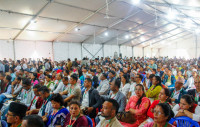
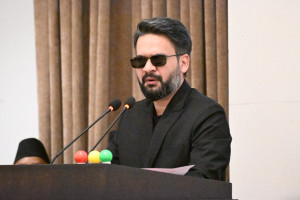
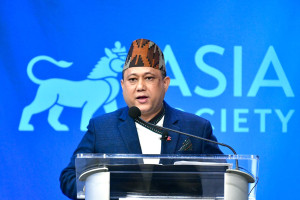
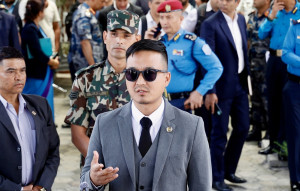
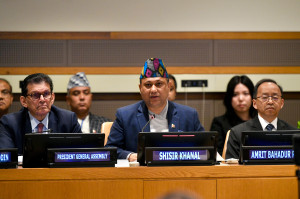
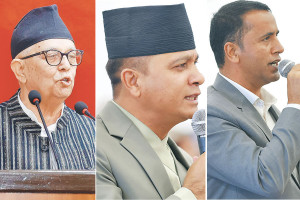
Rastriya Swatantra Party, now boosted by influential figures, looks to cash in on Gen Z protest’s momentum and diaspora backing, though analysts warn its appeal may be limited outside urban areas. On December 28, the RSP formally unified with Kathmandu Metropolitan City Mayor Balendra Shah, popularly known as Balen. This was followed on Monday by the merger of the Ujyalo Nepal Party, whose patron is former Nepal Electricity Authority chief Kulman Ghising. Post file photo
As a restructured political force, the Rastriya Swatantra Party (RSP) is positioning itself to challenge Nepal’s long-established parties in the election announced by the interim government for March 5.
Political analysts say the party’s strength appears to have improved compared to earlier elections, particularly after it unified over the weekend with two prominent figures widely regarded as challengers to Nepal’s long-dominant political leadership.
On December 28, the RSP formally unified with Kathmandu Metropolitan City Mayor Balendra Shah, popularly known as Balen. This was followed on Monday by the merger of the Ujyalo Nepal Party, whose patron is former Nepal Electricity Authority chief Kulman Ghising. The party retained its original name and election symbol, the bell.
The RSP has projected Shah as a future prime ministerial candidate, and named Ghising as the party’s first vice-chair. Ghising, who is credited with ending Nepal’s long-running power cuts as the chief of the Nepal Electricity Authority, adds to the party’s appeal.
Shah, Ghising and the RSP have all consistently described themselves as key stakeholders of September’s Gen Z movement that left 77 people dead and brought down the KP Sharma Oli administration within 24 hours.
In the aftermath of the violent protests and the dissolution of the Oli-led government, demonstrators on the streets openly proposed Shah as prime minister.
The demand was largely driven by the Gen Z movement’s endorsement of Shah’s suggestions, which he shared through social media during the protests.
Shah, however, declined the proposal. Subsequently, former chief justice Sushila Karki was appointed prime minister on September 12 with a mandate to hold elections.
Ghising is currently a senior minister in the Karki-led interim government, a position he secured largely due to the trust placed in him by the Gen Z movement.
In the previous House of Representatives election held in November 2022, the RSP, led by controversial media personality Rabi Lamichhane, won 20 of the 275 seats and emerged as the fourth-largest party in Parliament.
Formed just months before that election, the party positioned itself as a challenger to traditional parties, arguing that they had failed to deliver good governance or curb corruption.
Although the RSP entered Parliament with a limited number of seats and was unable to register major policy breakthroughs, public trust in the party does not appear to have eroded significantly.
For much of its first three years, however, the party spent considerable time defending its chair, Lamichhane, over controversies linked to his actions prior to entering politics. Even so, public sentiment towards the party has remained mixed rather than overtly negative.
Analysts say the recent unification with Mayor Shah and Ghising has injected fresh enthusiasm among the party’s supporters. “RSP, with its changed avatar after bringing in big names like Shah and Ghising, could reshape the electoral landscape,” says political analyst Shree Krishna Aniruddha Gautam.
It is also widely believed that Nepali expatriates played a significant role in the RSP’s strong performance in the last election. With Shah and Ghising on board, Nepalis overseas appear increasingly enthusiastic once again. Although they cannot take part in the election directly, many say they will urge their families and relatives back home to vote for the RSP.
Pramod Adhikari from Chitwan, who has been living in Australia for a long time, says he has long used social media to advocate for alternative political forces, even before the rise of the RSP. After the party’s formation, he has been an active supporter. Following the recent unification, he says his interest in the upcoming election has only grown stronger.
“I encouraged my family and relatives to vote for RSP last time, even though I was abroad. I will do so even more strongly this time,” Adhikari says. “With the mandate of the Gen Z movement clearly favouring alternative forces, this election should put them into government.”
Leaders of the RSP, meanwhile, claim they are confident of emerging as the largest party in March, citing Mayor Shah’s popularity among young voters and the momentum generated by Ghising’s entry.
“Shah commands a huge following among urban, highly educated youth and professionals. He can certainly add big value among the urban educated demographic,” says RSP leader Shishir Khanal.
“Another constituency where we are growing, but could grow much more, is Madhesh. We would get much faster and better footing with Shah in that community as well.”
Political analysts, however, are not convinced. In Madhesh, both Lamichhane and Shah are seen as aligned with anti-federalist forces—a perception that continues to shape regional politics.
Only days ago, former chief minister of the Madhesh province, Lalbabu Raut, urged Madhesh-based parties to come together and form an electoral front against forces opposed to federalism. In that context, Gautam says, discussions are already under way among several Madhesh-centric parties, with some having already forged alliances.
“Political dynamics in Madhesh differ significantly from the rest of Nepal,” Gautam adds.
Many observers also see the RSP as Nepali version of the global populist wave, arguing that the party has placed greater emphasis on leadership figures than on clearly articulated policies. This tendency is not limited to the RSP alone, as several recently emerged “alternative” parties also appear to prioritise personalities over policy.
This approach was evident soon after the formation of the UNP, which has now merged with the RSP. Speaking at a party function in Dharan at the time, Ghising, then the party’s patron, openly stressed the importance of leadership over policy.
Looking ahead to the March election, political analyst Keshav Dahal says public enthusiasm around the alternative force—the RSP, with Shah and Ghising on board—is likely to be strong. “A party that places greater emphasis on leadership than on policy carries inherent risks,” Dahal cautions, “and voters should remain mindful of that reality.”




 20.92°C Kathmandu