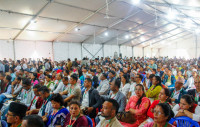
Young voters heading to the polls for the first time say political instability and deep dissatisfaction with established parties have pushed them to participate. For many, voting this time is less about confidence in the system and more about taking responsibility for a choice that directly affects their future. Post file photo
As many as 915,119 new voters have been enrolled for the March 5 elections. This means that nearly a million young Nepalis will be voting for the first time.
According to the final list published by the Election Commission, Nepal, 18.9 million citizens are eligible to vote for the March 5 House of Representatives polls.
More than two thirds of Nepal’s newly registered voters are from Generation Z, marking a noticeable surge in youth engagement ahead of the 2026 polls. The Election Commission views this trend as a sign of a new generation stepping into the political arena.
Many of these first-time voters the Post spoke to say their decision to have a stake in the election is driven not by party loyalty but by a desire to count at what they see as a critical moment for the country’s future.
Dipesh Gyawali, a resident of Tokha Municipality, is voting for the first time and says the election feels historic on a personal level. “For the first time, I feel personally responsible for the outcome of a national vote,” he says.
The situation right now is very critical, Gyawali adds, noting that he had not previously understood how much weight an individual vote could carry.
He says he is closely watching the rise of younger and independent candidates, particularly those challenging what he describes as the “musical chair” politics of established parties.
Gyawali does not believe supporting independent candidates will necessarily steer the country in the wrong direction. As many as 64parties have submitted their closed lists of proportional representation candidates for the March polls. Registered parties and independent candidates have until January 20 to file nominations for the first-past-the-post category of the House elections.
“Old parties are not achieving development goals,” he says. “There is very little chance of improvement. If the same faces come back, the same things will repeat.”
While acknowledging that backing new leadership involves risk, Gyawali says he would rather support new faces than return to what he considers a proven failure.
He expects major changes in cities, though he remains uncertain about rural areas, where older parties continue to maintain a strong hold.
Others say their decision to vote is driven less by representation and more by specific policy concerns.
For Samshraya Dhakal, a 23-year-old IT graduate, voting this time feels fundamentally different.
A registered voter from Bahrabise in Sindhupalchok, Dhakal says although he was eligible to vote in the 2022 election, he was not particularly interested at the time.
“This time, I don’t see myself just as a voter,” he says. “I see myself as someone whose future is directly tied to the decisions made by those in power.”
Dhakal says he did not observe a meaningful generational shift in recent party leadership selections. As a result, he is not voting based on ideology, party affiliation or individual personalities.
“I am voting for a leader who can influence policy and drive the nation forward,” Dhakal says.
For him, the national agenda must come before party interests.
Aayusha Kafle, 21, a resident of Tikathali in Lalitpur, believes experimentation is unavoidable if the political landscape is to change.
Voting for new parties or new teams, she says, should not be viewed as reckless but as necessary.
“I’m open to giving them a chance,” Kafle says. “If it doesn’t work, we can remove them in the next election.”
Kafle says what sets this election apart is the growing willingness among voters to question leaders and demand results after they are elected.
“That’s why I’m hopeful,” she says. “We’re not just voting, we’re watching.”
Rehaan Shah, 22, a fitness trainer, describes voting for the first time as a shift in how he understands citizenship.
“There’s excitement, but there’s also responsibility,” Shah says. “I want my voice to count after everything that has happened in the past few months.”
Shah admits he previously had little interest in politics, but continued political unpredictability pushed him to get involved.
For him, the election represents cautious hope. He says he is looking for candidates who understand governance and treat leadership as a duty rather than a privilege.
“I don’t want to vote for someone who just wants the position,” Shah says. “We’ve already seen what happens when leaders rule from a comfort zone.”
For Prasansha Gurung, 23, voting holds personal significance.
As someone from a minority community, she says she has often felt unrepresented in leadership. This time, however, she sees change, both in who is contesting and in how representation is being discussed.
“For the first time, I feel like there are candidates who reflect people like me,” Gurung says.
She is critical of how proportional representation has been used, arguing that it should prioritise marginalised communities rather than celebrities.
Gurung also believes political change must begin internally, through education, awareness and ethical leadership.
“The faster we work on internal development, the faster we can bring about external change,” she says.
She notes that many new candidates like Ram Lama (energy entrepreneur) and Rupak Bishwakarma Ghimire (dermatologist) contesting this time are highly educated, especially from the newly structured Rastriya Swatantra Party, with several others holding master’s degrees. This, she thinks, is a positive shift from earlier elections.
“Knowledge matters when you’re making decisions for a country,” she adds.
Aayush Basyal, 26, a registered voter from Bardiya, has a similar sense of anticipation.
“The upcoming election feels different because of the types of candidates emerging,” Basyal says. He expects political parties to rethink how they select nominees.
“I hope there will be candidates who are unconventional. That itself is a sign of change,” he says.
Basyal also points to increased political debate on social media as a factor shaping voter awareness, particularly among young voters, encouraging participation rather than disengagement.
Across these first-time voters, the motivations for showing up at the polls vary, from concerns over policy and representation to demands for accountability.
What unites them, however, is a decision to participate rather than remain disengaged.
For many, voting this time is less about confidence in the system and more about taking responsibility for a choice that directly affects their future.
As Aayusha Kafle puts it, “This election feels different because voters are being pushed to pay attention, and parties are being pushed to change.”
Aarya Chand is a reporter at The Kathmandu Post covering social issues. Before moving to the social beat, Chand was an intern covering culture and lifestyle for the Post.




 20.83°C Kathmandu