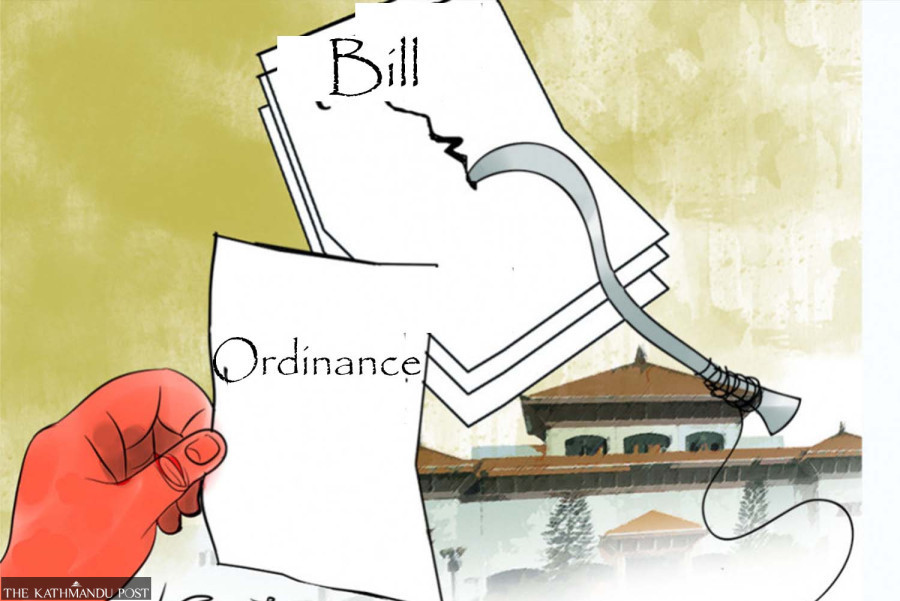
Opposition parties are united against at least two ordinances related to the Constitutional Council and dismissal of public officials. Post file illustration
Opposition parties in the National Assembly are preparing a strategy to reject some of the eight ordinances issued by the government last month.
Criticising both the manner in which the ordinances were introduced and their contents, opposition parties have intensified internal discussions on whether to reject all eight or target only a select few.
Informal discussions among opposition leaders have so far focused on two controversial ordinances, one related to the Constitutional Council and another concerning special provisions for the removal of public officials.
The Constitution requires ordinances to be tabled in the first meeting of Parliament following their issuance. Accordingly, the agendas for Monday’s meetings of both the House of Representatives and the National Assembly include the presentation of all eight ordinances.
Under the National Assembly Regulations, 2018, lawmakers can register a notice to reject an ordinance within two days of it being tabled.
The government had issued the ordinances after abruptly proroguing the federal Parliament session that had been summoned for April 30.
Besides the two controversial ordinances, the government also introduced ordinances related to public procurement, cooperatives, universities, health science academies, money laundering, and amendments to some Nepal Acts.
Article 114(2)(a) of the Constitution states that an ordinance must be accepted by both houses of the federal Parliament. It ceases to remain in effect if either House rejects it.
While the ruling coalition holds a comfortable majority in the House of Representatives, it lacks the numbers in the National Assembly.
In the 59-member upper house, the Nepali Congress is the largest party with 24 seats, followed by the Nepali Communist Party with 17 and the CPN-UML with 10 seats. The Janata Samajbadi Party has two seats, while the Loktantrik Samajbadi Party and Rastriya Janamorcha have one each.
As opposition parties dominate the National Assembly, the fate of the ordinances largely depends on whether they remain united.
Rules 89, 90, 91 and 92 of the National Assembly Regulations, 2018, outline the procedure for rejecting ordinances.
Rule 89 states that any notice [by lawmaker] seeking rejection must clearly mention the reasons.
If multiple notices [by multiple lawmakers] are registered, only one is selected for discussion, either through consensus or according to the order of registration.
Once a notice is registered, the process moves forward under Rule 90. If the lawmaker concerned does not withdraw the notice, the Assembly holds a discussion under Rule 91, during which the relevant minister must respond to lawmakers’ questions.
Under Rule 92, the chairperson then puts the proposal to a vote. If a majority supports rejection, the ordinance automatically becomes inactive.
Constitutional experts and senior advocates said the government cannot bypass the National Assembly on ordinances, unlike ordinary bills, which can become law even without the upper house’s endorsement.
“If an ordinance is rejected by even one House, it loses its legal validity,” said constitutional expert Bipin Adhikari. “While governments may bypass the National Assembly in certain legislative processes through the lower house, ordinances must be approved by both houses.”
The monarchist Rastriya Prajatantra Party, although it does not have representation in the National Assembly, has also opposed the ordinances in principle.
The Nepali Congress has formally opposed the ordinances through both its parliamentary party and central working committee.
Mahesh Bartaula, a UML leader, said his party was particularly against the ordinances related to the Constitutional Council and the removal of public officials.
Opposition parties have objected to a provision redefining “majority” in the six-member Constitutional Council chaired by the prime minister. The ordinance allows decisions to be taken by as few as three members, including the prime minister.
Bartaula argued that the provision undermines the principle of majority rule.
“The government is a continuing institution. If a new government refuses to recognise decisions taken by the previous one, the rule of law weakens,” Bartaula said. “The provision allowing the removal of public officials through an ordinance is a serious issue.”
Kamala Pant, leader of the Congress parliamentary party in the National Assembly, said opposition parties were likely to remain united against the two “most controversial ordinances.”
She said discussions on the issue continued with the UML and the Nepali Communist Party.
Jhakku Prasad Subedi, leader of the Nepali Communist Party in the National Assembly, said his party would take a final decision on the matter on Monday.
He criticised both the decision to prorogue Parliament in order to issue ordinances and the provision allowing three members to constitute a majority in the Constitutional Council.
“The interpretation that three members, including the prime minister, can form a majority in a six-member council is theoretically flawed,” Subedi said. “We also disagree with the process of issuing ordinances after halting a Parliament session that had already been summoned.”
He said opposition parties were likely to arrive at a common position on whether to reject some or all of the ordinances.
Prem Dangal, UML parliamentary party leader in the National Assembly, described the government’s move as “undemocratic and unparliamentary”.
While he said there were fewer objections to the ordinances related to public procurement and cooperatives, he stressed that the opposition would continue to oppose the more controversial decrees.
“The manner in which the ordinances were introduced by proroguing a Parliament session that had already been summoned is undemocratic,” Dangal said. “Some provisions may be positive, but the way the ordinances were issued [by proroguing parliament] is unacceptable.”
Opposition leaders said discussions had intensified around rejecting the ordinances related to the Constitutional Council and the removal of public officials.
Questions have also emerged over the legal status of decisions already taken under the ordinances if they are rejected after Parliament resumes.
Adhikari said actions already carried out under the ordinance would continue to remain valid even if the ordinance is later rejected.
“Once an ordinance is rejected, the previous legal provisions automatically revive,” he said. “And the ordinance will no longer affect future decisions.”
Through a single ordinance, the government had revoked the appointments of around 1,500 officials serving in public bodies under 110 different laws.
Following the issuance of the ordinance, ministries have been sending letters informing officials of their removal.
“If someone was removed while the ordinance was valid, that removal remains effective,” Adhikari said. “But if no removal letter has been issued, the officials should be considered to still hold their posts.”




 14.69°C Kathmandu