Oli, Lekhak yet to respond to NHRC over Gen Z protest crackdown
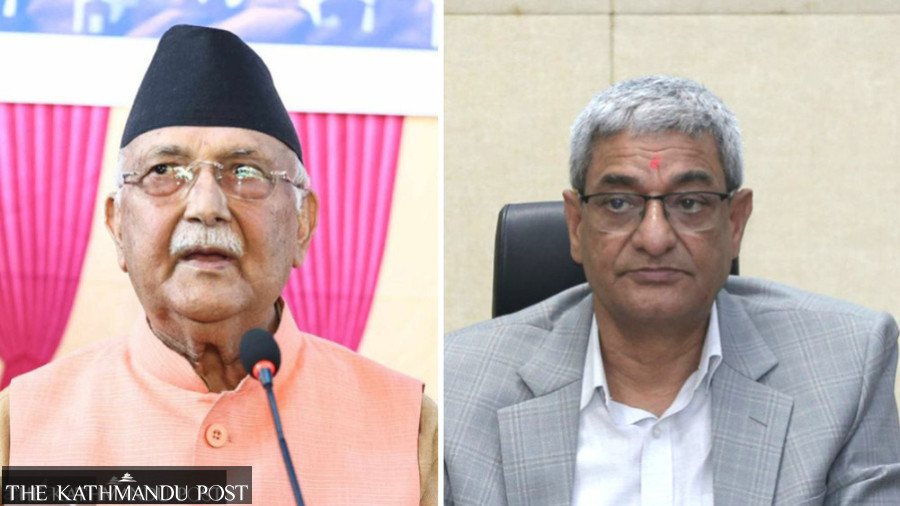
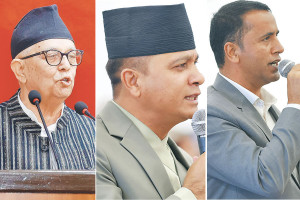
The former prime minister and then home minister have cited their busy schedules for not appearing before the rights watchdog. KP Sharma Oli (left) and Ramesh Lekhak Post File Photos
The National Human Rights Commission (NHRC) is still waiting for statements from then prime minister KP Sharma Oli and his home minister Ramesh Lekhak before finalising its report on the heavy loss of life and property during the Gen Z protests in early September that claimed 76 lives.
The constitutional human rights watchdog has been investigating the human loss in the first day of protest on September 8 and unprecedented loss to public and private property on the second day on September 9. Lily Thapa, a member of the commission who is leading the investigation, said they are in the final stage of completing the report. “Statements from 154 people have already been recorded in connection with the incidents,” she told the Post. “We are waiting for statements from then prime minister, Oli, and home minister Lekhak.”
Both have yet to provide their statements to the commission citing their busy schedules with party activities. The Oli-led CPN-UML is holding its general convention on December 13-15. Similarly, Lekhak’s party, the Nepali Congress, has scheduled its general convention for January 10-12.
“We are expecting they will allocate time very soon,” said Thapa. Even though he has not commented on the NHRC’s request to record his statement, Oli has been openly refusing to appear before the Gauri Bahadur Karki-led high commission formed to investigate the state atrocities and anarchy during the two-day protest.
The NHRC, in its preliminary investigation, blamed the government’s failure to anticipate the intensity of the Gen Z demonstrations, as well as the declining morale of security agencies, for the huge loss of lives and properties.
In a brief monitoring report made public on September 26, the constitutional human rights watchdog said the first half of the first day of protests on September 8 was peaceful. “Incidents of arson, followed by the deaths of protesters in police shootings later in the day, resulted in violence. Monitoring revealed that the deaths caused by police firing on the first day led to indiscriminate arson and vandalism on the second day,” read its preliminary report.
The commission said the report is based on its continuous monitoring of the situation across the country during and after the Gen Z protests, which were launched to demand an end to corruption and the establishment of good governance. “The government’s inability to assess possible causes that could have led to such incidents reflects a serious weakness. The decline in the morale of security personnel after the incident has created further challenges to maintain law and order,” the NHRC preliminary report said.
Meanwhile, the commission said its performance has been affected by inadequate resources, the lack of a dedicated office building, delays in addressing conflict-era cases, impunity stemming from poor implementation of its recommendations, and the executive’s traditional mindset towards human rights.
Presenting the commission’s annual report to President Ramchandra Paudel on Sunday, its chair, Top Bahadur Magar, said the Constitution of Nepal has incorporated various aspects of human rights as fundamental rights. However, people have yet to fully exercise these rights in practice.
“The commission has realised that it is important to implement policy and legal provisions in a practical manner. Similarly, ensuring the fulfillment of socio-economic and cultural rights, addressing climate change and its impacts, safeguarding the right to a clean environment, protection of human rights in business, and ensuring the rights of marginalised groups have all emerged as major challenges,” he said in a statement.
The annual report for the fiscal year 2024-25 shows that only 13.29 percent of the commission’s recommendations have been fully implemented.
While 34.12 percent have been recommended fully, 52.60 percent remain unimplemented. The implementation of the commission’s recommendations has declined every passing year.




 15.26°C Kathmandu