Government mulls ordinance to clear legal hurdles to allow Nepalis abroad to vote
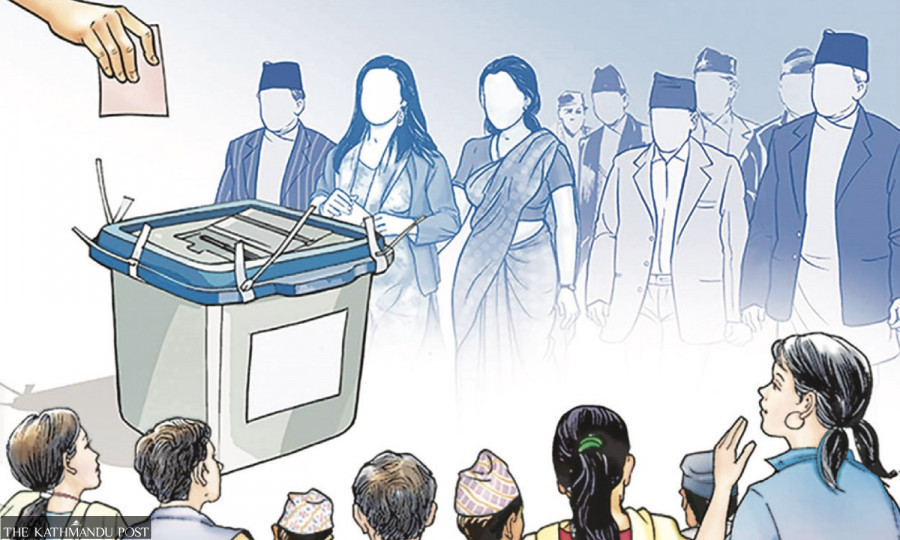
Officials doubt the feasibility of diaspora voting this time, say it will require ‘enormous homework’ and a lot of diplomatic dealings. Post file illustration
In what appears to be an attempt to save face, the Sushila Karki government is preparing to issue an ordinance to clear legal hurdles to allow the Nepali diaspora to vote even as the Election Commission has just three months to hold the polls.
The commission has said it is very much on track to hold the March 5 elections as it started preparations immediately after the election date was announced on September 12. Ever since taking the helm, Karki and her ministers have been expressing commitment to ensure voting rights to Nepalis residing abroad. However, other than the announcements and working on the draft of the ordinance, the government has not taken any concrete logistic and diplomatic measures to make sure the diaspora can vote.
Yet it is coming up with an ordinance with the provisions to allow Nepalis away from their home country to vote. After finalising the draft ordinance, the Ministry of Home Affairs has forwarded it to the Ministry of Law, Justice and Parliamentary for the review. The law ministry in turn has already forwarded it to the home ministry, which is in the process of presenting it to the Cabinet, according to a senior government official.
“It is the government that creates a feasible environment for the elections. The commission only executes it,” said Ram Prasad Bhandari, acting chief election commissioner. “If the government thinks it is still possible to allow the diasporic population to vote and it is capable of creating an environment, we are ready for it.”
Some top officials at the commission say attempts are being made to portray the commission as unprepared. “We have been hearing that some leaders and activists are trying to suggest that it is the commission that does not want to ensure voting rights for the Nepali diaspora,” said a senior commission official. “Let me remind them that around three years ago, the commission drafted a law to this effect and forwarded it to the government, but nothing was done in all these years.”
The official went on, “You cannot pressure the commission to ensure voting, which requires at least two years of preparation, when there are only three months left. We are ready to resign from our positions to clear the way for those who can make this happen. That is our challenge to them.”
The voter registration has already closed. Allowing the diaspora to vote will require reopening of the registration process which will take at least a few weeks. Also officials at the commission say allowing Nepali diaspora to vote will require enormous homework and a lot of diplomatic dealings to convince the host countries. The majority of Nepali migrants live in Gulf countries that do not hold elections.
Different Gen Z groups and leaders from Rastriya Swatantra Party have been pressing the government for granting voting rights to the Nepali diaspora citing the Supreme Court’s ruling. The government has cited the Supreme Court’s rulings to ensure diaspora voting under the proportional representation system.
A division bench of justices Sapana Pradhan Malla and Purushottam Bhandari, on April 27, 2017, had directed the government to allow Nepali citizens living abroad to vote.
“Make all necessary arrangements for ensuring the voting rights of all Nepalis living abroad,” the verdict said. It said Nepalis who have not renounced their citizenship, not acquired citizenship of another country, hold the voter identity card issued by the Election Commission, and have their names on the lists updated by a diplomatic mission should be allowed overseasvoting.
With no progress in implementation, the court’s Judgement Enforcement Directorate, in July, reminded the commission to implement the order. The directorate was activated following the pressure from lawyers affiliated to the RSP.
“Every decision should be taken after proper feasibility analysis rather than engaging in a politics of appeasement,” said the official at the commission. “Preparations for allowing diaspora to vote should start years before the elections, not when the poll is just around the corner.”




 27.61°C Kathmandu