Squatter children endure repeated displacement and a future in limbo
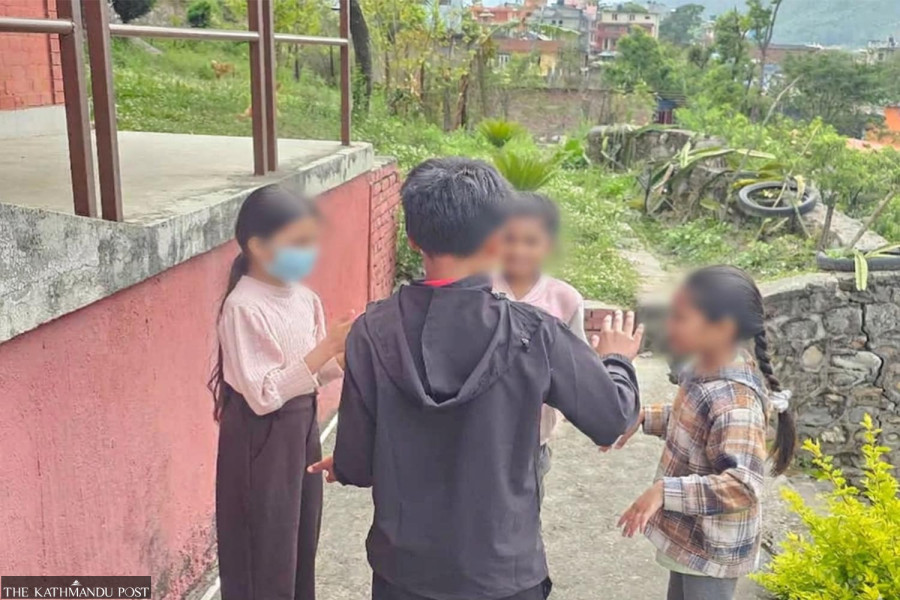
Nine-year-old Bishwanath Gurung has survived eviction, displacement and floods, but family instability and bureaucratic hurdles threaten his future. Post File Photo
A heartbreaking video circulating on social media platforms since Saturday morning captured the agony of displaced squatter children in Kathmandu. In the footage, nine-year-old Bishwanath Gurung stands shivering in a rain-soaked t-shirt and trousers. His bare feet are caked in thick mud, his eyes red and swollen from crying, as his small hands desperately clutch a tattered bag containing his only remaining worldly possessions.
Bishwanath is one of the scores of children left effectively homeless following the government's aggressive demolition of a squatter settlement in Shantinagar on April 24. Alongside his grandmother Menuka Gurung, the young boy was forcibly relocated to the Radha Swami Satsang holding centre in Kirtipur. However, their temporary shelter turned into a nightmare at midnight on Saturday, when torrential rains triggered flash floods and inundated the facility.
While adults scrambled through the dark to save themselves and salvage belongings from the rising waters, the children bore the brunt of the chaos. Bishwanath, who had spent months carefully preserving a few salvaged belongings from his demolished home, was forced to flee into the night empty-handed. By Sunday morning, he was spotted wandering aimlessly across the flooded holding centre, visibly traumatised, shivering without warm clothes, and barefoot.
"The floodwaters rushed in so fast that we could barely save our lives, let alone our clothes or utensils," said Menuka Gurung, speaking from yet another temporary relocation site at the government holding centre in Kharipati.
"My grandchildren have suffered far more than I have. We were packed into a government vehicle and driven across the city in the dead of night, finally arriving here in Kharipati past 1:00 am on Sunday. The children haven't slept, they haven't eaten properly, and they are terrified."
The harrowing images of Bishwanath quickly sparked widespread public outrage, prompting reactions from political figures. Harka Sampang Rai, the chairperson of the Shram Sanskriti Party, announced a cash assistance package of Rs50,000 for the family via social media on Sunday. "The money was handed over to us, and it has provided some immediate relief," said Menuka. She is quite worried that the stability of her grandchildren has been lost and they have been traumatised.
Bishwanath’s plight is not an isolated incident but the latest chapter in a prolonged saga of displacement of the evacuees. Kantiur reported on the young boy on April 30, just a few days after the Shantinagar demolition. The news reports detailed how the sudden arrival of municipal bulldozers shattered the lives of dozens of schoolgoing children.
During that initial encounter, Bishwanath was found sitting amidst the rubble of his former home, staring blankly as his father salvaged bricks. "I had just managed to reach grade five," Bishwanath had said in a tearful voice. "Now everything is gone. My parents are stressed about finding a room, and I haven't been enrolled in a new school yet. When the bulldozers came, I couldn't even save the remote-controlled toy car and the toy horse my grandmother bought me. All my friends are separated."
For days after the eviction, the family slept under a makeshift tarpaulin sheet pitched precariously near the banks of the Bagmati river. Even then, the elements offered no mercy. "The rain leaks inside and we get completely soaked," Bishwanath had shared during the internal displacement period in late April. "The wind was so strong it blew our plastic chairs away. I keep seeing the bulldozers in my nightmares, roaring and crushing big houses down. I just want them to stop coming."
Compounding the trauma of state eviction is a deeply fractured domestic life. Bishwanath and his older sister, Bishnulaxmi, who studies in grade six, have been raised almost exclusively by their grandmother. Their parents separated eight and a half years ago, and both have since remarried other individuals.
The second meeting with Bishwanath took place on the very day the news report was published in Kantipur. The siblings were getting drenched in a light drizzle. They did not even have a change of clothes and were shivering from the cold. When we asked their grandmother, Menuka, who was living under a temporary tarpaulin sheet, what she covered them with when it got cold, she replied, "I have a plastic mat; I cover them with that."
Their father and mother, who had been present during the previous visit, were nowhere to be seen that day. Bishwanath explained in a faint voice, "Father lives with my stepmother and my sister. Mother has also remarried. We live with our grandmother."
Our third meeting with the siblings during our reporting took place on May 7 at the Jana Bikash Secondary School in Balkhu. At noon, the school principal led us to a classroom to meet the children who had come to the school from the holding centre. Bishwanath was there in the classroom, with his classmates. "We have moved to the holding centre in Kirtipur now. Grandmother sent us here to study. They said they will give us books, notebooks, and clothes," Bishwanath shared, visibly thrilled at the prospect of receiving new supplies.
The fourth meeting with Bishwanath happened on June 15. He had missed school that day because the food regularly supplied to the Kirtipur holding centre had been significantly delayed. With no food arriving, the displaced residents had staged a protest by banging their plates. "The food didn't arrive. Since we would be hungry, grandmother didn't send me to school," said Bishwanath when we arrived, just as he was eating a second helping of the freshly delivered food.
Bishwanath’s father lives in a rented room with his second wife and their young daughter, and when Bishwanath and his sister try to visit him, there is no peace or space for them.
The situation with their biological mother is even more harrowing. "Bishwanath once went to stay with his mother, but his stepfather physically assaulted him, kicking him down the stairs. He came back with a severe head wound. After that, I resolved that no matter how difficult my financial situation becomes, I will protect these children myself. They are the very pieces of my heart."
Menuka had spent years operating a modest tea shop in the Shantinagar settlement, investing her life savings and taking out heavy loans to build a permanent structure for her family. The demolition erased both their shelter and their sole source of livelihood within a matter of hours.
On the day the house was demolished, Menuka was most worried about her grandchildren. Bishwanath watched the destruction blankly for a long time before bursting into uncontrollable tears. Though some onlookers patted him on the back and told him not to cry, he could not bear it. Clutching an umbrella, he walked away from the scene.
Along the way, he found a Nepali flag and carried it with him. The video of him holding the national flag went viral on social media at the time, just as it has now. The image of the young boy carrying the national flag against the backdrop of the ruined settlement caught widespread public attention.
Even now, Bishwanath frequently cries with his grandmother as he remembers their home. He often asks her, "Grandma, why did the government tear down our house?"
The instability has severely disrupted the children’s education. Following their initial transfer to the Kirtipur holding centre, Menuka enrolled them at the Jana Bikash Secondary School in Balkhu. However, the transition was painful.
Overwhelmed by homesickness and unfamiliar surroundings, Bishwanath ran away from the Balkhu school on his very first week, walking miles back to the Guhyeshwari Secondary School near Shantinagar, where his old friends and familiar teachers were located.
Furthermore, basic institutional bottlenecks threaten their academic future. Neither Bishwanath nor Bishnulaxmi possess official birth certificates—a mandatory requirement for school board registrations in Nepal. "To get their birth certificates, the local authorities demand the marriage registration certificate of their biological parents, who separated years ago and refuse to cooperate," said Menuka. "The old school administration knew us and allowed them to study out of pity, but new schools will not tolerate this lack of documentation indefinitely."
On Sunday, Home Minister Sudan Gurung visited the flood-affected victims at the Kharipati holding centre, offering assurances that the government would arrange daily dedicated transport vehicles to ensure the displaced children could travel from Bhaktapur to their respective schools in Kathmandu.
However, the promises proved hollow. On Monday morning, no government vehicle arrived at the gates of the Kharipati centre. Refusing to let her grandchildren miss another day of classes, Menuka took matters into her own hands, manually navigating public transport to escort the children back to their original school near the demolished settlement.
"They were incredibly happy to be back among their old classmates and teachers today," said Menuka, her voice cracking with emotion as she contemplated the highly uncertain future lying ahead for her family. "But I cannot stop worrying. How many days will they be allowed to study peacefully here before the government decides to move us to yet another unknown location?"




 18.54°C Kathmandu