Flood-hit evacuees from Kirtipur holding centre worry about children’s education
Flood-displaced families say shifting to Bhaktapur could derail children’s education unless the government delivers on transport promises. Protesters demonstrate at Maitighar in Kathmandu on Sunday demanding proper arrangements for landless squatters who were earlier evicted from various settlements. Deepak KC/TKP
The government’s emergency relocation of dozens of displaced landless families from a flooded holding centre in Kirtipur to temporary shelters in Bhaktapur has brought fresh anxiety over children’s education, as parents fear the move will disrupt schooling just months before examinations.
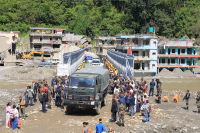
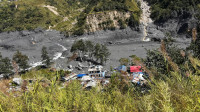
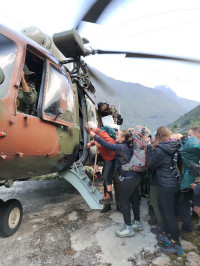
The concerns emerged after floodwaters entered Radha Swami Satsang holding centre in Kirtipur on Saturday afternoon, forcing families to flee with little time to rescue their belongings. Authorities then began transferring residents to government-run holding centres in Kharipati and Bode in Bhaktapur, with vehicles continuing to transport people until late Saturday night.
According to Anand Singh Bhat, chairman of the High Powered Committee for Integrated Development of Bagmati Civilisation, 77 people had been relocated to Kharipati and another 60 to Bode by Sunday morning.
“Some families have arranged accommodation on their own,” Bhat said. “One family has rented a room in Kirtipur, some have gone to relatives, and an elderly woman with mental health problems has been placed under the care of Manav Sewa Ashram.”
For Hirahari, who arrived at the Bode holding centre, the biggest worry is not the loss of household belongings but the education of his two grandchildren.
“They studied at Bishwaniketan School in Thapathali,” he said. “There is no transport from here to the school. I am worried their studies will suffer.”
He said government representatives had assured families that children’s education would not be disrupted and that transport arrangements would be made. Officials also promised employment for one family member. “They have made these commitments, but we do not know whether they will keep their word,” he said, urging the government to provide permanent settlement as soon as possible.
Sixty-seven-year-old Menuka Gurung reached the Kharipati holding centre with her grandson and granddaughter at around 1am on Sunday after spending hours stranded outside the flooded Kirtipur shelter.
“We were brought here after midnight and only had food once we arrived,” she said.
Her concern is similar. “My grandchildren used to take a bus from Balkhu to Guhyeshwori Secondary School in Shantinagar. Their examinations are approaching, and I fear this relocation will affect their studies.”
She said ministers who visited the holding centre on Sunday assured families that transport would be arranged so children could continue attending their existing schools.
Home Minister Sudan Gurung, Education Minister Sasmit Pokharel, Minister for Women and Children Sita Badi, Health Minister Nisha Mehta and Labour Minister Ramji Yadav visited the shelters on Sunday to meet displaced families.
Land Management, Cooperatives and Poverty Alleviation Minister Pratibha Rawal also met residents in Kharipati and reiterated the government’s commitment to providing permanent land ownership certificates.
“I had earlier said land ownership certificates would begin to be distributed in the second week of July,” Rawal told the displaced families. “Distribution has already started in Bardiya and will gradually expand to many districts across Nepal from next week.”
Not all displaced families have accepted relocation.
Forty-three-year-old Nita Basnet was back at the flooded Kirtipur shelter on Sunday afternoon with her husband and children, cleaning and drying belongings damaged by floodwater.
She said her family had spent Saturday night in Kharipati before returning to Kathmandu to search for rented accommodation closer to their children’s school.
“We are looking for a room here, but no landlord wants to rent a room to a family of seven,” Basnet said. “We have too many children, so people refuse us.”
Her 15-year-old daughter Binisha Magar, who studies in Grade 9 at Bishwaniketan School, said the family returned because remaining in Bhaktapur would jeopardise her education.
“We came back to find a room because staying there would interrupt our studies,” she said. Basnet said the Rs25,000 relief provided by the government was insufficient to cover relocation costs. She works as a domestic helper in two households and fears prolonged displacement could also cost her livelihood. “I am trying to rebuild our lives with whatever I earn, but it is becoming increasingly difficult,” she said.
Bhat said the government was considering two options for schoolchildren: providing transport so they could continue attending their existing schools or enrolling them in nearby public schools if necessary.
“There are government schools close to both holding centres,” he said. “We are serious about protecting the children's education and health.” He added that the government would continue providing food and accommodation until families found longer-term solutions.
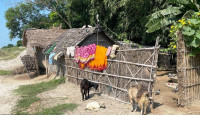
The displaced families are among hundreds forced into temporary shelters after informal settlements along riverbanks were demolished under the government’s river corridor clearance campaign. The families were accommodated across seven holding centres in Kathmandu, Bhaktapur and Kavrepalanchok while authorities worked on longer-term rehabilitation plans.
Initially, 294 people from 87 households were accommodated at a lodge in Machhapokhari, 277 people from 65 households at the Radha Swami Ashram in Kirtipur, and 355 people from 99 households at the Electricity Training Centre in Kharipati, Bhaktapur. Another 115 people from 24 households were housed at the Agricultural Training Centre in Bode, Bhaktapur, 80 people from 21 households at the Drinking Water Training Centre in Nagarkot, 195 people from 45 households at the Nepal Red Cross holding centre in Banepa, and 172 people from 47 households at the Ichangunarayan Apartments.
Some centres, including those in Nagarkot, Banepa and Bode, had already been emptied earlier this week as the government prepared to consolidate accommodation elsewhere. Plans to close Kharipati also faced resistance from the displaced squatters.
Bhat said those plans had now been suspended following the Kirtipur flooding.
“Kharipati and Bode will remain operational until the current crisis is resolved,” he said. “Ichangunarayan continues to house mostly elderly, sick and physically vulnerable residents, and food supplies are being provided there while families prepare their own meals.”




 16.49°C Kathmandu