Bird flu leaves Kavre poultry farmers counting losses as they await compensation
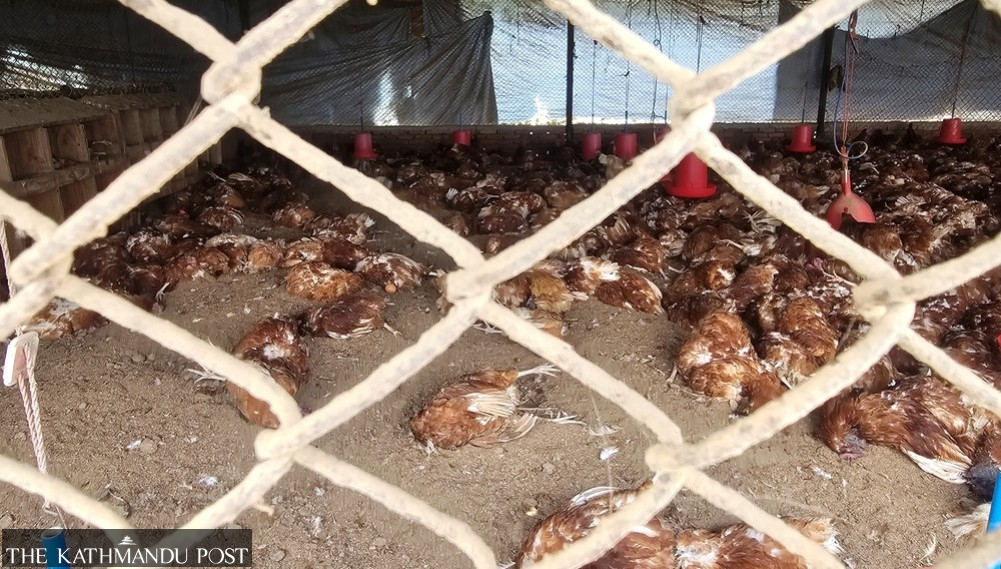
While authorities have contained the outbreak in seven districts, the virus continues to spread across the Kathmandu Valley and Kavre, exposing weak quarantine enforcement and poor farm biosecurity. The virus remains active and uncontrolled in Kathmandu, Lalitpur, Bhaktapur and Kavre. Meanwhile, authorities have contained the outbreak in Jhapa, Morang, Sunsari, Mahottari, Bara, Chitwan and Nawalparasi. Post Photo
Eight years ago, Pradip Karki invested Rs150,000 to start a poultry farm on rented land in Panauti Municipality-8, hoping to build a sustainable livelihood. Over time, the 43-year-old from Panauti Municipality-6 expanded the business to 5,000 layer chickens and was earning around Rs150,000 a month. Encouraged by steady returns, he had planned to double his flock.
Those plans collapsed three days ago when bird flu was confirmed at his Fresh Krishi Farm.
Following the confirmation, a team from the Department of Livestock Services culled all 5,000 chickens, destroyed eggs, feed and equipment that had come into contact with the infected birds, wiping out years of investment in a matter of hours.
“Years of hard work and millions of rupees in investment disappeared overnight,” Karki said. “The business had finally begun to do well. I wanted to expand it, but bird flu destroyed everything. I am back to square one.”
According to Karki, raising a layer chicken to the egg-laying stage costs about Rs1,300. That means his investment in the flock alone exceeded Rs6.5 million, excluding feed, labour and other operating expenses.
A healthy flock of 5,000 birds generated an average monthly income of around Rs150,000 under normal market conditions. That income has now vanished, along with the jobs of the farm’s two employees.
Karki had borrowed about Rs7 million from a bank to expand the business. With the farm shut down, he now faces mounting concern over loan repayments.
“My loan instalments are due, but my income has fallen to zero,” he said. “How can I repay the bank when the business itself no longer exists?”
To prevent further transmission of the virus, authorities have prohibited poultry farming at the site for the next three months.
The prospect of having no income for at least a quarter of a year has left Karki uncertain about the future.
“My family’s only source of income is gone,” he said. “I might survive for a while by borrowing from friends, but what happens after that? How do I start again?”
The farm supported not only his family but also two workers, both of whom have now lost their jobs.
“I cannot afford to keep paying them when there is no business,” he said. “I have sent them home for now. If I manage to restart the farm, I will call them back.”
Although the government provides compensation to farmers whose poultry is culled, Karki said officials have yet to tell him when the money will arrive or how much he will receive.
Without timely relief, he fears he will not have enough capital to rebuild the business.
“If the compensation is delayed, I have no way of starting from scratch,” he said. “Right now, I am worried not only about surviving the next three months but also about what comes after.”
Karki said the outbreak has shaken confidence across the poultry sector. Although infections have so far been confirmed only among layer chickens, rumours circulating in the market have also hurt broiler producers.
“The virus has been detected only in layer farms,” he said. “But many consumers now believe all poultry is unsafe. As a result, demand for both chicken meat and eggs has fallen sharply.”
The decline in consumer demand has placed even farms free of infection under severe financial pressure.
Karki said the government must do more than contain the disease. It should also provide accurate public information to prevent panic and restore consumer confidence in poultry products.
Transit routes, weak quarantine and poor biosecurity make Kavre hotspot
While bird flu cases have been reported in several districts, Kavre has emerged as one of the worst-affected areas. According to Dr Bajra Kishore Thakur, chief of the District Veterinary Hospital and Livestock Service Centre, the rapid spread of the virus in the district is linked to the heavy movement of poultry, weak quarantine systems, improper disposal of carcasses and failure to follow biosecurity measures.
Kavre shares a border with the Kathmandu Valley districts of Kathmandu, Bhaktapur and Lalitpur, resulting in the daily movement of large quantities of poultry and poultry products through the district. The district is also a major transit route connecting the hills with Madhesh Province, increasing the risk of the virus spreading through transport networks, Thakur said.
Although the outbreak first emerged in Koshi Province, weak quarantine checks failed to prevent infected poultry from being transported to other areas, allowing the virus to enter Kavre, he added.
According to the Department of Livestock Services, the avian influenza outbreak has spread to 11 districts. The virus remains active and uncontrolled in Kathmandu, Lalitpur, Bhaktapur and Kavre. Meanwhile, authorities have contained the outbreak in Jhapa, Morang, Sunsari, Mahottari, Bara, Chitwan and Nawalparasi.
The first bird flu case in Kavre was confirmed at Sanga in Banepa Municipality-13. Thakur suspects the virus was introduced through poultry transport vehicles passing through the area. The possibility of transmission through wild birds has also not been ruled out, as the H9 strain of the virus was previously detected in crows in Namobuddha.
Thakur said some farmers had failed to properly dispose of dead poultry, leaving carcasses in bushes and open areas instead of burying them safely. Wild birds, including crows, could have fed on the carcasses and carried the virus to other locations.
“Once an infection was detected on a farm, the necessary biosecurity measures were not properly implemented,” he said. “This negligence allowed the virus to spread to neighbouring farms.”
So far, the disease has been confirmed at 17 locations across Kavre, including wards 7 and 13 of Banepa Municipality and wards 5, 8, 9 and 10 of Panauti Municipality. Thakur attributed the concentration of cases in Panauti to improper carcass disposal, frequent movement of transport vehicles and vulnerable supply routes.
To contain the outbreak, authorities in Kavre have culled 62,519 chickens and ducks and destroyed 36,001 kilograms of feed and 9,800 eggs. The culling was carried out at 17 affected farms in Banepa and Panauti following biosecurity protocols, causing losses worth millions of rupees to the district’s poultry sector.
The livestock office has intensified surveillance in Banepa, Nala, Dhulikhel, Panchkhal and Roshi Rural Municipality. Thakur said awareness programmes were being conducted in coordination with farmers, local representatives, stakeholders and the media.
Farmers who lost their poultry are now urging the government to speed up compensation payments. Under existing rules, affected farmers are eligible to receive up to 75 percent of the government-assessed value of culled poultry.
The livestock office said compensation would be distributed after the Compensation Assessment Committee, chaired by the chief district officer, completes its evaluation. Gopal Kumar Adhikari, chief district officer of Kavre, said the recommended compensation rates had already been forwarded to the concerned central authorities.
“The relief will be distributed as soon as the central budget is released. We are continuously following up to ensure the funds are cleared quickly,” Adhikari said.
He clarified that compensation would vary depending on the type, age and production stage of poultry, based on the government’s rate sheet.
“Not everyone receives the same amount per bird. The 75 percent compensation is calculated according to predefined categories,” he said.
Meanwhile, Dr Umesh Dahal, director general of the Department of Livestock Services, said the department had started transferring compensation directly into the bank accounts of affected farmers.
He assured that farmers would receive the payments within a few days based on valuations submitted by district-level committees.




 14.79°C Kathmandu