Landslides threaten 60 locations in Kedarsyu and Thalara in Bajhang
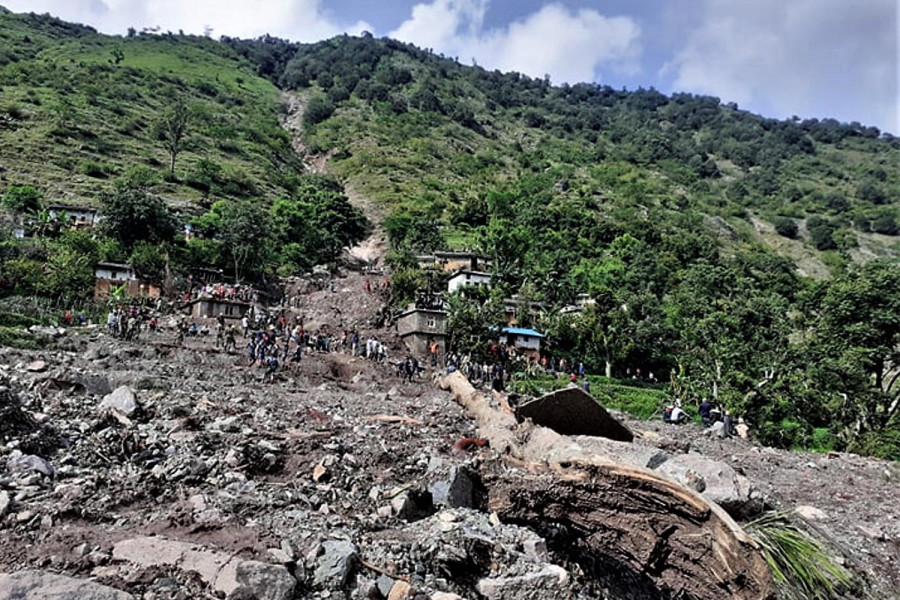
Decades of erosion, unplanned road construction and delayed mitigation measures have destabilised fragile slopes. With each monsoon season, fear becomes routine in these settlements. Nights are marked by sleeplessness, sudden alarms and hurried evacuations as the ground shifts and cracks widen. Basant Pratap Singh/TKP
A landslide above the Narugad Khola in Kedarsyu Rural Municipality has been active for around 21 years, slowly reshaping the landscape and swallowing settlements in its path. What began as a minor slope failure caused by continuous erosion at the foot of Talibada, Kathkhet and Maitoli villages has since grown into a sprawling landslide, gradually consuming much of Kathkhet and now advancing towards Talibada and Maitoli.
Locals say the movement has never really stopped. Instead, it accelerates during the monsoon and remains active even in the dry months, giving residents little respite.
With each monsoon season, fear becomes routine in these settlements. Nights are marked by sleeplessness, sudden alarms and hurried evacuations as the ground shifts and cracks widen.
“The landslide has reached the edge of our courtyard. When it rains heavily, it starts roaring, the houses shake and we flee,” said Meena Bista of Talibada. “We take our children and run towards the school ground.” She said such evacuations have become frequent over the past three years, with families repeatedly forced to flee their homes in the middle of the night.
As the landslide continues to destroy structures and erode land, 68 families from the three villages in wards 2 and 3 of Kedarsyu Rural Municipality have already been displaced. Another 76 families are still living within the active risk zone, where deep cracks have appeared across fields and settlements. Several houses have developed structural damage and are now considered unsafe for habitation.
Most displaced families have moved to other parts of the municipality, staying with relatives or renting temporary accommodation. Local residents also report that some households have left the country altogether, migrating to India in search of safety and livelihoods.
“Those who had some savings managed to buy land elsewhere and rebuild their homes,” said Bhuji Devi Bista of Talibada. “After losing everything, some are now living in forests, while others have gone to India. But we are still here, trapped in a danger zone.” She added that those who remain have no alternative land or property and continue to live in constant fear of collapse.
“We don’t know when we will be buried,” she said.
Residents say the landslide is no longer a seasonal problem. Movement is visible throughout the year, with cracks widening after every spell of rain and small slips occurring even during dry periods. The unpredictability has intensified anxiety, making everyday life more difficult than before.
“Every year, houses are swept away and families are forced to leave,” said local resident Nare Bista. “The landslide is like a monster with its mouth wide open. We do not know when it will swallow all three villages.” He said repeated land loss has already destroyed more than 500 ropanis of cultivable land, leaving families without agricultural income or secure shelter.
“All the fields that sustained us are gone,” he said. “One after another, the houses are being washed away regularly. We have neither land to farm nor a place to live. We are helpless and have nowhere to go.” He added that many vulnerable families remain in place simply because they have nowhere else to move.
Widespread threat across Kedarsyu
The risk is not confined to Talibada, Kathkhet and Maitoli. According to a study by the National Disaster Risk Reduction and Management Authority (NDRRMA), landslide threats extend across Kedarsyu Rural Municipality, placing 1,356 families in 33 settlements at risk.
Of these, 572 families across 18 settlements are classified as high risk. These include Billibagar, Chaudam Bagar, Bakhet, Saisyu, Sudada, Baigad, Mallesi, Tyadigaon, Jasuda, Talikhet, Siradi and Seku, among others. Many of these settlements sit on steep slopes or unstable terrain, where road cutting and drainage problems have further weakened the ground.
The area has also experienced repeated deadly landslides over the past two decades.
On July 4, 2020, a landslide in Mallesi of Ward 8 killed seven people, including four members of a single family, and destroyed 17 houses and sheds. The disaster displaced multiple households and left large sections of the settlement uninhabitable. Survivors have since rebuilt in safer locations, but many remain within the same hazard-prone zone due to lack of land elsewhere.
Earlier, in 2008, another landslide in Bagthala had claimed four lives, an incident that reflects the long-standing vulnerability of the region.
Tragedy across the river in Thalara
Across the river from Kedarsyu lies Diklagaun in Thalara Rural Municipality, another site of repeated landslide activity. On the night of October 18, 2021, a catastrophic landslide struck the settlement, burying members of two families while they slept.
After an eight-day search operation, rescue teams recovered only four bodies. Nineteen people were declared missing and later presumed dead, bringing the total fatalities to 24.
Among the victims were 18 members of one family and six from another, a loss that wiped out entire households and left surviving relatives devastated.
One of the survivors, Kalak Sarki, lost his mother, wife, children, brother, sister-in-law and nieces and nephews in the disaster. He remains one of the few from his extended family still living in the area.
Even years later, he says the psychological impact has not eased.
“The village was completely destroyed,” Kalak said. “If it rains like that again, nothing will remain here.” He said 12 families have already abandoned Diklagaun due to fear of another disaster.
“Those who had money bought land elsewhere and moved to towns or cities,” he said. “But where are we supposed to go?”
A geological assessment conducted by the NDRRMA has identified 23 families in Lower Diklagaun as highly vulnerable. The study also lists 18 landslide-prone villages across wards 4, 5, 6, 8 and 9 of Thalara Rural Municipality, placing 542 families at risk. These include Regam, Dorgaon, Ainwada, Kuch, Bayal, Tallo Dikla, Toli, Duwali, Pikhet, Sunargaun, Biskhet, Panditgaun, Ambagar, Jhyabagar and Khani.
Experts say the situation is worsening and requires immediate intervention, particularly relocation of high-risk households.
“If those at risk are not relocated immediately, a major disaster could strike at any moment,” said Tej Bohara, who worked in disaster risk reduction in Kedarsyu and Thalara for about three years. He said some landslide zones could still be stabilised using bio-engineering techniques, but only if action is taken without delay.
He warned that delays in relocation and mitigation could lead to avoidable loss of life during the next monsoon cycle.
Road construction worsening instability
The NDRRMA study identifies unplanned road construction as a major factor aggravating landslide activity across Bajhang’s fragile terrain. Excavation without proper engineering design, combined with inadequate drainage systems, has made slopes increasingly unstable.
Lekh Prasad Bhatta, a geologist at the NDRRMA who contributed to the study, said rainfall events are now triggering more frequent slope failures due to weakened geological conditions.
“In several areas, heavy rainfall causes underground rock and soil layers to fracture and weaken,” he said. “Where roads are cut without proper engineering and drainage systems are not managed, rainwater turns loose debris into fast-moving flows that expand landslide zones.”
Bhatta said authorities have already informed both municipalities and communities about the risks.
“We have submitted detailed recommendations, including relocation of high-risk households and slope stabilisation measures,” he said. “But implementation remains slow.”
He warned that failure to act on these recommendations could lead to large-scale disasters at any time.
Local governments cite resource constraints
Despite repeated warnings, residents say little visible progress has been made in relocation or long-term mitigation. Local governments acknowledge the scale of the problem but say financial and technical limitations restrict their ability to act.
“Many villages are now uninhabitable. We have kept emergency supplies ready for about 1,300 families, including tarpaulins and basic utensils,” said Lekhraj Rawal, disaster focal person of Kedarsyu Rural Municipality. “We have also identified emergency shelters in different locations.”
However, he said relocating entire settlements is beyond the municipality’s financial capacity.
“It is simply not possible with our current budget,” he said.
Similarly, Prakash Rokaya, chairperson of Thalara Rural Municipality, stated that some bio-engineering interventions are carried out in partnership with ‘People in Need’, an non-governmental organisation, but large-scale relocation remains unfeasible.
“The risk is widespread, and more than 600 families need relocation,” Rokaya said. “That level of intervention cannot be managed at the local level alone.”
He added that repeated appeals have been made to provincial and federal authorities, but support has been limited.
District-wide vulnerability
According to the District Disaster Preparedness and Response Plan, landslide risk extends far beyond Kedarsyu and Thalara. At least 47 additional villages across the remaining municipalities of Bajhang are also classified as high risk.
A 2018 study by GeoHazards International further highlighted the scale of the problem, identifying 6,630 landslide-prone locations across 12 municipalities in the district.
Mukesh Kumar Kesari, chief district officer and chairman of the district disaster management committee, Bajhang, said existing policies are limiting preventive action.
“If a house is destroyed, the government provides Rs 500,000 in relief,” he said. “But under current rules, we are not allowed to spend even Rs 50,000 to prevent that loss before it occurs.”
He said this imbalance between response and prevention is worsening vulnerabilities across the district.
“Such policy constraints are clearly deepening the crisis on the ground,” he said.




 23.98°C Kathmandu