RSP under NHRC scrutiny over underage party members
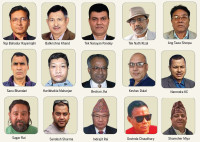
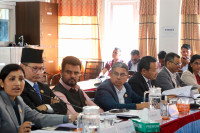
The constitutional watchdog seeks clarification after the party reported over 35,000 members under 18. The party says it was a technical error.Office bearers and central members of the Rastriya Swatantra Party take oath from party president Rabi Lamichhane (not seen) at their central office in Banasthali, Kathmandu, on Wednesday. Six office bearers and 99 central members were elected from the Chitwan general convention. Dipesh Darshandhari/TKP
The National Human Rights Commission has initiated an inquiry into reports that the Rastriya Swatantra Party enrolled minors as party members. In a letter to the party, the constitutional human rights watchdog has asked it to clarify whether it inducted children below the age of 18 as party members.
In the party’s organisational report presented during the closed-door session of its first general convention on June 23, then General Secretary Kabindra Burlakoti said that 35,257 of the party’s 523,465 members were under the age of 18. The report drew strong criticism from various rights organisations.
The commission then took up the matter. In a statement, the commission’s assistant spokesperson, Shyam Babu Kafle, said the rights body had taken serious note of the report.
“If, as indicated in the report presented at the party’s general convention, memberships were indeed issued to children under 18, such an act would be contrary to Nepal’s prevailing laws and the country’s international commitments,” the statement reads. “Therefore, the party is requested to provide detailed information as soon as possible regarding whether such memberships were distributed.”
Section 21(1) of the National Human Rights Commission Act requires concerned bodies and officials to provide the commission with information and cooperation upon request.
Organisations and individuals working in the field of child rights had earlier objected after the report revealed that the RSP had enrolled children as party members. The National Campaign for Children as Zones of Peace (CZOP) raised concerns after Burlakoti’s organisational report stated that more than 35,000 children under 18 were party members. Lawmakers from different political parties also raised the issue in Parliament, urging the ruling party to act in accordance with the constitution and existing laws.
According to the report endorsed by the convention, 13,001 of the underage members were from Bagmati Province, the highest among all provinces, while Karnali had the fewest with 1,414. The report also listed 6,235 underage members in Koshi, 3,030 in Madhesh, 5,116 in Gandaki, 3,648 in Lumbini and 2,813 in Sudurpashchim.
The party was quick to respond, saying the inclusion of children in the report was an error. In a statement, General Secretary Bipin Acharya said the figures presented at the convention represented only a preliminary analysis of data in the party’s digital membership application system and did not constitute an official record of verified members.
“The party remains fully committed to the Constitution of Nepal, the Political Parties Act, prevailing laws, and Nepal’s international treaty obligations regarding children’s rights and the principle of keeping children free from political activities,” the statement reads.
“Since applicants enter their personal details themselves, some applications contain errors. These included confusion between the Bikram Sambat and Gregorian calendar systems, typographical mistakes in dates of birth, and cases where applicants entered the current date or other incorrect information instead of their actual birth date. As a result, the system mistakenly showed some applicants as being under 18.”
Acharya’s statement further reads, “Our party has no policy, practice or institutional objective of enrolling children below 18 as party members or involving them in political activities in that capacity.”
The statement also says the figures presented in the convention report should not be regarded as the number of actual party members. Of the 523,465 membership applications registered in the digital system, 390,112 have already been verified by the relevant party committees using official documents, including citizenship certificates. The remaining applications are still being verified. Therefore, the party says it is inaccurate to treat the unverified preliminary applications as final and authenticated membership records. It adds that it has launched a comprehensive technical and administrative review of its membership system.
The RSP also announced measures to prevent similar mistakes in the future. It said the digital system will automatically identify applicants shown as being below the age of 18 and prevent those applications from entering the approval process. It also said all verified membership records will be reviewed again to determine whether any minors were granted membership. If any are found, those memberships will be cancelled immediately, the party said, adding only individuals aged 18 or above will remain in the party’s official membership records.
In his statement, Acharya expressed regret that preliminary application data, which had not undergone sufficient testing and verification, was included in the public report presented at the convention, creating confusion among the public, the media and other stakeholders. He said the party is committed to reviewing all records, making the necessary corrections and publishing updated figures as soon as possible.
Article 39 of Nepal’s constitution prohibits the exploitation or improper use of children. The Children’s Act, 2018 , defines a child as any person below the age of 18 and prohibits the use of children for political purposes. Violations of the law are punishable by a fine of up to Rs50,000, imprisonment for up to one year, or both.




 15.33°C Kathmandu