Concrete barriers help curb wildlife incursions in Bardiya
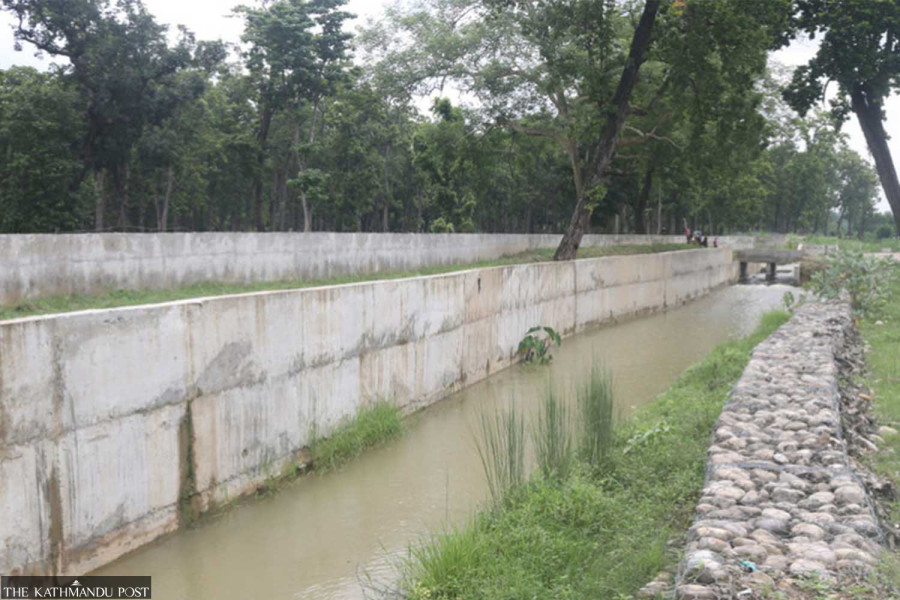
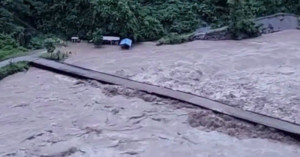
New barriers built along an irrigation canal have reduced elephant and other wildlife incursions into settlements, but communities remain exposed where electric fencing is poorly maintained. A wildlife barrier built alongside an irrigation canal in ward 1 of Thakurbaba Municipality, Bardiya. Kamal Panthi/TKP
A concrete barrier has been built in Thakurbaba Municipality to prevent elephants, tigers and other wild animals from entering settlements and damaging crops after they stray from Bardiya National Park.
The barrier has been incorporated into the walls of a concrete irrigation canal built by the Babai Irrigation Project. The canal runs along the boundary of the national park and has been designed to provide irrigation to farmers while also restricting the movement of wildlife into nearby settlements.
About 808 metres of canal and barrier have been constructed in Dumreni in ward 1 of Thakurbaba for Rs205.998 million, according to Gopal Sharma, chief of the Babai Irrigation Project.
“The concrete canal also serves as a barrier against wildlife,” Sharma said. “It will provide irrigation to the Dumreni area while preventing damage caused by wildlife.”
The new structure has reduced the movement of elephants, tigers and other wild animals into settlements, according to residents.
“Since the concrete barrier was not there in the past, we lived with the constant fear that wild animals could enter at any time,” said Nain Kami of ward 1. “The canal and barrier will help reduce conflict between people and wildlife.”
Farmers in areas protected by the barrier are now less worried about wildlife attacks and crop losses. Thakurbaba Municipality said no human casualties or crop damage caused by elephants or other wild animals had been reported in areas where the new barrier has been completed.
Thakurbaba Municipality shares a 32-km boundary with Bardiya National Park. The municipality completed another 15 km of concrete wildlife barrier in mid-July as part of efforts to reduce human-wildlife conflict, said Mayor Tilak Lamsal.
“The barrier has reduced the intrusion of elephants, deer, wild boars and other animals into settlements and helped ease human-wildlife conflict,” Lamsal said. “It is also expected to help increase agricultural production by protecting crops.”
The municipality financed the barrier through federal and provincial grants and its own internal resources. More than Rs300 million has been spent on constructing roughly 15 km of concrete barrier, according to the municipality.
But the risk remains high in areas where concrete barriers have yet to be built.
Over the past 16 years, Bardiya National Park, the National Trust for Nature Conservation and various donor agencies have installed nearly 65 km of electric fencing and wire mesh along vulnerable sections of the park boundary.
The electric fencing is designed to deliver a shock when touched, discouraging elephants and other wild animals from crossing it. But the system has proved vulnerable to damage. Elephants sometimes use dried logs to knock down or damage the fencing, allowing them to break through and enter settlements.
Ajit Tumbahangphe, chief of the Bardiya Conservation Programme (BCP) under the National Trust for Nature Conservation (NTNC), said inadequate community monitoring and poor maintenance were among the main reasons wildlife continued to breach the fencing.
“We carry out repairs as soon as we receive information about damage,” he said. “We have also installed wire mesh alongside the electric fencing.”




 24.67°C Kathmandu