Livelihoods of mountain communities are unravelling as overharvesting drains Himalayan herbal wealth
Once sustained by abundant yarsagumba and other medicinal herbs, people in high altitude settlements are now on the brink as indiscriminate harvesting practices have rapidly depleted alpine stocks.Residents of Surma Rural Municipality in Bajhang forage for yarsagumba in this undated photo. Basant Pratap Singh/TKP
A long line of women and children can be seen every day along the banks of the Bahuligad river in Chainpur, the district headquarters of Bajhang. Stretching nearly one-and-a-half kilometres from the suspension bridge near Khulamanch (open-air theatre) to the concrete bridge at Chaud, they spend hours crushing stones into gravel under the scorching summer heat.
Among them is 62-year-old Junkiri Bohara of Thakunnada in ward 4 of Surma Rural Municipality. Frail and suffering from illness, she no longer has the strength to swing a heavy hammer. Instead, she collects small stones washed down by the river, carries them in a doko (bamboo basket) with the support of a walking stick, and painstakingly crushes them into gravel with a small hammer.
"In months when I am healthy, I can prepare enough gravel to fill two tractor trailers. If I fall ill, even filling one becomes difficult," said Junkiri, wiping sweat off her face. "I have no choice. I have to work to survive. At this age, I never imagined I would have to earn my living by breaking stones."
A tractorload of gravel sells for around Rs4,500 in Chainpur. The income is barely enough for Junkiri to pay rent for a small room near the river and cover her daily expenses.
Her life was very different just eight years ago. She lived with her husband, three sons, daughters-in-law and grandchildren. Their farmland produced food for only two or three months each year, but the family comfortably met the rest of its needs by collecting yarsagumba (Ophiocordyceps sinensis) and other medicinal herbs from the highlands. Together, they earned between Rs1 million and Rs1.2 million annually during the three-month harvesting season, enough to feed the family throughout the year and still save money.
Their fortunes changed after her husband suffered from a kidney ailment. The family exhausted its savings and borrowed heavily for his treatment, but he did not survive. The debt remained, while the income that once sustained them steadily disappeared.
"If herbs were still available like before, my sons could have repaid the loans," said Junkiri. "Now there is hardly anything to collect. They had no option but to leave for India in search of work. I am here alone." When illness prevents her from working, she survives on the monthly allowance provided to single women.
Most of those breaking stones along the Bahuligad are from Surma Rural Municipality, and many share a similar story.
Until about a decade ago, Surma was considered one of Bajhang's most prosperous rural municipalities because of its rich medicinal herb resources. Income from yarsagumba, wild garlic (Allium ursinum), satuwa (Paris polyphylla) and other valuable herbs have transformed lives. Families bought land in Chainpur, Dhangadhi and Mahendranagar, built houses, and sent their children to study engineering, nursing, science and other expensive courses in cities including Kathmandu, Pokhara, Butwal and Dhangadhi.
"Earlier, medicinal herbs were abundant, so people could earn a decent living," said Jharana Bohara of ward 4 of Surma. "Now the herbs have almost disappeared. We have poor harvests, no jobs and no choice but to take whatever work we can to feed our families." She said selling pebbles now pays her room rent and her children's school expenses.
Residents say that in the mid-2000s, people from the rural municipality had almost stopped going to India for work, as the medicinal herb economy flourished. That trend has reversed now.
"Many children have been forced to leave school in the cities and return to the village because their parents can no longer afford the costs," said Manisha Bohara, another resident of Surma. "The herbs are no longer available as they once were, and there is no other reliable source of income."
The hardship extends well beyond Surma. Communities across Saipal, Talkot, Masta, Chhabis Pathibhera, and Bungal rural municipalities and the northern settlements of Jayaprithvi Municipality, where farming yields little because of the harsh Himalayan terrain, have also seen their livelihoods deteriorate as herb production has declined.
With few alternatives, many families have locked their homes and migrated together to India for wage labour.
Dharma Singh from Pimi village in ward 1 of Jayaprithvi Municipality is among them. Until six years ago, the family lived comfortably. Every spring, Dharma collected yarsagumba and other medicinal herbs from the alpine pastures of Saipal and Surma, earning between Rs300,000 and Rs500,000 a year. His wife, Shanti, supplemented the family income by gathering herbs such as satuwa and sugandhawal from nearby forests. Although their farmland produced food for only a few months, the earnings from medicinal herbs met the family's needs.
Now, their modest house stands locked and deserted. The once neatly plastered walls have faded, weeds cover the courtyard, and the family has not returned for six years.
"They earned well in the beginning, but then suffered losses for three or four consecutive years because they could no longer find enough herbs," said their neighbour Laldevi. "Each year they spent months in the highlands, borrowed money to survive, and eventually left for India to repay their debts. They have not returned in six years."
Former ward chair Gagan Bahadur Singh said Dharma's family is far from alone. In the village of around 400 households, more than 70 families that once depended on medicinal herbs have abandoned their homes after their traditional source of income collapsed.
The decline mirrors a broader crisis unfolding across the country’s highland districts. Falling yarsagumba production, climate change, overharvesting and weak regulation have steadily reduced the availability of precious medicinal herbs, undermining rural economies that became heavily dependent on the seasonal trade. For families in Bajhang, what was once a pathway out of poverty has increasingly become a story of dwindling opportunity, mounting debt and migration in search of survival.
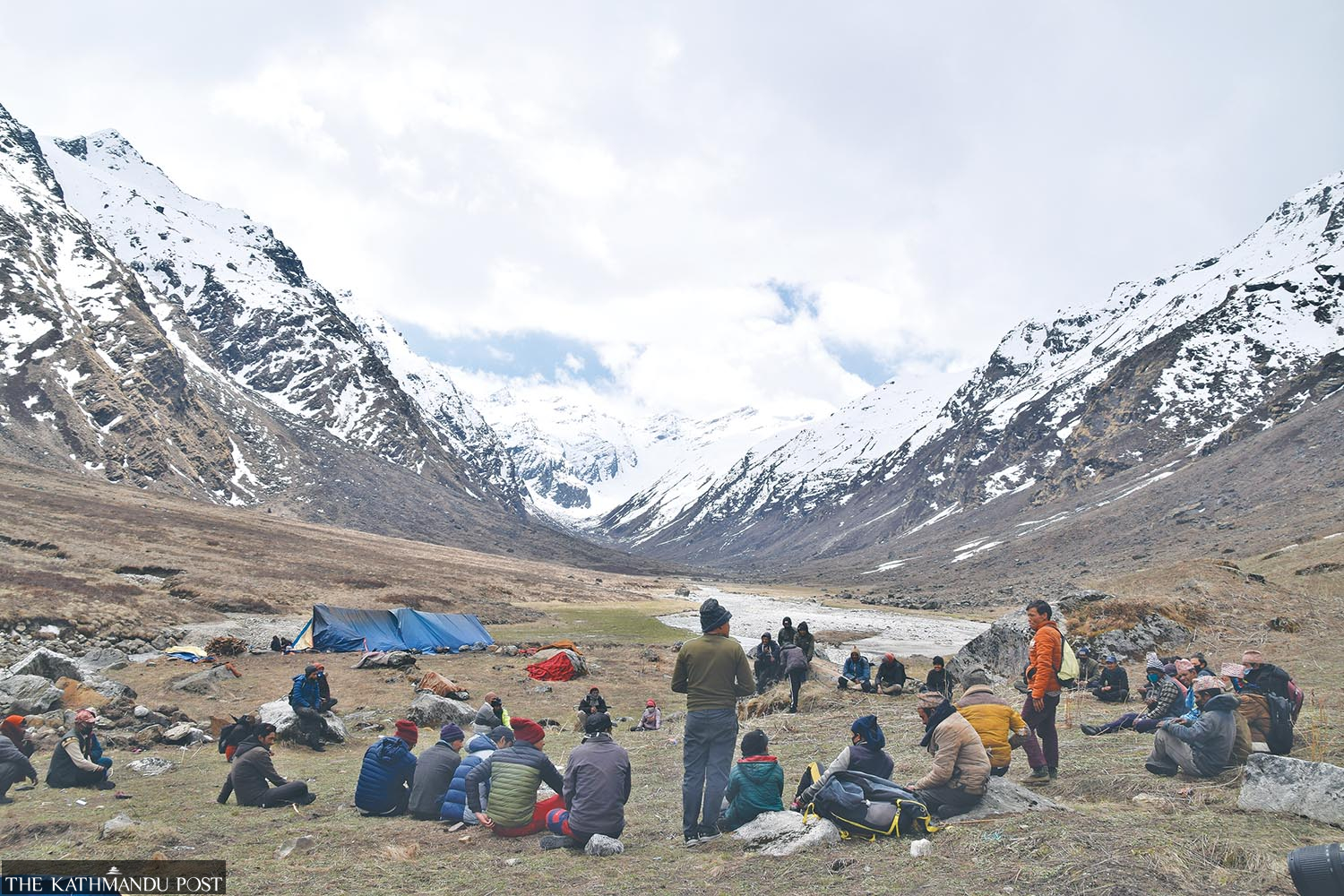
People out for yarsagumba harvest rest near Saipal Himal in Bajhang in this photo from 2021.
When yarsagumba vanished, so did the income
For years, selling yarsagumba, locally known as kira, was the main source of income for Govinda Rokaya's nine-member family at Lokanda in ward 4 of Talkot Rural Municipality. Their farmland produced barely enough food for two months, but earnings from the prized Himalayan fungus sustained the household from the early 2000s. The income covered food, clothing, cooking essentials and the children's education, while the savings enabled the family to build a new house in the village.
Life followed a predictable rhythm. The family spent three months each year collecting yarsagumba in the alpine pastures and devoted the rest of the year to farming. That routine brought financial stability for more than 15 years. But over the past five or six years, everything has changed.
Now, the 45-year-old often carries heavy loads of cement, steel rods, zinc sheets and pipes on foot for three or four days to remote settlements in Saipal Rural Municipality. At other times, he travels to Nainital, Kharikhan and Kedarnath in India in search of wage labour.
"I was happy when the yarsagumba collection freed me from working in India. Now the same hardship has returned,” said Govinda. He recalls collecting as many as 500 to 600 pieces of yarsagumba in a single day between 2003 and 2008. "When we found one, there would often be another 200 or 300 nearby," he said. "Now, after finding one, you have to walk to the next ridge to look for another. Some days you search until your hands and feet ache but return empty-handed."
Between 2007 and 2017, abundant harvests and high market prices fuelled an economic boom across rural Bajhang. The fungus, often called the ‘Himalayan gold’ lifted many families out of persistent poverty. Yet the prosperity proved short-lived.
Dhanya Bohara of Surma is another example. Fifteen years ago, his 19-member family struggled to make ends meet, and four of his six sons left school before completing grade 5 because he could not afford the fees. Once the yarsagumba trade flourished, however, the family's fortunes changed dramatically. By collecting yarsagumba, they built a concrete house in the village, purchased land in Chainpur and, within a few years, earned as much as Rs2.5 million.
Those days are gone. Over the past five or six years, the entire family has earned only Rs200,000 to Rs300,000 annually from yarsagumba. "There are more mouths to feed now. The fungus is no longer found like before, and we have no other source of income,” said Dhanya.
Prices plunge as well
Although there are no official figures showing the exact value of Bajhang's medicinal herb trade, traders estimate that the business was worth around Rs2 billion annually until the fiscal year 2021-22. As production has declined, however, the trade has contracted sharply, forcing many dealers to abandon the trade altogether.
Herbs trader Basanta Khadka said only those whose money remains tied up in advance payments are still trying to continue. "Many traders who were not financially exposed have already quit. Only a few of us are still waiting to recover the advances we paid to collectors,” he said.
According to Khadka, traders traditionally provided collectors with advance payments before the harvesting season. In the past, a collector receiving an advance of Rs200,000 could gather herbs worth Rs500,000 to Rs600,000. Now, many struggle to collect products worth even Rs50,000 to Rs60,000. "When collectors cannot supply herbs equal to the advance they received, they fall into debt," he said. "At the same time, traders are left with huge financial losses."
Dan Bahadur Surmeli, a medicinal herb trader and president of the Bajhang Chamber of Commerce and Industry, estimates that the district's herb trade has declined by around 70 percent compared with eight to ten years ago.
"I alone used to trade herbs worth around Rs250 million a year, and there were traders handling even larger volumes," he said. "Now my firm barely manages business worth Rs10 million to Rs15 million annually."
Data from the Division Forest Office in Bajhang also show a dramatic fall in yarsagumba production. Annual exports, which reached as much as 424 kilograms between 2008 and 2013, had fallen to just 136 kilograms by 2025-26. Collectors are under even greater pressure because prices have dropped alongside production. While yarsagumba sold for as much as Rs3 million per kilogram in the district between 2009 and 2011, it fetched less than Rs800,000 per kilogram last year, said Surmeli.
Various studies point to the same trend. The International Union for Conservation of Nature (IUCN) has reported a 30 percent decline in yarsagumba populations over the past 15 years and listed the species as vulnerable. When the assessment was published on the IUCN Red List in 2021, Gregory Mueller, chair of the IUCN Species Survival Commission's Fungi Conservation Committee, said excessive harvesting had pushed the species into a vulnerable state.
After yarsagumba, wild garlic has become one of the most valuable sources of income for mountain communities in Bajhang. Once selling for as much as Rs40,000 per kilogram at the collection point, it has also become increasingly scarce.
"Four or five years ago, one person could collect four or five kilograms in a day," said Bimala Bohara of Saipal Rural Municipality. "Now it takes four or five days just to gather one or two kilograms. If this continues, we may soon struggle to find even a single plant."
The sharp rise in wild garlic prices encouraged excessive and untimely harvesting, accelerating its decline. According to Division Forest Office records, exports dropped from 4,428 kilograms in the 2021-22 fiscal year to 1,800 kilograms last year.
Other high-value herbs are showing similar trends. Satuwa, once harvested in volumes of more than 3,700 kilograms annually before collection restrictions were imposed because of overexploitation, has nearly disappeared. Forest Office records show exports fell from 145 kilograms in 2023-24 to just 10 kilograms the following year. The IUCN also lists the species as vulnerable.
Production of other commercially important herbs, including kutaki (Picrorhiza kurroa) and setakchini (Polygonatum verticillatum), has also declined steeply. Exports of kutaki have dropped from around 48,000 kilograms annually to just 4,500 kilograms, while setakchini exports have fallen from about 60,000 kilograms to 24,000 kilograms over the past 10 years.
Bajhang, a mountain district in Sudurpaschim province, also exports dozens of other medicinal plants, including padamchal, bishjara, bojho, bhrigiraj, bhojpatra, sugandhawal and resinous pine products, all as raw materials. The number of herb species exported has fallen from around 40 herb species a decade ago to just 25 today. According to Dipesh Pakurel, a medicinal plant specialist at the Asia Network for Sustainable Agriculture and Bioresources (ANSAB), medicinal herbs account for roughly 40 percent of annual household income in many Himalayan communities. As production declines, families that depend heavily on these resources are facing growing economic hardship.
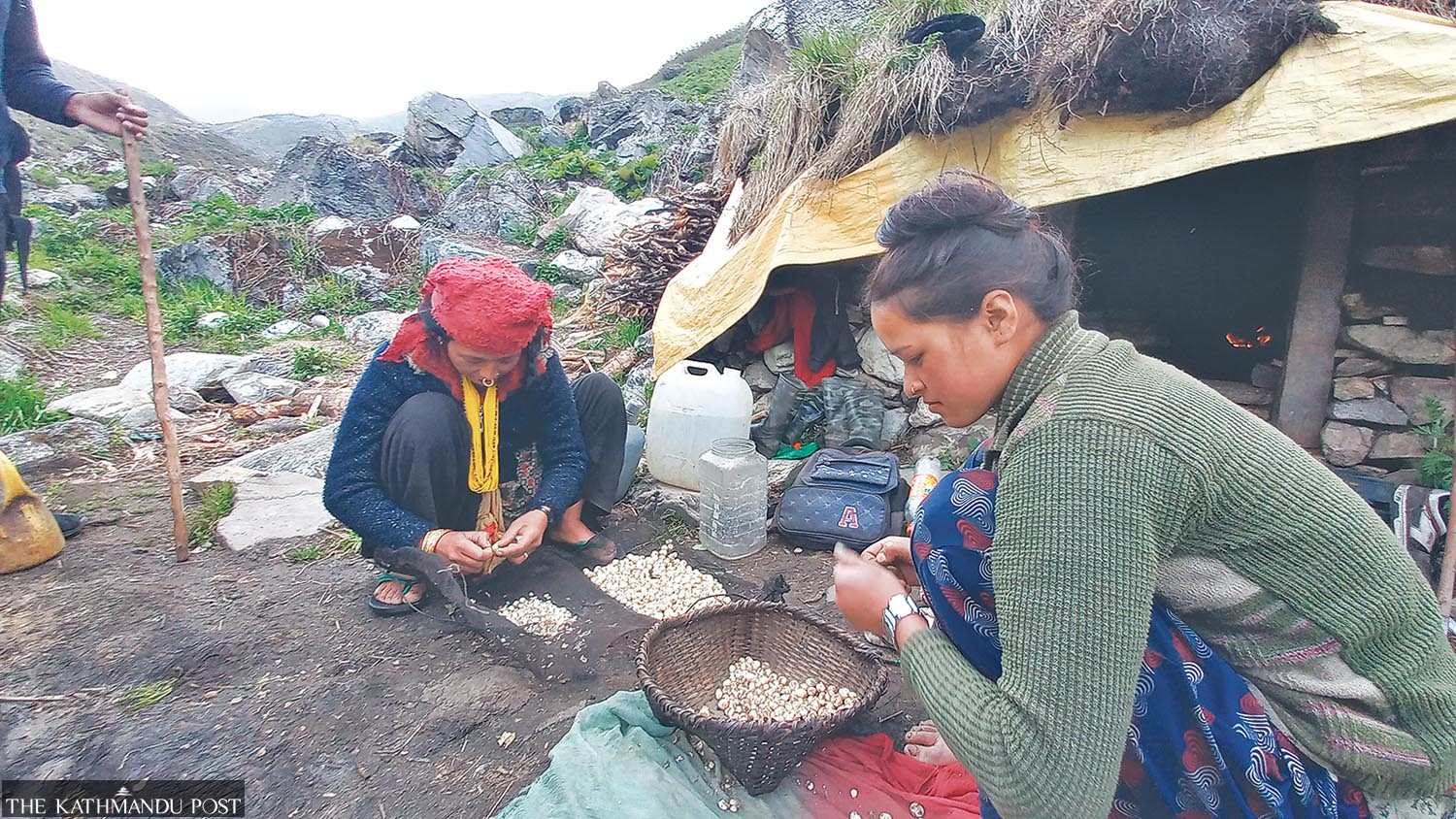
Residents of Surma Rural Municipality sort freshly harvested wild garlic.
Overharvesting, deforestation and waste deepen herbal crisis
According to some long-time collectors, the sharp decline in medicinal herb production is largely the result of excessive, untimely and indiscriminate harvesting practices.
Dil Bahadur Bohara of Surma recalls that a collector once earned Rs300,000 to Rs400,000 in a single season from wild garlic alone. Now, even the most successful gatherers struggle to make Rs15,000 to Rs20,000.
"Wild garlic and satuwa should be harvested only after their seeds mature and fall to the ground towards the end of June. But people now begin digging them up as early as April. We have harmed our own future. If the plants had been allowed to seed first, they would regenerate. Instead, they are uprooted before they can reproduce,” said Dil Bahadur.
Collectors say a similar pattern has devastated yarsagumba. A widespread practice locally known as jhadu laune involves clearing away grasses and digging into the soil while searching for the fungus. According to them, the method destroys the underground larvae that later develop into yarsagumba.
"When people remove all the grass cover and dig into the soil, living larvae are exposed," said collector Jaya Bahadur Rokaya of ward 4 of Talkot Rural Municipality. "Once the larvae are brought to the surface, they cannot develop into fungus."
Environmental scientist Uttam Babu Shrestha, who has long studied yarsagumba and Himalayan medicinal plants, says climate change has compounded the problem.
"Declining and increasingly erratic winter snowfall, together with rising temperatures, has affected the Himalayan ecosystem as a whole," he said. "Medicinal plants are naturally among the species suffering the consequences."
Collectors also blame widespread deforestation in alpine herb-growing areas. Devendra Dhami of Saipal says forests that once covered entire hillsides have virtually disappeared over the past decade. "Places that once had dense forests are now almost barren. Yarsagumba thrived beneath shrubs and trees, while herbs such as satuwa simply cannot survive without forest cover,” he said.
Large quantities of firewood are cut every harvesting season by collectors and shepherds. A study by the International Centre for Integrated Mountain Development (ICIMOD) in 2021 found that an average group of six collectors burns around 12 kilograms of firewood each day. With roughly 15,000 people reaching the alpine meadows every season, total firewood consumption during the three-month harvesting period is enormous, accelerating forest loss and degrading habitats for species including wild garlic, satuwa, atis and other valuable herbs.
Seasonal grass fires have further worsened the decline. Former Saipal Rural Municipality chair Rajendra Dhami said some collectors deliberately set fire to grasslands hoping it will make yarsagumba easier to spot, while others ignite fires out of frustration after unsuccessful searches. Carelessly discarded cigarette butts also spark wildfires. "Once a fire spreads, it destroys not only yarsagumba habitat but every plant growing in those alpine pastures," he said.
Waste left behind by thousands of seasonal collectors has become another serious concern. Plastic packaging, discarded clothing, bottles and other rubbish now litter many high-altitude meadows.
"Medicinal herbs do not grow where there is broken glass, plastic or other waste," said Kalpana Bohara of Surma. "Even a piece of discarded cloth can prevent yarsagumba from emerging."
An ICIMOD study conducted in Saipal found that more than 40,000 quintals of waste had already accumulated in harvesting areas, and the volume has been increasing every year.
Dinesh Rokaya of Sahara Nepal, which collaborated on the study, warned that if the trend continues, not only yarsagumba but many Himalayan medicinal plants could disappear from these pastures within a few years.
Heavy seasonal sheep grazing is also believed to contribute to the decline. More than 25,000 sheep from Bajhang and neighbouring districts graze in alpine meadows from spring to autumn, while temporary sheep sheds remain in place for extended periods.
Plant conservationist Reshu Basyal said the crisis cannot be solved simply by blaming collectors or traders. "Many harvesters are unaware of sustainable collection methods," she said. "The priority should be reducing illegal harvesting, creating alternative livelihoods and promoting sustainable management through awareness, regulation and cooperation."
Shambhu Tiwari, chief of the Division Forest Office in Bajhang, said local governments, collectors, forest authorities and the private sector must work together to strengthen conservation efforts and ensure the long-term sustainability of the district's valuable medicinal herbs.




 23.98°C Kathmandu