Nepali farmers battle surging plantation costs as delayed monsoon dims paddy outlook
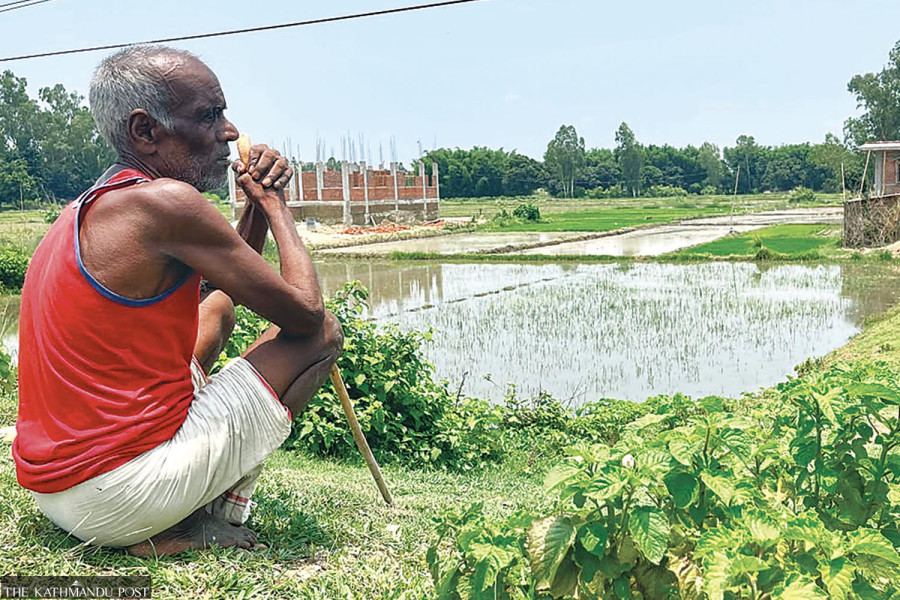
Water shortages, nationwide shortages of fertilisers and seeds, and mounting production costs shave farmer profits off paddy cultivation. Shaini Mandal, 62, a farmer from Arnaha in Shambhunath Municipality-12, pictured close to his paddy field. Bidyananda Ram/TKP
Days after the monsoon was officially declared, farmers across the country have yet to see rainfall they desperately need in the planting season. Fields lie dry, and falling groundwater levels have rendered many shallow tube wells useless.
Although the monsoon entered Nepal about a week late on June 19, farmers are anxious as its progress stalled after reaching Lumbini Province.
The system entered through Koshi Province and spread across Madhesh and Bagmati provinces before covering only parts of Gandaki and a small section of Lumbini, where it has since lost momentum.
“Temperatures across many parts of the central and western Tarai are hovering around 40 degrees Celsius, with no rainfall in sight,” said Sanjeev Adhikari, a meteorologist at the Department of Hydrology and Meteorology.
Heatwaves continue to grip central and western Tarai. As water scarcity worsens, some local governments have begun restricting groundwater extraction. Lumbini Sanskritik Municipality has banned the use of boring wells for paddy transplantation, citing the need to conserve groundwater and prevent the long-term impacts of unchecked deep boring. The municipality has warned that machinery used to pump groundwater for rice transplantation will be confiscated and owners prosecuted.
“Without rain, my seedbeds are dry. I’ve already run my boring pump seven times, and it’s still not enough,” said Pramesh Yadav of ward 7 in Gulariya Municipality in Bardia.
Yadav said soaring fuel prices have multiplied production costs. He bought diesel at Rs223 per litre to operate his irrigation pump.
During the monsoon season, he cultivates paddy on 60 katthas of land and maize on another 17 katthas. He purchased 20 kg of hybrid paddy seeds at Rs750 per kilogramme and spent Rs4,200 on 35 kg of Radha-4 seeds.
“I've used up 77 litres of diesel just to plough the land three times,” Yadav said. “After paying for seeds, transplantation, irrigation, fertiliser and pesticides, cultivating paddy for a season incurs around Rs130,000.”
“Eventually, if we manage a good harvest, the government sets a discouragingly low minimum support price.”
In ward 6 of Kapilvastu's Beloha, Mangatthu Yadav spent Rs3,200 on 40 kg of Sawa Mansuli seeds, enough for 30 katthas of land. He spent another Rs3,200 on weeding and fertiliser.
“The seedlings should have been ready for transplantation within three weeks, but the fields have cracked up without rain,” he said. “The seedlings have dried up. Now I’ll have to spend another Rs8,000 to Rs10,000 to prepare a second batch.”
Ramdas Kewat of Bhavpur, ward 2 in Yashodhara Rural Municipality, cultivates 80 katthas of land. Even in late June, he has not even been able to prepare his seedbeds.
“There is no irrigation here,” he said. “My eyes are tired of looking at the sky, waiting for rain.”
Kapilvastu has around 83,000 hectares of cultivable land. Paddy is cultivated in 65,852 hectares.
Pralhad Thapa of Chandrapur in Rautahat said unpredictable weather, rising production costs and the state's neglect of agriculture have made farming increasingly unsustainable.
According to him, farmers continue to struggle with chronic shortages of fertilisers and quality seeds, inadequate irrigation and an acute shortage of labour. Although mechanisation has expanded, it has also increased production costs, while pumping groundwater has become too expensive for many farmers.
Farmers living near the border often cross into India to buy costly fertilisers and hybrid seeds through informal channels, but there is no guarantee of quality, he said.
Cultivating one bigha of paddy costs between Rs40,000 and Rs50,000, Thapa added.
Until 2010, Rudal Sah of Gamhariya, ward 1 in Phatuwa Vijayapur Municipality in Rautahat, cultivated three bighas of land using a traditional system of shared community labour. Most youths from his village have migrated to cities or gone for foreign employment.
“We used pairs of oxen, organic manure and indigenous seeds,” he recalled. “Now growing even one crop of paddy or wheat has become a struggle from beginning to end. You can't even find enough labourers.”
Sah said the disappearance of native seed varieties, coupled with erratic weather, has increased outbreaks of crop diseases and fall armyworm infestations. A decade ago, he harvested around 160 to 200 kg of paddy per kattha. Today, production has fallen to about 100 kg.
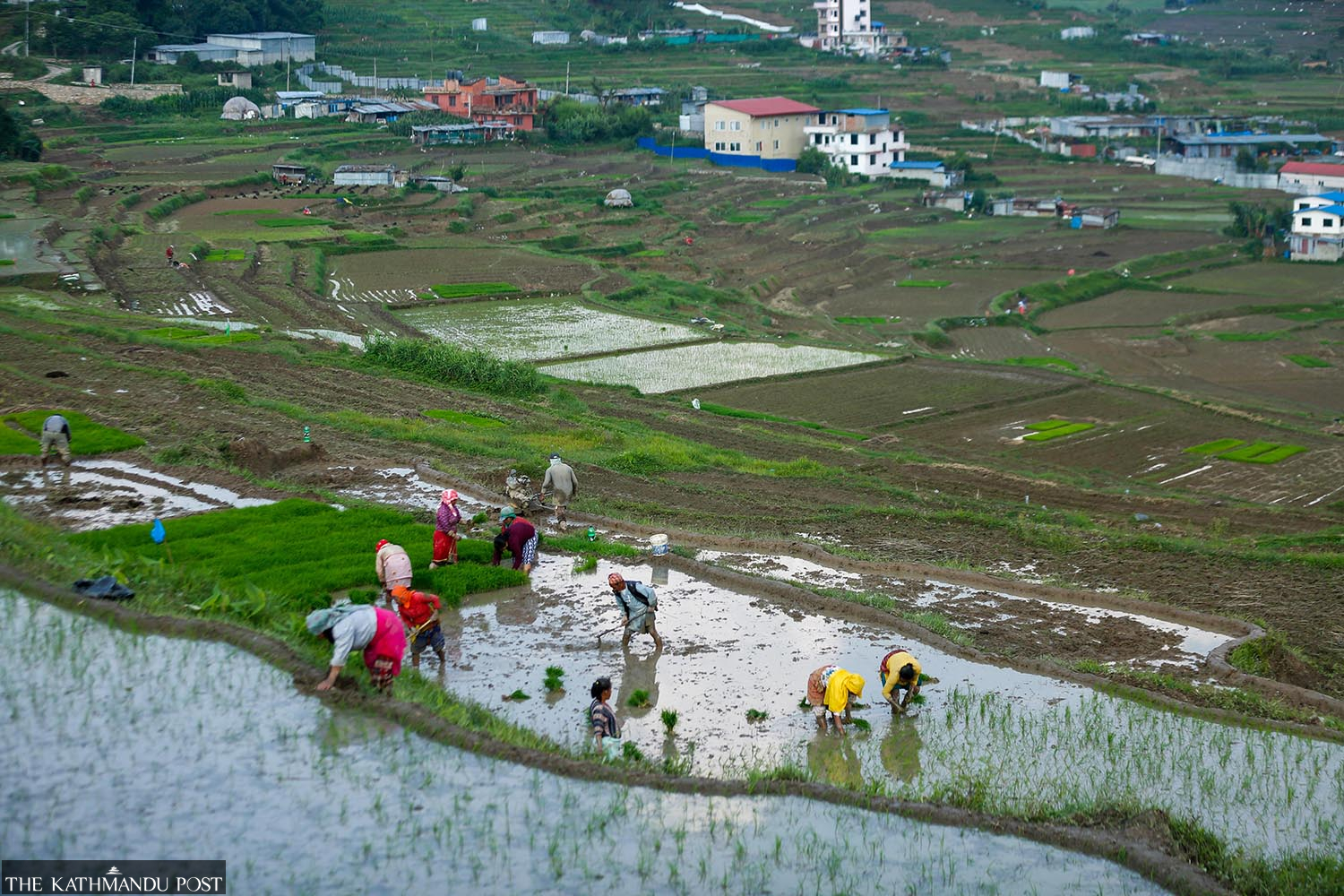
Farmers transplant paddy saplings in the muddy fields of Khokana, Lalitpur. Dipesh Darshandhari/TKP
Chhumaru Sardar of Lakhanthari, ward 1 in Gramthan Rural Municipality, Morang, cultivates seven bighas of own and leased land.
While tractors, threshers and combine harvesters have reduced labour requirements, they have also increased production costs, he said. Erratic weather, rising fuel prices, high wages, limited access to subsidised bank loans, poorly targeted agricultural subsidies and labour shortages remain his biggest challenges. According to him, government subsidies and concessional loans largely benefit those with political or personal connections.
“To farm, you have no option but to borrow money,” Sardar said. “But getting a bank loan is a bureaucratic ordeal. You spend days going from one office to another just to complete the paperwork.”
He hires around 30 labourers for every bigha of land. Cultivating two and a half bighas costs about Rs70,000, meaning his seven-bigha farm requires an investment of around Rs200,000 before harvest.
Although the farm generates around Rs700,000 a year, he said the profit margin is minimal when the value of his family's labour is taken into account.
Kalauddin Ansari of ward 13 in Ramgram Municipality, Nawalparasi West depends entirely on farming for his livelihood, cultivating seasonal vegetables, paddy, wheat and mustard.
“If you calculate the production costs together with the physical labour we put in, we are operating at a loss,” he said.
According to the Agriculture Knowledge Centre in Parasi, the district requires 18,000 metric tons of urea, 12,000 metric tons of DAP and 5,000 metric tons of potash each year.
However, Tara Prasad Khanal, branch manager of Krishi Samagri Company Limited, said only 500 tonnes of urea and 200 tonnes of DAP have been distributed so far. The district has 20,480 hectares under paddy cultivation.
Fifty-year-old Ram Krishna Chaudhary of ward 3 in Rapti Sonari Rural Municipality, Banke cultivates four bighas of land to support a joint family of 10. The family produces between 60 and 70 quintals of paddy annually, besides seasonal maize.
“Technology has advanced compared to the old days, but fertiliser never arrives on time,” he said. “It doesn't rain when we need it. Then when we pump groundwater, electricity is irregular.”
Nepali farmers never receive a fair return on their labour, he lamented. “The government needs to understand our problems and ensure timely supply of fertilisers.”
In the Madi valley of Palpa, farmers have completed paddy transplantation on around 40 percent of the area's 6,000 ropanis suitable for the crop. Although planting is normally completed by early July, unreliable irrigation and dearth of chemical fertilisers continue to delay planting.
“No matter who comes to power, it's always the same story for us farmers,” said Buddhi Raj Basyal of ward 9 in Tansen Municipality.
The 72-year-old harvested around 7,000 kg of paddy a decade ago. Following the split of family property, his annual harvest has fallen to around 3,000 kg.
About 70 percent of farmers in the Madi plains depend entirely on rainfall because irrigation canals are either absent or in disrepair. Palpa has 8,210 hectares under monsoon paddy cultivation, where farmers mainly grow improved and hybrid varieties including Sawa Mansuli, Radha, Khumal, Basmati, US 312 and Sabitri.
Perennial shortages of fertilisers and seeds
In Prasauni, ward 23 of Birgunj Metropolitan City in Parsa, Hiralal Kushwaha was levelling his field under the scorching afternoon sun, preoccupied with one concern: finding DAP fertiliser before paddy transplantation.
“I managed to save one bag of urea from last winter's wheat crop,” he said. “But DAP is nowhere to be found.”
Kushwaha frequently crosses into Raxaul, India, to buy seeds. He said the relentless cycle of ploughing fields, searching for labourers, managing irrigation, hunting for fertilisers and, finally, harvesting has become physically exhausting and financially draining.
Although he has installed a boring well, operating it is costly. His diesel pump consumes 15 litres of fuel every 15 hours, while an electric pump uses one unit of electricity an hour.
“Years ago, we needed very little chemical fertiliser, even though yields were lower,” he said. “Now you won't harvest a single grain without it, even though production has increased several times.”
In Arnaha, ward 12 of Shambhunath Municipality, Saptari, Shaini Mandal sat by the roadside staring at his fields. While neighbouring farmers have begun transplanting paddy, he remains unable to do so because of the fertiliser shortage.
“I cultivate 10 katthas of land under a sharecropping arrangement, where half of the harvest goes to the landowner,” he said. “The fields have enough rainwater, but I can't plant without fertiliser. I've already spent Rs6,000 on tractor ploughing using money my sons sent home from their jobs in the Gulf. If I plant without fertiliser, I won't even recover my investment.”
Another farmer from the area, Suraj Mandal, has begun transplanting paddy across two-and-a-half bighas without fertiliser.
“I installed an agricultural electricity meter, but the voltage is too low to operate the water pump,” he said. “I need fertiliser within the next five days, and the worry of finding it keeps me awake.”
Last year, drought forced him to leave his fields uncultivated. Tractor ploughing, which cost Rs250 per kattha last year, has risen to Rs600 this season because of higher fuel prices.
Saptari has around 78,000 hectares under paddy cultivation.
Rajendra Joshi of Jimuwa, ward 10 in Bhimdatta Municipality, Kanchanpur, owns 10 katthas of land. He said farming has become increasingly unprofitable as production costs continue to rise while returns stagnate.
“The only real benefit is the straw and husk I get to feed cattle,” he said. “Otherwise, growing paddy and wheat brings nothing but financial losses.”
According to Joshi, hiring six to seven labourers for transplantation costs between Rs5,000 and Rs6,000. A bag each of DAP and urea costs another Rs4,000—if available. Harvesting requires another Rs5,000 in labour, while threshing costs an additional Rs3,000 to Rs4,000.
He estimates that cultivating just half a bigha costs nearly Rs30,000 a season. Even with a harvest of 10 quintals of paddy, income barely matches production costs, leaving no profit.
Kanchanpur has around 50,000 hectares under paddy cultivation.
Bagmati logs just 3.5 percent paddy transplantation
Lack of rainfall has slowed paddy transplantation across Bagmati Province, where only 3.5 percent of the total paddy area had been planted as of late June.
During the same period last year, more than 16 percent of transplantation had been completed, according to Sujan Kandel, spokesperson for the provincial Ministry of Agriculture and Livestock Development.
Post photo
Kathmandu district has recorded the highest transplantation rate, with 40 percent of its 5,959 hectares of paddy fields planted. Makawanpur, however, has yet to reach one percent because of the prolonged dry spell.
In Chitwan, one of the province's main agricultural districts, transplantation has been completed on only 1.3 percent of its 28,680 hectares of paddy fields.
The corresponding figures stand at 3 percent in Nuwakot, 2 percent in Ramechhap, 5 percent in Sindhupalchok, 16 percent in Kavre, 8 percent in Rasuwa, 10 percent in Lalitpur, 11 percent in Bhaktapur, 0.41 percent in Dhading, 4 percent in Dolakha and 4.2 percent in Sindhuli.
Across Bagmati's 13 districts, paddy is cultivated on 135,868 hectares of land. So far, only 3,654 hectares have seen transplantation.
Looming drought fears
The met office has forecast below-average rainfall across most parts of the country this summer.
According to meteorologist Adhikari, the forecast indicates higher-than-normal temperatures this season.
Meteorologists attribute the delayed and weakening monsoon to the emergence of the El Niño phenomenon in the Pacific Ocean, a climate pattern associated with drought and reduced agricultural output.
El Niño causes abnormal warming of surface waters in the eastern Pacific, disrupting weather systems worldwide. The resulting changes in atmospheric circulation weaken the South Asian monsoon.
Even Madhesh, Nepal's main food-producing province, is expected to receive below-normal rainfall.
According to the department, there is a 55 to 65 percent probability of below-average precipitation in the eastern part of Madhesh Province, the southern belt of Koshi Province, the southern region of Karnali Province, and most parts of Lumbini and Sudurpashchim provinces.
The south-west monsoon, which lasts from June to September, provides 75 to 90 percent of South Asia's annual rainfall. It is the primary source of water for irrigation, reservoirs and drinking supplies. Below-average rainfall during the monsoon season poses a serious threat to food production and increases the risk of food insecurity.
Experts from the United Nations' Food and Agriculture Organisation have warned that much of Asia faces a high risk of drought this year. The agency has urged governments to identify vulnerable areas early so farmers can delay transplantation, switch to drought-tolerant crop varieties, stockpile livestock feed and secure alternative water sources.
Once the monsoon becomes active again, it will gradually advance towards Sudurpashchim. Adhikari warned that heavy rainfall next week could increase the risk of floods and landslides.
Nepal's annual demand for paddy is around 7 million metric tons, leaving the country with a deficit of about 1 million metric tonnes each year.
According to the Department of Agriculture, growing consumer demand for fine and aromatic rice has contributed to a sharp increase in imports.
The National Agricultural Census 2021 shows that of Nepal's 4.13 million farming households, around 2.76 million, or 67 percent, cultivate paddy.
Farmers say they continue to face obstacles at every stage of production, from buying seeds to selling their harvest. Although all three tiers of government have pledged support for agriculture in their annual budgets, people say there’s little help reaching them.
National paddy productivity has increased from 3.80 metric tons per hectare in 2019-20 to 4.19 metric tons per hectare in 2024-25. Paddy fields account for 54 percent of the country's total cultivated land.
In the previous fiscal year, Nepal produced 5.95 million tonnes of paddy from 1.42 million hectares of land. Paddy accounts for 13 percent of the agricultural gross domestic product and about half of the country's total food grain output, generating an estimated Rs200 billion annually for the national economy.
(Based on the reporting from Phanindra Sangam in Kathmandu, Ram Prasad Chauhan in Bardia, Rupa Gahatraj in Nepalgunj, Manoj Paudel in Kapilvastu, Shiva Puri in Rautahat, Shankar Acharya in Parsa, Bidyananda Ram in Rajbiraj, Parbat Portel in Biratnagar, Nabin Paudel in Nawalparasi, Bhawani Bhatta in Kanchanpur, Madhav Aryal in Palpa and Pratap Bista in Hetauda)




 22.94°C Kathmandu