Bird flu reaches 11 districts as farmers await compensation
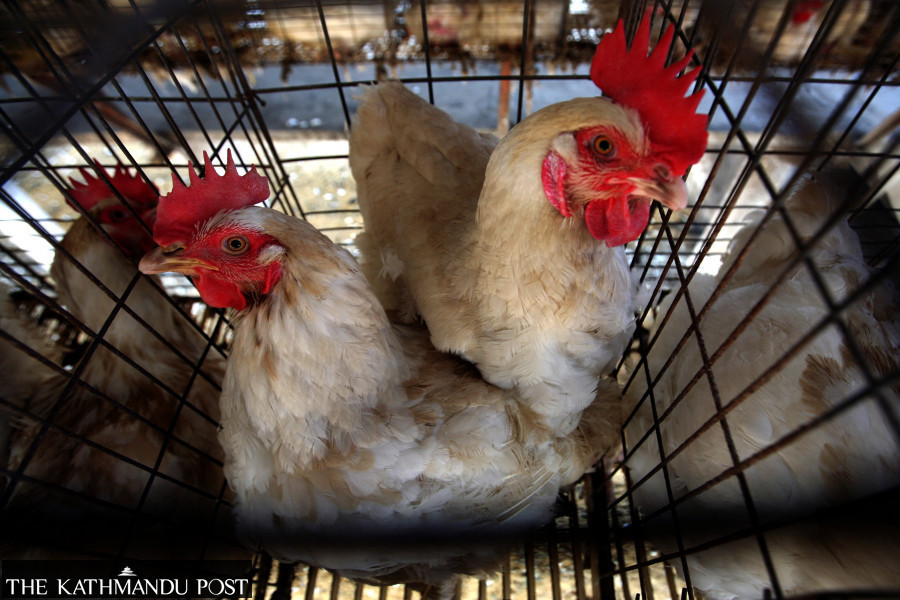
Nearly 600,000 birds have been culled as authorities race to contain the outbreak, while compensation delays deepen financial strain on poultry producers. Post file photo
Bird flu has spread across multiple districts in Nepal, triggering heightened biosecurity concerns, causing large-scale poultry losses and leaving farmers struggling with delayed compensation and mounting financial pressure.
In affected areas, thousands of chickens, eggs and feed have been destroyed as authorities move to contain the outbreak. Farmers say the losses have been severe, with some reporting damage worth millions of rupees, while compensation promised under government relief guidelines has yet to reach many of them.
Dipendra Ashrumali of Damitar in Godawari Municipality-Damaitar, Lalitpur, is among those affected after 5,700 chickens were culled at his farm last week following an outbreak. He also disposed of around 35 quintals of feed and about 1,000 eggs, with total losses he estimates at nearly Rs 6 million.
“I expect relief as the government has promised 75 percent compensation,” he said.
The avian influenza virus A (H5N1) has spread to 11 districts across Nepal, with the outbreak that began on March 18 in Sundarharaicha-4 and Urlabari-8 of Morang evolving into a major hotspot now concentrated in the Kathmandu Valley.
According to Director General of the Department of Livestock Services, Dr Umesh Dahal, infections were confirmed in five locations in the Kathmandu Valley alone on Wednesday. So far, bird flu has been detected in 87 locations across Jhapa, Morang, Sunsari, Mahottari, Bara, Chitwan, Nawalparasi, Kathmandu, Bhaktapur, Lalitpur and Kavre.
The department said active cases remain in Kathmandu, Lalitpur, Bhaktapur and Kavre.
According to official data, around 600,000 poultry birds have been culled so far, along with 989,313 eggs and 195,485 kilograms of feed.
Following confirmation of infection among birds at the Central Zoo in Jawalakhel, the zoo has been closed indefinitely. So far, 37 animals and birds have died, while 24 have tested positive for infection.
New outbreaks have been confirmed in Changunarayan, Suryabinayak and Tokha. Authorities culled 38,795 chickens in wards 2, 8 and 9 of Changunarayan Municipality. Similarly, 8, 9,378 chickens were destroyed in wards 1, 4 and 8 of Suryabinayak Municipality, according to veterinarian Dr Amik Shrestha of the Livestock Service Office, Lalitpur.
He said many birds had already died before containment measures began. He added that the disease is mostly affecting local and layer chickens, while broilers are less affected.
Under the Standards for Relief for Items Destroyed during Bird Flu Control, 2022, farmers are entitled to government compensation based on market value. The standards provide for relief of up to 75 percent of production costs, based on the recommendation of the Rate Determination Committee coordinated by the Chief District Officer (CDO).
However, officials say the scale of the outbreak has created budget shortages.
“Losses were much higher than expected this time, so the budget is insufficient,” said Dr Dahal. “We have already requested the Finance Ministry, through the Agriculture Ministry, for fund reallocation.”
The outbreak that began in March in Morang is estimated to have caused direct losses worth around Rs 600 million, according to the department.
“This is only the immediate damage estimate,” Dr Dahal said. “Farmers are under severe pressure. A farm typically remains closed for at least two months after an outbreak, which disrupts its entire income cycle.”
Only Rs 20 million has been allocated for farmer compensation in the current fiscal year. The department has requested an additional Rs 500 million. For the next fiscal year, Rs 560 million has been allocated for relief.
The Bagmati provincial government has also set aside funds for livestock losses caused by disasters, but compensation is distributed under strict legal provisions and payments are not repeated for the same event. No relief is provided for diseases such as H9, Ranikhet (Newcastle disease) and E. coli, with authorities urging farmers to prioritise biosecurity and hygiene.
According to the Ministry of Agriculture and Livestock Development in Bagmati Province, compensation for losses up to March has already been distributed.
“We had allocated Rs 50 million for livestock losses due to disasters, and payments for March incidents have been completed,” said the ministry’s information officer and crop development officer, Abishkar Paudel. “Losses after March will be covered in the next fiscal budget.”
In Koshi Province, farmers affected since March are still waiting for compensation.
The outbreak began on March 18 at Athiyabari Agricultural Farm in Urlabari-7, Morang, after sudden poultry deaths. On the same day, infection was confirmed at Haleshi Mahadev Agricultural Farm in Sundarharaincha-4.
Two days later, on March 20, bird flu was detected at Oko Agricultural Farm in Itahari-14, Sunsari. On March 21, cases were confirmed at Damak Agricultural Farm in Jhapa-10.
According to the Directorate of Livestock and Fishery Development in Biratnagar, 412,954 chickens, 602,155 eggs, and 157,078 kilograms of feed have been destroyed across Sunsari, Morang and Jhapa since March.
Officials say compensation files have been sent to the federal Department of Livestock Services, but funds have not yet been released.
“We have submitted the details with recommendations,” said Dev Kumar Darlami, information officer at the provincial Ministry of Industry, Agriculture and Cooperatives. “But farmers have not yet received payments.”
According to assistant fishery development officer Mahesh Katuwal, Sunsari suffered the heaviest losses, where around Rs 292.39 million worth of damage was recorded following the destruction of 286,921 chickens, 377,080 eggs and 121,775 kilograms of feed.
In Morang, 102,943 chickens, 127,625 eggs and 24,838 kilograms of feed were destroyed.
In Jhapa, 20,090 chickens, 97,450 eggs and 10,465 kilograms of feed were destroyed, with losses estimated at around Rs 29 million. The total losses in the three districts amount to more than Rs 500 million, according to the directorate.
Despite the submission of damage reports, compensation has yet to reach farmers.
“We have collected the damage details and sent them to the department with recommendations,” said Katuwal. “But farmers have still not received compensation.”
Farmers say the delay has made it difficult to resume business operations.
“It has already been three months, and the government has not provided compensation,” said Dhan Prasad Rai, operator of Oko Agricultural Farm in Itahari. “We took bank loans of around Rs 25 million to start the business. Bird flu destroyed everything.”
In Kavre, infections have been confirmed at a poultry farm in Sanga, Banepa Municipality-13, and in squatter settlements in Panauti-7.
Around 1,600 to 1,700 layer chickens in Sanga and about 750 ducks and local chickens in Panauti have been affected, according to Bajra Kishor Thakur, chief of the District Livestock Service Office.
Culling operations are ongoing, he said.
(With inputs from Parbat Portel in Biratnagar, Jyoti Shrestha in Kavre and Sundar Shilpakar in Bhaktapur)
Expert view: “Early detection is key to controlling bird flu”
Senior veterinarian Dr Manoj Kumar Shahi of the Ministry of Agriculture, Forests and Environment said public concern typically rises during bird flu outbreaks, but properly cooked poultry products remain safe for consumption.
He said cooking poultry at high temperatures destroys the virus, and there is no need for panic.
He added that people working in poultry farms, slaughterhouses and meat shops should use protective gear such as masks, gloves and boots, and wash their hands thoroughly with soap and water after handling poultry to reduce the risk of infection.
For farmers and poultry businesses, he stressed the importance of strict biosecurity measures, including preventing wild birds from entering farms, installing nets, regularly disinfecting farm premises and maintaining proper hygiene.
He said vehicles used to transport chickens, chicks, feed or eggs should also be cleaned and disinfected regularly.
If a farm is affected by bird flu, restocking should not be carried out immediately. A minimum period of 42 days without any new infection is required before poultry operations can resume, he said.
He added that bird flu is not only a concern for farmers but also an issue linked to public health and the national economy.
“Therefore, decisions must be based on accurate information and precaution, not fear or rumours,” he said. “Reporting suspicions on time and adopting necessary safety measures can help control the risk.”
Global data show that over the past 20 years, from 2004 to 2023, production of poultry meat and eggs has increased by about 90 percent. During the same period, poultry’s share of total meat production increased from 30 percent to 40 percent.
In Nepal, over the same period, annual egg production increased from 580 million pieces to 1.64 billion pieces, while meat production rose from around 15,000 tonnes to nearly 200,000 tonnes. Poultry farming has played an important role in nutrition security, employment and the livelihoods of low-income farmers.
According to the World Organisation for Animal Health, bird flu was first detected in birds in 1978 and later detected in humans in 1997.
Since then, cases have been reported in animals including cattle, cats, dogs, tigers, lions, foxes, eagles and pigs, raising global concern about cross-species transmission.
The most effective way to prevent a pandemic is the rapid containment of the virus in poultry populations to prevent mutation and transmission to other animals and humans.
Bird flu causes nearly 100 percent mortality in poultry. So far, transmission from animals to humans has been rare, and there is no confirmed evidence of sustained human-to-human transmission.
Globally, around 900 human infection cases have been reported, with a mortality rate of around 50 percent, according to World Health Organisation data.
Nepal has recorded one death from bird flu so far.
Under the Bird Flu Disease Control Rules, 2021, response measures include culling infected and exposed birds, destroying eggs, feed and contaminated materials, disinfecting affected areas, restricting the movement of poultry and poultry products, and conducting awareness campaigns. Authorities also coordinate surveillance across the human health, livestock and wildlife sectors.




 14.82°C Kathmandu