Nepal’s summer tourism thrives as Indians escaping heat fill hotel rooms
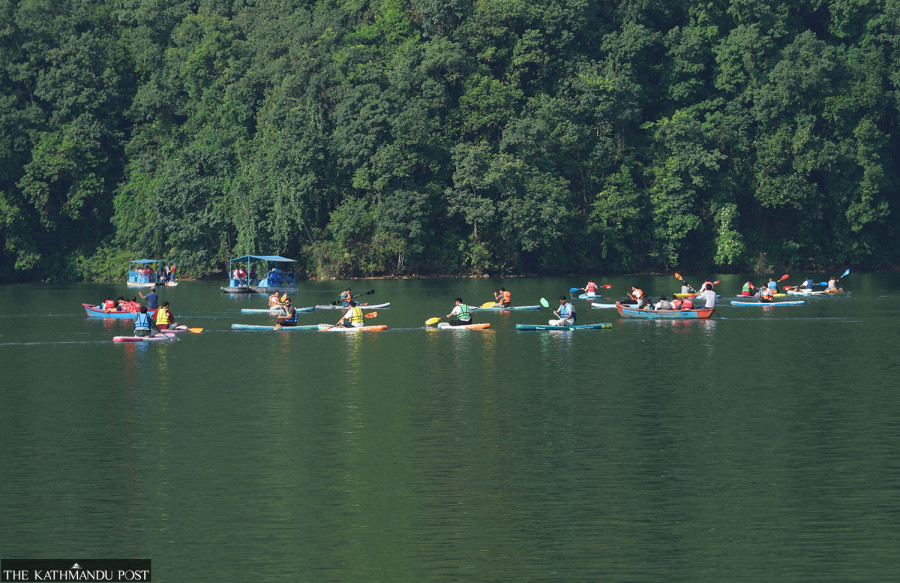
Indian arrivals to Chitwan and Pokhara jump sharply as travellers seek relief from soaring temperatures in Uttar Pradesh and Bihar, boosting Nepal’s wildlife and leisure tourism during the traditional off-season. Indian tourists go boating on Phewa Lake in this recent picture. Manoj Paudel/TKP
In 2010, the Nepal Tourism Board launched a promotional campaign titled “Garmi Se Behal, Chalo Nepal”—If you want to escape the heat, take a trip to Nepal.
The campaign was rolled out ahead of Nepal Tourism Year 2011 to attract Indian visitors seeking respite from the sweltering summer temperatures across the plains of northern India. It was revived in 2016 in major Indian cities as Nepal sought to revive tourism following the devastating 2015 earthquake.
Despite extensive promotion, the campaign failed to generate the expected influx of visitors.
Now, however, a severe heatwave sweeping across northern India appears to be accomplishing what tourism marketers could not.
Indian tourists are arriving in Nepal in growing numbers, many drawn by the country’s relatively cooler climate, affordable travel costs and diverse attractions. Chitwan National Park, traditionally quieter during the summer months, is among the destinations benefiting from the trend.
According to tourism entrepreneurs in Sauraha, many visitors from the Indian states of Uttar Pradesh and Bihar are travelling to Nepal to escape the intense heat in their home regions.
Rishi Tiwari, a hotelier and jeep safari operator in Sauraha, said Indian tourists often combine visits to Chitwan with trips to Muktinath, Pokhara and Manakamana.
“The heat is extreme in parts of northern India. Many Indian travellers visiting Nepal for religious and leisure purposes are also spending time in Chitwan,” Tiwari said.
He added that Indian visitors frequently cite Nepal’s cooler weather and lower travel expenses as major attractions.
Airfares have also become relatively affordable as the June-August period, which coincides with Nepal’s monsoon season, is considered the country’s tourism off-season.
Tourism and hotel operators in Sauraha said Indian tourists rarely chose Chitwan as a primary destination during the summer months in previous years. While destinations such as Pokhara and Muktinath traditionally attract large numbers of Indian visitors during this period, Chitwan generally experiences a seasonal slowdown.
This year, however, the park has recorded a significant rise in Indian arrivals even during the hottest months.
Most Indian visitors arriving in Sauraha participate in jeep safaris, one of the park’s most popular activities.
Ramesh Regmi, owner of Nature Heritage Hotel in Sauraha, said many tourists stop in Chitwan while returning from Muktinath or after visiting the Pashupatinath Temple in Kathmandu.
“I have seen many travellers returning from Muktinath spend a night in Chitwan. Others stop after visiting Pashupatinath. Most stay only for a night before returning to India through the Sunauli border,” Regmi said.
Indian visitors arrive both in small private vehicles and in organised tour groups travelling by bus. According to Regmi, travellers arriving in private vehicles generally dine at hotels, while larger groups often prepare their own meals and primarily use hotels for accommodation.
Because visitors can experience wildlife viewing and jungle activities within a short period, jeep safaris remain particularly popular among Indian tourists, he said.
The growing influx is reflected in visitor statistics maintained by the Chitwan National Park.
According to Avinash Thapa Magar, the park’s information officer, a total of 256,800 visitors entered the park between mid-July 2025 and mid-June 2026. The figure includes domestic tourists, foreign nationals and visitors from SAARC countries.
Domestic tourists accounted for the largest share at 153,874 visitors. International tourists numbered 83,071, while visitors from SAARC countries totalled 19,855.
While overall foreign tourist arrivals declined in recent months, Indian arrivals surged sharply.
Park records show that 9,881 foreign tourists visited Chitwan between mid-April and mid-May. The number dropped to 7,433 between mid-May and mid-June. The highest monthly foreign tourist arrivals this fiscal year were recorded in October, when 11,809 visitors entered the park.
Indian tourist arrivals, however, moved in the opposite direction. While 1,813 Indian visitors entered the park between mid-April and mid-May, the figure jumped to 5,863 between mid-May and mid-June.
The surge coincides with a broader increase in Indian travel to Nepal. Government statistics show that Nepal received around 40,000 Indian visitors by air in May, the highest monthly arrival figure for Indian tourists this year.
Park officials say domestic tourism has also remained strong.
Tourism operators attribute part of the increased visitor flow to Nepal’s policy of granting a two-day weekend, which has encouraged more domestic travel and short holiday trips.
Tourism entrepreneurs in Pokhara are also elated by the surge in Indian tourists.
An estimated 1,500 to 2,000 vehicles carrying Indian tourists enter Pokhara daily.
Around half of these visitors continue onward on a pilgrimage to the Muktinath Temple, while younger travellers are exploring trekking routes such as Mardi Himal and Annapurna Base Camp.
Rajesh Tripathi from Kanpur, Uttar Pradesh, visited Pokhara with his family for two days in early June. He travelled in his own vehicle, and this was his third visit to the city.
“First I came with friends; this time I brought my family,” he said. “It is hot in India, and coming to Nepal provides relief, even if only for a few days.”
Santosh Mishra from Lucknow, Uttar Pradesh, arrived in Pokhara with five friends in early June. He headed straight to Phewa Lake and said he was delighted by the cooler weather.
“Pokhara is just like what I had seen on social media,” he said, adding that he decided to visit after watching Instagram reels. “There is still more to see. I want to experience the food and nightlife here.”
Due to the high influx of Indian and domestic tourists, hotels across Pokhara—from star-rated properties to smaller tourist-class establishments—are operating at high occupancy levels.
Temple Bell, Bar Peepal, Barahi, Atithi, Temple Tree and several other hotels are hosting large numbers of Indian guests. Fishtail, Pokhara Grand and other major hotels have also seen a strong Indian presence.
According to Laxman Subedi, president of the Hotel Association Pokhara, hotels in the city currently have around 90 percent occupancy.
“This is the season when Indians come, and the number of Nepali tourists has also increased due to the two-day holiday,” he said. “Even when it rains, it is difficult to find a hotel room, especially with foreign trekkers also staying in Pokhara.”
For wildlife enthusiasts, Chitwan remains Nepal’s premier safari destination, offering opportunities to observe one-horned rhinoceroses, Bengal tigers, elephants and a rich variety of birdlife.




 25.92°C Kathmandu
1.jpg)
.jpg)